




This wrap-up has been compiled by the Programme
Priority 2 Water-Smart societies
Objective 2.1 Sustainable waters
AdvlQwater:
Wrap-up of project achievements
Pharmaceuticals and other micropollutants are increasingly contaminating the Baltic Sea waters. The Interreg AdvIQwater project developed and tested advanced wastewater treatment methods based on photocatalysis, fungal treatment, and biofilm to effectively remove pharmaceutical residues from wastewater, and compiled practical guidance for public authorities and wastewater utilities on how to combine these methods for optimal effects.
Highlights
AdvlQwater
Highlights
AdvlQwater
The AdvIQwater project brought together scientific institutions, wastewater utilities, companies, and authorities across the Baltic Sea region to jointly develop, test, and combine advanced wastewater treatment solutions based on photocatalysis, fungal (bacterial/anammox) treatment, and biofilm (MBBR) methods into an effective hybrid system to reduce pharmaceutical and micropollutant pollution.
In a nutshell, the project delivered:
- Best practice guideline with recommendations for further actions and technology implementation
Download links
Project
Details
Project type
Small project
Project duration
October 2022 – March 2025
Contribution to the EUSBSR
PA Hazards
Budget in million
EURO
Involved
Countries
Lead partner
Project partners


Project Details
Project type
Small project
Project duration
October 2022 – March 2025
Contribution to the EUSBSR
PA Hazards
Budget in million EURO
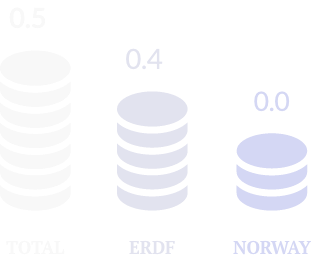
0.5 total // 0.4 ERDF // 0.0 Norway
Involved Countries
Lead Partner: Poland
Project Partners: Estonia // Denmark // Poland
Best practice guidance for advanced wastewater treatment
Best practice guidance for advanced wastewater treatment
AdvIQwater developed a comprehensive guideline addressing wastewater utilities, municipalities, policymakers, and technology providers on advanced wastewater treatment. The guideline closes the gap between scientific research and practical application by translating piloted technologies into clear, practice-based recommendations applicable to real wastewater treatment contexts.
The guideline examines biological treatment methods, including biofilm reactors and anammox-based MBBRs, fungal treatment for pharmaceutical removal and metal recovery, advanced oxidation processes such as photocatalysis, and granular activated carbon (GAC) as a complementary solution. It explains how these technologies work individually and how they can be combined and sequenced to enhance removal efficiency within existing wastewater treatment plants.
The recommendations are based on joint testing activities conducted transnationally, including laboratory and pilot-scale installations using real wastewater streams in collaboration with utilities such as Tartu Water (Estonia), Türi Water (Estonia), Gdańsk Waterworks (Poland), Aarhus Vand (Denmark), and Hillerød Utility (Denmark). A combined treatment train integrating MBBR, photocatalysis, and GAC sorption was tested and evaluated, providing concrete evidence on performance, operational feasibility, and removal efficiencies for a wide range of micropollutants.
Get inspired
Cooperation and knowledge exchange
Cooperation and knowledge exchange
The project actively engaged partners and associated organisations from multiple Baltic Sea region countries, representing science, utilities, industry, NGOs, and policy bodies. Transnational seminars with technology showcases were organised in Poland, Denmark, and Estonia, complemented by regional workshops and a summer school. The greatest value of this transnational approach lies in jointly aligning methodologies, comparing results across countries, and ensuring the transferability of solutions.
In numbers
12 organisations cooperating across borders
20 directly benefitting from project solutions
Interreg pays off
Solutions in use
Interreg pays off: Solutions in use
The guidelines and project results have been shared directly with wastewater treatment plants, companies, municipalities, and policymakers in Denmark, Estonia and Poland. A policy brief based on the findings was discussed with partners and HELCOM representatives and formally submitted, strengthening the link between project results and the revised Urban Wastewater Treatment Directive.
The project has already triggered follow-up actions: utilities such as Aarhus Vand and Hillerød Utility are planning full-scale implementation of selected technologies, while pilot installations remain available for further cooperation and testing at partner institutions. The established cooperation network continues to support knowledge transfer, future technology development, and uptake of advanced treatment solutions across the Baltic Sea region.
Project Wrap-Up
Thanks to Interreg funding and transnational cooperation, AdvIQwater substantially advanced the removal of pharmaceutical residues and micropollutants from wastewater in the Baltic Sea region by connecting science, utilities, industry, and policymakers. Now, wastewater operators and authorities can apply tested, scalable solutions to protect water quality, ecosystems, and public health.