




What Estonia's Energy Community Leaders Have Learned
22 April 2026
On 26 March 2026, the Community Energy Day brought together practitioners across Estonia to share their experiences and knowledge on energy communities.
Martin Kikas, a representative of the Tartu Regional Energy Agency, opened the event by noting that community energy is more than just electricity generation – it is an opportunity to contribute to one’s neighborhood and the community as a whole.
“The better energy consumption is managed, the better our quality of life,” said Kikas.
He recalled a Seto proverb that prosperity comes to a household in two ways: by reducing expenses and increasing income – and community energy helps with both. Kikas also emphasized that it takes courage to try new solutions.
Setomaa shows how a shared vision leads to action
Representatives of the Seto Aiad co-op and the Oma Elekter energy cooperative, Margus Timmo and Markus Männik, presented the journey of the Setomaa energy community, which began as early as 2011–2012 with a joint initiative for more efficient land use. Today, a broad cooperation network has developed in Setomaa, encompassing tourism, berries, craft associations, and Seto cuisine.
The cooperative Oma Elekter, founded in October 2024, installed solar panels on its roof in March 2026, along with a 60-kW battery storage system. The goal is to establish a Center for Valorizing Horticultural Products in Southern Estonia. “Our own electricity gives the cooperative the confidence to operate,” explained the leaders, adding that open communication among members and learning from mistakes are the foundation of successful collective action.
Markus Männik encouraged others to try as well: “The Seto example is a good one of how what was envisioned 10 years ago has grown significantly larger and better. It was worth giving it a try.”
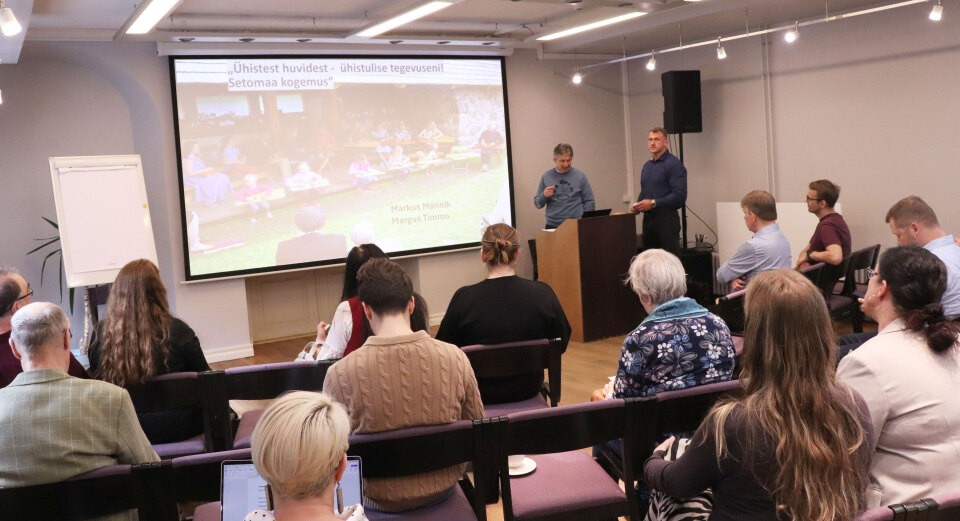
Margus Timmo and Markus Männik giving a presentation at the Community Energy Day on 26 March 2026.
Energy security is being built from the ground up in Ida-Viru County
Hardi Murula, a representative of the Association of Local Municipalities of Ida-Viru County, explained how the development of energy communities in the region began in 2023 as part of the TARGET advisory project. In addition, 16 apartment buildings are being renovated with support from the ELENA program.
As a notable example, Murula highlighted the ambitious plan of Savala village to produce all of its own energy in the future – using a solar park, a hybrid inverter with battery storage system, and a local microgrid. Such a solution would improve the community’s energy security and support local entrepreneurship and mobility. A model for this is the renewable energy solution already in use at the Aidu Water Adventure Center, which has proven its worth in every way.
The Kääpa community is registering an energy community despite obstacles
Annika Oras, the director of Kalevipoja Koda Foundation, described how building the Kääpa energy community has faced many challenges. Locally acting corporations have not yet shown interest in developing the local energy community, which imposes certain limitations. Nevertheless, the process continues – the energy cooperative will be registered in early April, and development of the solar panel project will proceed. Interest is expected to grow once the local apartment building is renovated and solar panels are installed there.
The landscape of Estonian energy communities needs clear prerequisites and a realistic outlook
Nele Ivask, an energy community expert at the Tartu Regional Energy Agency, provided an overview of the current state of Estonian energy communities. According to her, ongoing initiatives serve as valuable learning material, and they have revealed the prerequisites a community must have for the process to get underway: a concrete need, an active core group of leaders, and supportive partners – including both the local government and regional businesses.
She cited the complexity of connecting to the grid, restrictions on energy sharing, and financing the initial investment as the main obstacles. “It is important that the initiators have a realistic understanding of the project’s economic feasibility,” she emphasized.
The Community Energy Day was held at the Tartu Center for Creative Industries.

Additional links
details
-
Homepage
-
Project typeCore Project

-
ImplementationNovember 2023 - October 2026
-
StatusOngoing
-
Contribution to EUSBSRPolicy Area Energy

-
Target groups
- Interest group
- Local public authority
- National public authority
- Small and medium enterprise
-
Social media
-
Additional links
-
Tags