




Jelgava tests how public buildings can share solar energy
18 September 2026
Jelgava’s energy community began with a practical municipal question: could the city cover part of the electricity needs of its public buildings with locally produced solar energy?
The city operates schools, libraries, municipal offices, cultural venues and leisure facilities that all require electricity. Until now, Jelgava has sought reasonable electricity prices through joint procurement. The StartSun project offered an opportunity to test whether some of the electricity used by public buildings could instead be produced on their own rooftops.
The pilot is based at two municipal buildings: Jelgava Pārlielupe Secondary School and the Jelgava Culture Centre. Solar panels and battery storage have been installed at both sites. The electricity produced will first cover the buildings’ own consumption. Any surplus can then be shared within the energy community.
Why this case matters
Jelgava shows how public buildings can serve as practical test sites for municipal energy communities.
Main challenge
The hardest part was developing the legal framework for a new concept in Latvia.
Lesson for others
Before choosing a building, assess not only its electricity use but also its roof structure, technical condition and long-term suitability.
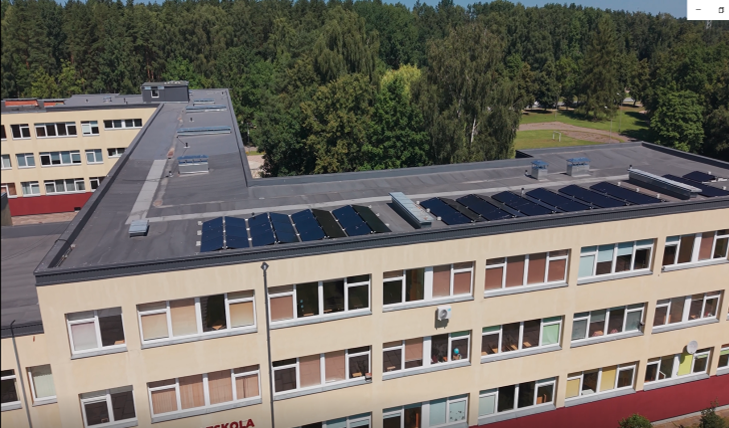
Photo by Zemgale Regional Energy Agency
A city ready to test a new model
Jelgava has worked on energy and climate issues for years. In 2009, the city established the Zemgale Regional Energy Agency and joined the Covenant of Mayors. The municipality has continued to seek ways to reduce carbon dioxide emissions and improve the energy performance of its buildings.
When Jelgava City Municipality was invited to join StartSun as a pilot area, the goal was clear. The project had to lead to a concrete result: the establishment of an energy community.
This was challenging because the concept was still new in Latvia. At the same time, the project made it possible to install solar panels and battery storage at two municipal buildings.
The first discussions involved Jelgava municipal leadership, the Department of Development and Urban Planning and the Zemgale Regional Energy Agency, the project’s official partner in Jelgava.
The central question was not only whether solar panels would work technically. It was whether a municipality could test a practical model for sharing locally produced energy between its public buildings.
Public buildings at the centre of the pilot
The pilot is based in buildings that are part of everyday city life. One is a school with a swimming pool. The other is a culture centre that hosts concerts, children’s activities, dance studios, art studios and other events.
Producing part of their electricity locally connects renewable energy to services that residents use every day. Solar panels and batteries can help cover a share of electricity use in places where education, culture and community life take place.
The pilot also makes renewable energy more visible. When people see solar panels on a school, swimming pool or culture centre, the idea becomes linked to familiar local places rather than remaining an abstract technical concept.
A concept that needed explaining
When the idea was first introduced, the response was largely interested. People wanted to understand how the system would work and what an energy community would mean in practice.
In Latvia, the legal concept of an energy community is still new and complex. The team had to consider how energy sharing would work, what legal form was needed, how new regulation would fit with existing legislation and municipal procedures, and how much administrative work the model would require.
This raised an important practical question. Was an energy community always the simplest and most suitable way to use locally produced solar energy? In some buildings, self-consumption or a net metering system may be more appropriate. In other cases, an energy community can provide the best model.
Working through these questions is necessary if the approach is to be useful for other municipalities.
The hardest part was the legal framework
Bringing the two buildings into one energy community was not the most difficult part. Both buildings are connected to the same municipality, and the members of the energy community are Jelgava City Municipality and the Zemgale Regional Energy Agency.
The more difficult task was developing a legal framework that could work alongside existing legislation and municipal procedures. This required cooperation between lawyers, municipal leadership, the development department, representatives of both buildings and the energy agency.
The team held many meetings, and each stage required clarification. Jelgava was working with a new type of energy community model in Latvia, with few ready-made examples to follow.
One of the most useful outcomes of the process has been a clearer understanding of the documents, decisions and agreements needed to establish an energy community.
There is still practical uncertainty. It is not yet clear how much electricity the two buildings will use and how much surplus electricity will be available for sharing. The first year of operation will provide more reliable answers.
Choosing a building is not only about electricity use
One of Jelgava’s most practical lessons concerns the choice of buildings. A building with high electricity use during the sunnier part of the year may initially seem like an obvious choice. But energy use alone is not enough.
Before making a decision, the technical condition of the building must be assessed. Jelgava’s experience shows that a construction engineer’s opinion is needed to confirm whether a roof can carry solar panels.
Planning an energy community does not begin only with electricity bills and solar potential. It also requires attention to roofs, structures, permits and the long-term condition of the buildings.
If the building itself is not ready, even a well-designed energy community project may not move forward.
What other municipalities can learn
The Jelgava pilot shows that a municipal energy community can be a practical way to test renewable energy use in public buildings. But it also shows that an energy community is not the only possible solution.
Depending on the building and its energy-use profile, self-consumption, net metering or an energy community may be the most suitable approach. Choosing between these options requires clear information about legal requirements, technical conditions, costs and expected benefits.
Jelgava’s experience suggests that the StartSun Start-up Package can provide a useful starting point by bringing together the information needed to establish an energy community.
Based on the Jelgava experience, wider uptake would benefit from national support for renewable energy investments, including solar panels, batteries and ground-source heat pumps. More favourable conditions for energy sharing would also help similar initiatives develop.
The first year will provide the answers
Jelgava’s energy community has not yet shown how the model will work in the long term. The solar panels and battery storage are in place, but the system now needs to be tested in practice.
Only after a full year of operation will it be possible to assess what worked, what did not and what needs to be adjusted. Lower electricity bills during the sunnier part of the year would be a concrete benefit. If the sharing model needs changes, that will also provide valuable knowledge.
This is the purpose of the pilot. It is not intended to show that energy communities are simple or ready-made. It is intended to test how a municipality can make a new model work in real conditions.
Jelgava is now testing how locally produced solar energy can support the public buildings and services that residents use every day.

Additional links
details
-
Homepage
-
Project typeCore Project

-
ImplementationNovember 2023 - October 2026
-
StatusOngoing
-
Contribution to EUSBSRPolicy Area Energy

-
Target groups
- Interest group
- Local public authority
- National public authority
- Small and medium enterprise
-
Social media
-
Additional links
-
Tags