



GYPREG Final Seminar: Gypsum treatment shows potential across the Baltic Sea region
10 November 2026
After three years of research, field trials and international cooperation, the GYPREG project presented its key findings at its Final Seminar on 28 October 2026 in Helsinki, Finland, and online. Researchers and policymakers and other stakeholders discussed how research results could be translated into effective water protection measures across the Baltic Sea region.
Gypsum reduced readily available phosphorus in all tested soils
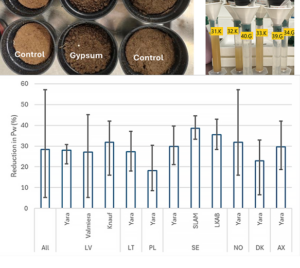
Results of the joint laboratory experiment at Syke. © GYPREG, Petri Ekholm
GYPREG investigated whether gypsum treatment, already used as a water protection measure in mainland Finland, could also work elsewhere in the Baltic Sea region. In a joint laboratory experiment involving 30 soils, gypsum reduced water-extractable phosphorus in every soil tested. The average reduction was 28%, while the highest reached 57%. Water-extractable phosphorus is readily available to algae and contributes to eutrophication when it enters waterways. Gypsum can also reduce the transport of eroded soil particles and the phosphorus attached to them.
The effectiveness of the treatment varied between soils. Soil properties appeared to be a the most important factor: this highlights the need to identify the fields where gypsum treatment can provide the greatest environmental benefit.
Field pilots put research into practice
The field pilots were conducted in Åland, Latvia, Lithuania, Poland and Sweden. Gypsum was applied to more than 300 hectares of agricultural
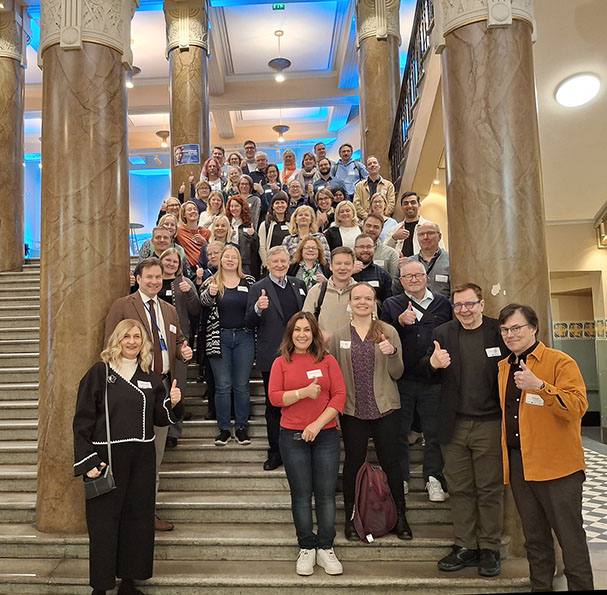
In person participantss of the seminar at Paasitorni, Helsinki, Finland. © GYPREG
land under different farming and environmental conditions.
The pilots identified practical issues that need to be considered before wider implementation. These include the availability and suitability of gypsum materials, regional farming practices and environmental requirements. Longer-term monitoring is still needed to determine how long the benefits last and to assess possible effects on soil health, crop production and the surrounding environment.
Careful targeting is key to wider use
Gypsum is not a stand-alone solution to the eutrophication of the Baltic Sea. When applied to suitable soils, however, it can complement other agricultural water protection measures and help reduce the nutrient loads reaching rivers and coastal waters.
Wider use will require careful targeting, practical guidance for farmers and advisors, suitable gypsum materials, and cooperation between researchers, agricultural organisations and policymakers.
“Gypsum can buy us time to reduce the concentration of soluble phosphorus in agricultural soils. It is not a solution for every problem, but it is inexpensive and suitable for large agricultural areas. Our results give us a stronger foundation for identifying where the treatment can make the greatest difference,” says GYPREG project leader Petri Ekholm at the Finnish Environment Institute.
Cooperation continues beyond GYPREG
By combining scientific evidence, field experience and international cooperation, GYPREG has laid the groundwork for further research and the possible wider use of gypsum treatment. The Final Seminar concluded three years of joint work, but efforts to reduce agricultural nutrient losses continue. The knowledge gained through GYPREG can support future water protection measures, agricultural policy and cooperation across the Baltic Sea region.
Watch the recordings from the GYPREG Final Seminar below.

Additional links
details
-
Homepage
-
Project typeCore Project
-
ImplementationNovember 2023 - October 2026
-
StatusCompleted
-
Contribution to EUSBSRPolicy Area Nutri, Policy Area Bioeconomy

-
Target groups
- Interest group
- International governmental organisation
- National public authority
- NGO
- Regional public authority
-
Social media
-
Additional links
-
Tags