




Karlskrona develops its energy plan for resilience, sustainability and inclusion
21 August 2026
Karlskrona Municipality is currently updating and further developing its municipal energy plan as part of the Enercracy project. The work marks an important step for the municipality, as the energy plan is being developed into a separate strategic document. This strengthens the role of energy planning in Karlskrona’s long-term development and highlights how energy issues are increasingly connected to climate transition, resilience and local development.
Karlskrona has unique geographical and societal conditions. Located on several islands in south-eastern Sweden, surrounded by an extensive archipelago, the municipality has a strong maritime identity and an attractive living environment. At the same time, this geography creates specific challenges for transport, accessibility and infrastructure. Mobility often depends on bridges, boats and well-functioning connections, making the transition to a more sustainable and robust energy and transport system both important and complex.
The municipality is also in a period of strong development. Sweden’s largest naval base is located in Karlskrona, and increased activity related to national defence affects the municipality’s development. In parallel, companies within subsea cables and other forms of energy infrastructure are expanding, while new establishments are being discussed. This creates opportunities for growth, innovation and employment, but also increases the need for a stable and efficient energy system.
The development of the energy plan is therefore closely linked to Karlskrona’s future as a growing municipality. Electrification, new energy production, transport transition and business development all require closer coordination between municipal planning and energy infrastructure. The aim is to create a clearer and more practical basis for how energy can support sustainable growth, climate transition and resilience.
A central part of the work so far has been dialogue. Karlskrona Municipality has carried out several internal and external dialogues with industrial companies, property owners, municipal companies, grid operators, Region Blekinge, the County Administrative Board of Blekinge and residents. These dialogues have been used to gather input, identify needs and understand what different actors are planning to do, for example in relation to energy efficiency, grid development, local energy production and sustainable transport. The results will be used in the action plan connected to the developing energy plan.
This dialogue has also included direct meetings with residents. One concrete example of the dialogue process was Karlskrona Municipality’s participation in Aspödagen in July 2026, together with the Energy Agency Southern Sweden. Residents, second-home owners and other visitors were invited to discuss the municipality’s future energy planning and respond to a survey. The discussions covered topics such as local electricity production, solar and wind power, energy storage, grid capacity, public transport, energy preparedness and energy efficiency.
The activity showed strong engagement. Among the survey respondents, 75% considered energy and climate issues very important for Karlskrona’s future, while the remaining 25% considered them quite important. Many participants had also already taken their own steps, such as cycling or using public transport more often, improving the energy performance of their homes, driving electric or plug-in hybrid vehicles, or installing solar panels and batteries. This gives the municipality valuable input for the continued development of the energy plan and shows the importance of meeting people where they are.
“We need to prepare for the future. The industrial expansion currently taking place, including at NKT and within the shipyard sector, means that the municipality needs to be proactive and already plan for increased energy demand,” says Alexander Altenby.
NKT is a major industrial company in Karlskrona that manufactures high-voltage subsea cables.
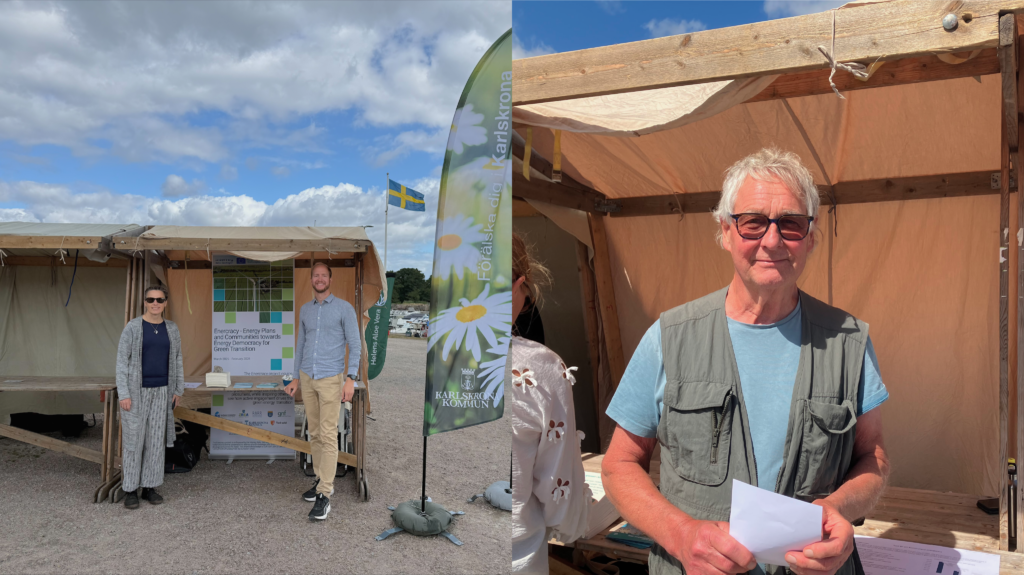
Left: Annika Öberg, South Swedish Energy Agency, and Emil Lind, Karlskrona Municipality. Right: Alexander Altenby during Aspödagen
The dialogue process also strengthens the democratic dimension of energy planning. The energy transition affects the whole municipality, but different actors have different roles, resources and opportunities to contribute. By involving both organisations responsible for infrastructure and residents with local knowledge and everyday experience, Karlskrona aims to develop an energy plan that is practical, locally anchored and socially sustainable. This approach supports a transition where energy planning is not only about technical systems, but also about participation, trust and shared responsibility.
Several important areas are emerging in the ongoing work. Transport and mobility are central, since the transport sector remains strongly dependent on fossil fuels. Electrification is expected to be an important part of the transition, which increases the need for charging infrastructure, coordination with the electricity grid and early integration of mobility solutions in urban development. At the same time, other fossil-free fuels may continue to play a role in parts of the transport system where electrification is more difficult.
Local energy production is another important theme. Karlskrona already has several forms of local and regional energy production, including combined heat and power, wind power, solar power and regionally produced biogas. Solar power has grown rapidly in recent years and is expected to be an important part of the discussion on future local energy supply. Future development will need to balance energy needs with land use, environmental considerations and local acceptance.
Within this broader context, local participation, prosumerism and energy communities are emerging as possible tools for strengthening the local energy transition. Karlskrona Municipality sees energy communities as one way to increase participation and local engagement in energy issues. Such initiatives may allow residents, businesses, property owners and associations to invest in, produce, use, store or potentially share renewable energy. They can contribute to increased knowledge, local energy production and stronger engagement.
As the work with the energy plan continues, Karlskrona Municipality also wants to highlight energy poverty and equal access to energy as important perspectives. Access to reliable and affordable energy is a basic condition for everyday life, and the benefits of the energy transition should be available to residents with different needs and circumstances. Increasing knowledge about vulnerable households can help the municipality explore how energy and climate advisory services, property owners, social services and other relevant actors can cooperate so that more residents can benefit from the energy transition.
Energy preparedness is also expected to be an important part of the continued work. As society becomes increasingly dependent on electricity, heat and fuels, the municipality needs to strengthen its ability to maintain essential services during disruptions. This includes reserve power, continuity planning, vulnerability analyses and cooperation with energy companies, authorities, businesses and other actors. For Karlskrona, resilience is closely connected to both climate transition and civil preparedness.
The work is carried out in close cooperation with the Energy Agency Southern Sweden and within the framework of the Enercracy project, which provides an opportunity to exchange experiences with other municipalities in the Baltic Sea Region.
The next step is to continue developing the energy plan and anchoring it with key people both within and outside the municipal organisation. The plan is expected to be sent out for consultation during the autumn, with the aim of being adopted around the turn of the year. Through this process, Karlskrona is strengthening its capacity to plan for a future where energy is not only a technical issue, but a foundation for resilience, sustainable growth and local development. Within the Enercracy project, the municipality can also contribute valuable experience on how local energy planning can combine growth, energy security, climate action and participation in a practical way.

Additional links
details
-
Homepage
-
Project typeCore Project

-
ImplementationMarch 2025 - February 2028
-
StatusOngoing
-
Contribution to EUSBSRPolicy Area Energy

-
Target groups
- Infrastructure and public service provider
- Interest group
- Local public authority
- Regional public authority
- Small and medium enterprise
-
Social media
-
Additional links
-
Tags