




Easy to buy, easy to return: reusable lunch jars in Gdańsk
16 October 2026
What if your office lunch came in a glass jar, and you got your deposit back by returning it to the machine? As part of the Change(K)now! project, Gdańsk start-up Venloop tested this in four companies. More than 8 in 10 jars came back. The real obstacles turned out to be somewhere else. We asked Maciej Greń, Founder and CEO of Venloop, what they learned.
Let’s start with the jars. Would office workers really bring back a glass jar to get their deposit?
The reuse part worked better than we expected. Employees pay a 2 PLN deposit for each glass jar, and it is refunded automatically when the jar is returned to the machine. Across LPP, Allcon and Wolters Kluwer, 178 of the 216 jars sold came back, a return rate of about 82%. The machines were switched off over the summer break and are only now coming back into use, so we do not have much new data yet. Tasting sessions before each launch helped people get to know the meals and the system. The barriers we saw were rarely about returning the jar. They were about habits, such as bringing food from home, and about the purchase process in the app.
What surprised you most?
Price turned out to matter less than we thought. Managers at the host companies named price as the main barrier, but a 20% price cut did not increase sales. In a survey we ran among Wolters Kluwer employees after the first phase (67 responses), 20 people pointed to the login and purchase process as a barrier and 10 pointed to price. People were willing to use reusable jars. What stopped them was the extra steps before they could buy a meal.
Earlier you mentioned habits, like bringing lunch from home. What would it take for a lunch in a reusable jar to become the easy choice at work?
It has to be at least as easy as what people already do. Paying should take one tap with a card or phone, with no app or login, which is why we are moving to tap-to-pay. The food also has to match what people want for lunch. In the same survey, employees asked mostly for sandwiches, salads and warm vegetarian meals, so we are changing the assortment there. Habits like bringing lunch from home change slowly, so the machine has to be there every day with meals people want, and people need to be able to count on it on the days they did not bring food. Returning the jar is already part of the routine, because it happens at the same machine where people buy their next meal.
Venloop is a young company. How did being part of an international project like Change(K)now! help you get your machines into large companies?
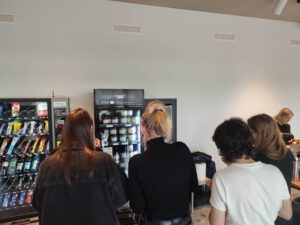
Being part of the Change(K)now! partnership gave our pilot credibility from the start. Companies we approached saw an international Interreg project, not only a start-up asking for space. This helped us place Venloop machines in four companies in Gdańsk (Orplast, LPP, Allcon and Wolters Kluwer) without paying a hosting fee. The host companies provided space and electricity, and we handled supply, restocking and returns. The project also gave us a structured evaluation of the pilot, which we now use to plan the next steps.
Did it matter to the companies and their staff that cities across the Baltic Sea are working on the same thing?
It changed how the host companies and their employees saw the pilot. They were not only testing a new lunch option, they were taking part in a change that other cities and countries around the Baltic Sea are working on too. That sense of being part of something bigger made companies more open to hosting the machine and to giving us honest feedback.
What’s next? Will we see Venloop machines in other places?
Yes. At the end of the summer we installed a Venloop unit at the Półwysep Lipa resort in Kashubia, operated by Maknitt-Tur. It was adapted for outdoor, seasonal use, and the operator is considering using it again in the 2027 season. We have also implemented tap-to-pay at Allcon, so employees can now pay with a card or phone directly at the machine instead of going through the app. At Wolters Kluwer, based on the survey results, this October we are relaunching with tap-to-pay and a new assortment. If this works in Gdańsk, the next step is Wolters Kluwer’s Warsaw office.
Zooming out: what does a lunch machine in Gdańsk have to do with a more circular food system?
The pilot shows that a deposit-based reuse system for ready meals can run in ordinary workplaces, with more than 80% of jars coming back without any extra effort from the host company. Returned jars are cleaned and refilled, and damaged ones go to recycling. The meals have a long shelf life, so the machines can be restocked less often and less food is wasted. For reuse to grow, it has to be as easy to use as single-use packaging. That is the direction we are working in.

details
-
Homepage
-
Project typeCore Project

-
ImplementationNovember 2023 - October 2026
-
StatusOngoing
-
Contribution to EUSBSRPolicy Area Innovation

-
Target groups
- Business support organisation
- Interest group
- Local public authority
- Regional public authority
- Small and medium enterprise
-
Social media
-
Additional links
-
Tags