




Market evaluation and the development of markets in recycled nutrients
28 October 2025
As part of the project, CiNURGi has identified and described the most innovative and optimal solutions for nutrient recycling and assessed their market potential. To promote the development of the market in recycled nutrients CiNURGi has compiled and analysed best practices and most innovative solutions for nutrient recycling based on organic wastes from farming, industry and municipalities, which are already commercialised or close to being market mature and having potential for a wider dissemination in the Baltic Sea Region.
CiNURGi operates from the conviction that solutions for nutrient recycling shall provide positive environmental and climate impacts, meaning an overall positive contribution to societal economy, which is why the solutions for nutrient recycling were analysed for their environmental, climate and overall economic impact as well as end-user acceptance, market potential and policy framework. Nutrient recycling solutions must have a prospective market, and acceptance from end-users’, namely crop farmers. CiNURGi has also been identifying and evaluating ongoing nutrient-recycling (NR) initiatives across the Baltic Sea Region, placing particular emphasis on case studies that demonstrate the technical feasibility and maturity of recycled nutrient fertilizer (RNF) production. In addition, policies are important since they can set up barriers, often unintentional, and in other cases include elements that could serve as enablers for deployment of the prospective solutions, which is why these aspects need to be analysed.
The process of identifying the best practices and most innovative solutions and their assessment for environmental, climate and overall economic impacts are described in:
- Scientific article: Priscila D. Lima, Ida Sylwan, Oksana Valetska, Henning Foged (2026) Bio-based fertiliser – custom-made method for evaluation of its production; environment, climate and overarching economic performance. Frontiers in Environmental Economics, section Resource Economics 5:1805879. DOI: 10.3389/frevc.2026.1805879
- Report by Foged, H. L., Sylwan, I., & de Morais Lima, P. (2026).: Identification and Assessment of Innovative Nutrient Recycling Solutions: Environmental, Climate, and Economic Performance . https://doi.org/10.5281/zenodo.18628679
- Report/ Tool by Foged, H. L., Sylwan, I., & de Morais Lima, P. (2026). BBF evaluation tool. https://doi.org/10.5281/zenodo.18628819
The efforts to demonstrate the technical feasibility and maturity of recycled nutrient fertilizer (RNF) production are summarized in:
- Report by Izabela Konkol, Ksawery Kuligowski, Priscila de Morais Lima, Vaida Dzemedzionaite, Cheryl Marie Cordeiro, Liina Edesi, Sari Luostarinen, Kalvi Tamm, Ari-Matti Seppänen, Taavi Võsa (2026): Case Study: RNF Fertiliser Production Facilities in Baltic Sea Countries
While the analyses for end-user acceptance, market potential and policy implications are described in:
- Report by Foged, H. L., Sylwan, I., de Morais Lima, P., Virtanen, E., Laakso, J., Valetska, O., Sarvi, M., Brown Stummann, C., Virolainen Hynnä, A., & Witorożec-Piechnik, A. (2026).: Market Evaluation and Review of Policy Affecting Nutrient Recycling. https://doi.org/10.5281/zenodo.18628997
Identifying innovative solutions
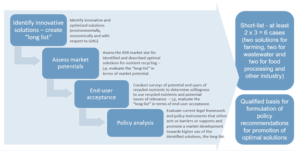
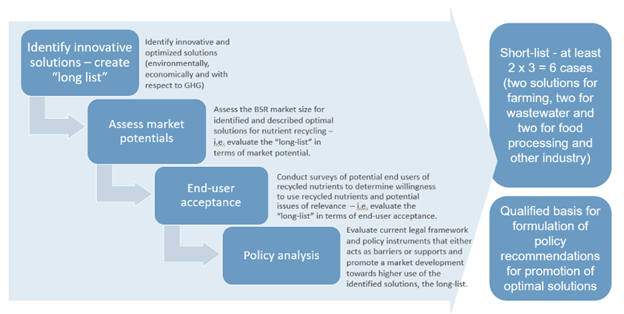
This figure shows the flow of the process to identify and prioritise the best practices and most innovative solutions for increased nutrient recycling.
To identify innovative solutions CiNURGi opened a call for “Best practices and innovative solutions for recycling of nutrients” in 2024. The aim was to invite pioneers in nutrient recycling to step forward and share their success stories. CiNURGi identified several solutions for nutrient recycling and evaluated their environmental, climate and overall economic impact. From the pool of 24 identified solutions, 11 cases were retained for further analyses, since 13 cases were outside of the scope, or not sufficiently developed or in other ways unable to deliver necessary data and information for an immediate evaluation of environmental, climate and overall economic impact.
A custom-made method was developed to allow an immediate evaluation of environmental, climate and overall economic impact of value chains for increased nutrient recycling, since no conventional method exists for this purpose. The method assesses the Nutrient Recycling Impact (NRI) as well as the Direct Emission Reduction Impact (DERI) and calculates and overall Guiding Social Cost (GSC) of the solutions. The GSC includes the capitalised value of the NRI and the DERI as well as assessed value chain costs. In this method all evaluations are done against a baseline scenario, informed by the value chain owners, meaning the way of disposing of the organic wastes if the given value chain was not established.
To summarize the findings of the report Identifying best practices and most innovative solutions for nutrient recycling and analysing them for their environmental, climate and economic performance: there is a wide difference in the environmental, climate and economic performance of the analysed solutions, partly due to the policy context. Processing of organic wastes requires additional consumption of energy for transport and processing, it most often requires investments in handling, storage and processing facilities, and typically also means consumption of chemicals for the processing. In several cases the production of bio-based fertilisers cannot be justified, not even in a social economic perspective where the possible policy barriers are removed and the capitalised value of the environmental and climate benefits is diverted back to the value chain owners in the form of subsidies or alike.
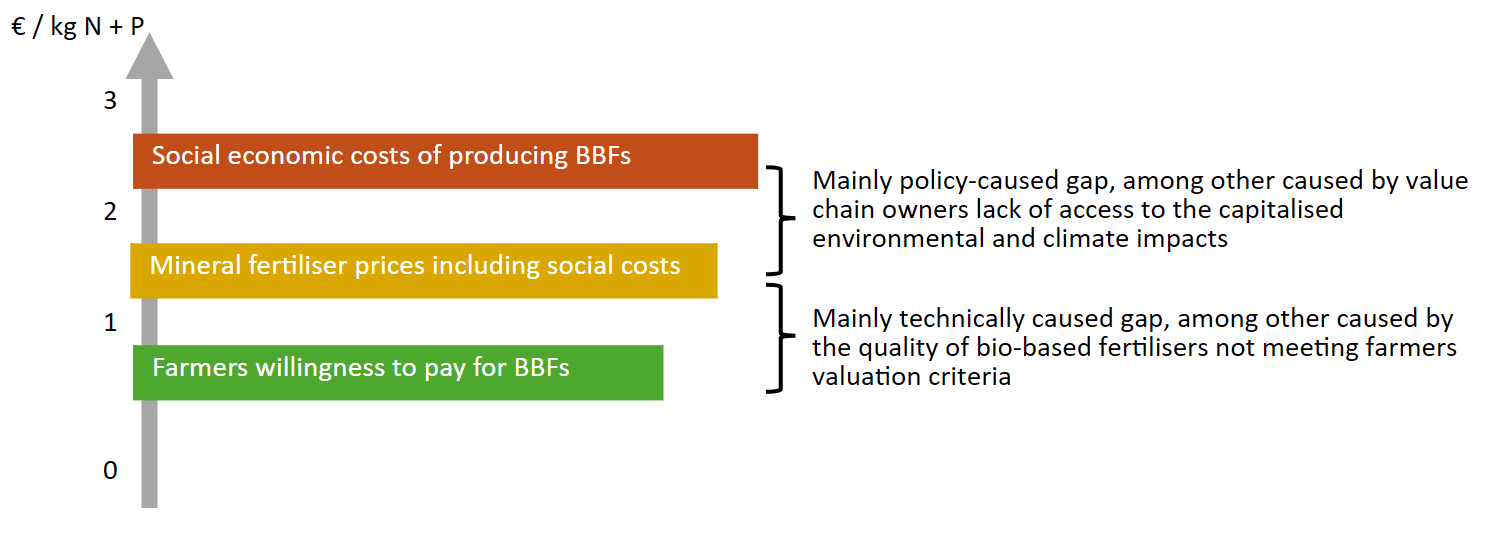
Nutrients in bio-based fertilisers are in average 75% more costly in a society perspective than nutrients in mineral fertilisers. Therefore, nutrient recycling should be promoted with products requiring the least possible processing costs.
To summarize the findings of the report Market Evaluation and Review of Policy Affecting Nutrient Recycling: CiNURGi conducted surveys and interviews to gain insight into end-user acceptance, since this is imperative for market penetration. Farmers have clear preferences related to the chemical content, fertilising effect, origin, etc. of bio-based fertilisers, but as the most important criterion for crop farmers is the price, the market for recycled nutrients is hampered by high production costs. Market potentials are constrained by needs for investments in facilities for collection and processing of the organic wastes as well as high production costs. The availability of the raw materials for recycled nutrient fertilisers is overall good and does not pose a potential market limitation, in the same way as crop farmers’ willingness to pay for fertilisers.
The analysis of the current policy landscape for nutrient recycling revealed six key barriers and five incentives affecting the recycled nutrient fertiliser market development. A major barrier is that the Baltic Sea Region countries do not prioritise to offer financial incentives for an increased nutrient recycling, which the Common Agricultural Policy (CAP) makes possible. Also, there are, in most Baltic Sea Region countries, complicated procedures for permitting the use of industrial and municipal wastes for fertilisation purposes.
Winners of the CiNURGi nutrient recycling award announced
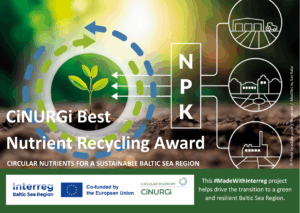
In a concrete effort to support the scale-up of nutrient recycling solutions CiNURGi invited companies to present their solutions, through an open call launched in late 2024. CiNURGi invited companies to submit innovative nutrient-recycling solutions that transform various organic waste streams into market-ready products. The call attracted 24 submissions, of which 11 cases were longlisted for in-depth evaluation in 2025.
Out of this pool of value chains for production of bio-based fertilisers (BBFs), the two best cases, evaluated from various criteria, from each of the municipal, industry and farming waste sectors were shortlisted as finalists for the CiNURGi recognition prize, the Best Nutrient Recycling Award. These six companies were ultimately awarded the nutrient recycling prize for their innovation. The CiNURGi project chose to promote several outstanding nutrient recycling solutions across municipal, industrial, and agricultural sectors, highlighting the many different ways in which bio-rich nutrient flows can be transformed into fertilizer.
The Award went to six outstanding initiatives:
Farming sector winners:
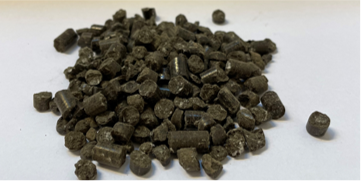
Planteo (Poland) produces organic fertiliser pellets made from 100% plant-based agricultural and food waste-based digestate. The product can be used both in agriculture and private gardens and is allowed in organic farming.
BioPir (Finland) produce separation liquids and solids from pig manure based digestate, using natural settling followed by mechanical separation. The end product is allowed for use in organic farming.
Municipal sector winners:
SF-Soepenberg GmbH (Germany) turn activated wastewater sludge into a struvite granulated fertiliser through chemical processing. The end product has a high concentration of both nitrogen, phosphorus and magnesium.
Sanitation 360 (Sweden) has developed a technology for collecting human urine and processing this into a nitrogen rich fertiliser granulate. The solution comprises a urine-diverting toilet or urinal, a collection tank pre-dosed with a mix of chemicals for avoiding N volatilisation before collection and processing, either on-site or at a drying facility.
Industrial sector winners:
Gyllebo Gödning (Sweden) offers fertiliser pellets in a product line called “Biofer”. The main raw material for the fertiliser is meat and bone meal from processing animal tissue. The nutrient content is adjusted accoriding to intended use with minerals that are allowed in organic farming.
Bio10 (Finland) is via mechanical separation of digestate producing separation liquids and solids for allowing the export of excess phosphorus out of the region. The digestate is mainly based on organic household wastes, including food wastes and food industry wastes. The end product is allowed in organic farming.
Task lead: Organe
Supporting RNF Production
Beyond identifying innovative approaches, CiNURGi also promotes their practical use in the production of recycled nutrient fertilizers (RNFs). To support this objective, the project has established Support Centres coordinated by IMP-PAN, RISE, and LUKE, together with industrial partners including SF-Soepenberg GmbH and VA SYD. These organisations provide expertise in areas such as nutrient recovery from wastewater, biomass processing technologies, and large-scale implementation across agricultural, municipal, and industrial sectors. Their role is to assist companies that wish to further develop nutrient recycling solutions. Drawing on their experience working with different businesses, the partners have produced a Case Studies Report that showcases real-world RNF technologies and business approaches.
To summarize the findings of the Case Studies Report: RNF Fertiliser Production Facilities in Baltic Sea Countries, the report supplements the previous reports by introducing mature cases with the technology focus broken down into agro, industry and municipal sectors. The report highlights a variety of methods for transforming agricultural, municipal, and industrial biomass streams into recycled nutrient fertilizers. Although these technologies differ in terms of maturity, nutrient composition, regulatory status, and market readiness, they collectively demonstrate the strong potential of RNFs to support more circular nutrient management systems.
The report shows that the choice of feedstock has a significant influence on both product quality and processing requirements. It also reveals that different technologies face varying levels of regulatory approval and market acceptance. As a result, achieving both circularity and economic viability across different regions will require a diverse mix of technological solutions. For example, manure- and digestate-based RNFs can improve soil quality, while technologies such as struvite recovery and urine-derived fertilizers provide nutrients in forms that are readily available to plants and suitable for precise fertilization practices. Products derived from processed animal by-products and struvite are already compliant with EU fertilizer regulations and can be marketed commercially. In contrast, fertilizers produced from source-separated human excreta or wastewater streams are subject to stricter regulatory requirements.
Overall, the findings indicate that nutrient recycling technologies are becoming increasingly advanced and have considerable potential to contribute to circular agricultural systems and improved regional nutrient management.
The project also carries out structured pilot implementation assessments. These are supported by Peer-to-Peer Reviews, in which external experts assess the technologies’ performance, scalability, and environmental impacts.
Task lead: IMP PAN


Interactive map showing pilot locations. Use the arrow keys to move the map view and the zoom controls to zoom in or out. Press the Tab key to navigate between markers. Press Enter or click a marker to view pilot project details.
Additional links
- Read about the project
- Report: Identification and Assessment of Innovative Nutrient Recycling Solutions: Environmental, Climate, and Economic Performance
- Report: Case Study: RNF Fertiliser Production Facilities in Baltic Sea Countries
- Report: Market Evaluation and Review of Policy Affecting Nutrient Recycling
- Nutrient recycling awards: News about the longlisted companies.
- Top Six Bio-Based Fertiliser Production Cases from Open Call Published – CiNURGi evaluation results available
- Winners of the CiNURGi Nutrient Recycling Award announced at ESNI-NERM
- CiNURGi RISE support centre activities ready to be fully deployed by industry
details
-
Homepage
-
Project typeCore Project

-
ImplementationNovember 2023 - October 2026
-
StatusOngoing
-
Contribution to EUSBSRPolicy Area Nutri

-
Target groups
- Interest group
- National public authority
- Small and medium enterprise
-
Social media
-
Additional links
-
Tags