




Hamburg-Altona, Germany
03 August 2026
The Free and Hanseatic City of Hamburg, located along the river Elbe, is one of the major inland port cities in Europe, housing around 1.2 million people. Functioning as a city-state, Hamburg is divided into seven boroughs with their own governance structures. Altona is the westernmost urban borough of the city of Hamburg in northern Germany, with a population of over 280,000. It houses vast green areas, but also vibrant, dense neighbourhoods.
BATS lead partner Hamburg-Altona sees a steep drop in active mobility over the winter, especially among cyclists, driven by harsh weather and a perceived lack of suitable infrastructure. Within the BATS project, the borough together with the local agency LSBG ran local experiments to understand what lies behind that drop and to bring the numbers back up.
Protective elements for a safer cycling network
Reventlowstraße is a busy main road in Altona that was being redeveloped into an important Velo route linking the central Altona area with the suburbs to the west. As part of that redevelopment, the team added protective elements (cost-effective, rubber-based bumpers and bollards) to the new cycle lane, physically separating cyclists from the motorised traffic and adding reflective features to help riders find their way through the long dark hours of winter. The experiment set out to test whether these elements improved both the actual and the perceived safety of cyclists, and how well the elements themselves held up under winter conditions and snow clearance. To find out, the team engaged users directly on the street through short intercept surveys, on-site observation of how cyclists and pedestrians behaved, and World Café workshops with NGOs, planners and operational actors including the fire department and winter maintenance services.
Results & Lessons. The majority of the surveyed users, pedestrians included, voiced an improved feeling of safety because of the protective elements installed (in a quick survey of over 120 participants, more than 80% of cyclists and around half of pedestrians reported feeling safer than before). The snowy 2026 winter exposed a clear weakness: as snow piled up, a layer of dirt built up on the bollards and cancelled out their reflective features, undermining exactly the wayfinding and visibility they were meant to provide after dark. Protective elements need dedicated “vertical” cleaning protocols. More broadly, the experiment reinforced the need for close collaboration with (winter) maintenance organisations and with the final (bicycle) users, to better anticipate unforeseen consequences.
Projections to make active mobility tunnels feel safer
The second experiment tackled the fear and discomfort many people feel in dark, enclosed tunnels, which can be enough to keep them from walking or cycling through them. Rather than simply adding more light, Altona used gobo projectors to cast walking- and cycling-related phrases (and a scannable QR code) onto the tunnel floor: a “positive distraction” designed to draw attention away from the grim architecture and towards something dynamic and inviting. One projector went into the Elbschlosstunnel, a busy active-mobility commuter tunnel beside the Elbe, and three into the Lessingtunnel, a railway underpass with a pedestrian section running through the middle. To gather feedback in these high-flow commuter spaces, the team used quick, poster-and-sticker surveys that took around 30 seconds to complete, alongside intercept conversations and workshops with NGOs and inclusion representatives.
Results & Lessons. Getting the projectors installed took considerable negotiation, because ownership of the Lessingtunnel alone was split three ways (the borough owned the ground, Hamburg’s infrastructure authority the columns, and the national railway the ceiling). However, feedback from more than 50 users was encouraging, with people (women especially) reporting that the space felt more welcoming, as though it had been designed for them.
An accessibility point also emerged: Hamburg’s inclusivity board warned that floor projections could read as physical obstacles for visually impaired users, a consideration worth building in from the start.
The main lesson was to acknowledge how YRAM is a many hands problem that requires constant collaboration and input across departments as well as with residents, and thus the way forward is embracing communicative planning as a core aspect of YRAM planning to fully understand the real needs of users.
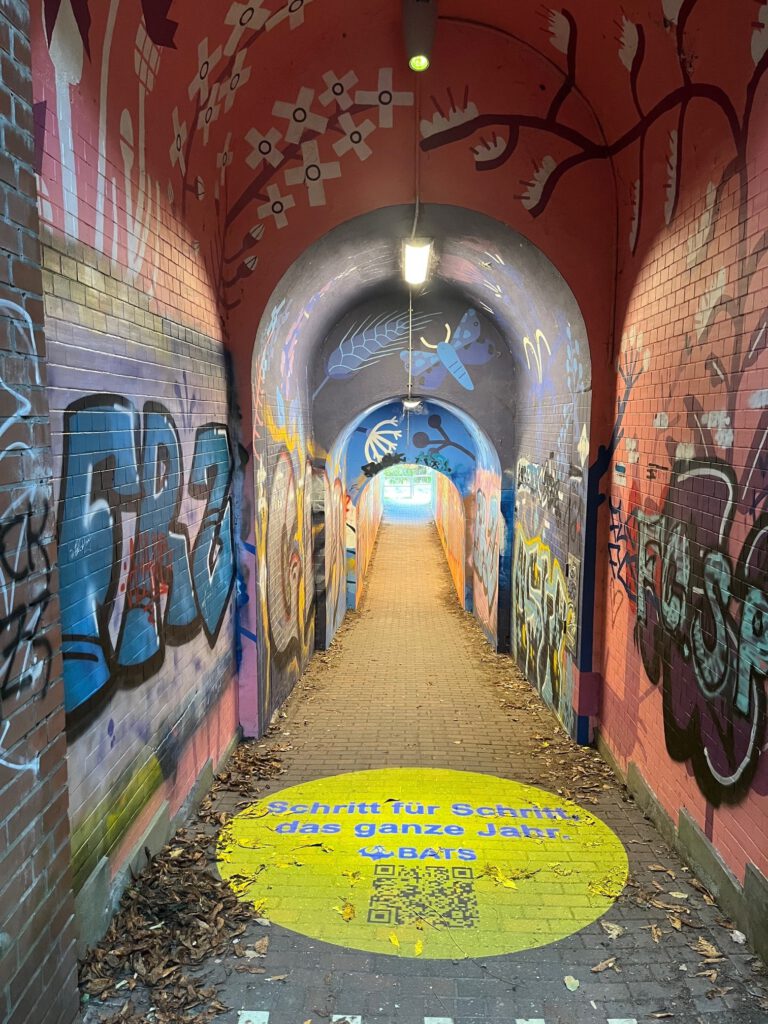
Tunnel projectors installed in Hamburg’s Altona district!

Interactive map showing pilot locations. Use the arrow keys to move the map view and the zoom controls to zoom in or out. Press the Tab key to navigate between markers. Press Enter or click a marker to view pilot project details.
Additional links
details
-
Homepage
-
Project typeCore Project

-
ImplementationNovember 2023 - October 2026
-
StatusOngoing
-
Contribution to EUSBSRPolicy Area Transport

-
Target groups
- Infrastructure and public service provider
- Local public authority
- Regional public authority
-
Social media
-
Additional links
-
Tags