




How Anykščiai turned reusable takeaway food containers into a local success
24 March 2026
We asked Daiva Žiogienė, Manager of working group, Anykščiai District Municipality, who is partner of Change(K)now! project and who led the initiative how it was implemented, what challenges they faced, and what lessons other communities could take from their experience.
Anykščiai took a bold step by introducing reusable takeaway food packaging. What inspired this decision?
The initiative in Anykščiai was inspired by the need to reduce single-use takeaway packaging and promote more sustainable consumption habits. The municipality led the process by launching a pilot project, procuring standardized reusable containers through public procurement, and building agreements with local restaurants. No complex regulations, just a shared commitment to change and to show how a small town can model solutions for the whole country, while aligning with the EU’s sustainability goals.
You worked with 16 local cafés to bring this initiative to life. How did you engage these businesses, and what incentives or support helped them embrace the change?
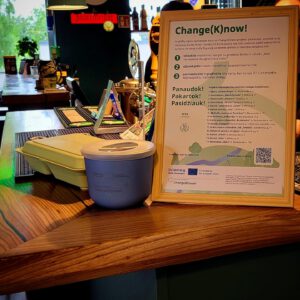
We partnered with 16 local cafés and restaurants by building personal connections through one-on-one meetings, workshops, and open dialogue. To make it easy for them, we provided reusable containers at no cost, removing the financial barrier. Other incentives? We also highlighted the benefits: stronger customer loyalty, a boost in their public image, and even national media spotlight.
Your system used a deposit-based approach for reusable packaging. Why was this model selected, and how does it compare to other options you considered?
We opted for a deposit system because it’s simple, intuitive, and works. Customers pay a small deposit (€3–4) and get it back when they return the container, without apps or QR codes. The goal was to make circularity effortless, and this model did just that.
A reuse system requires more than just good intentions, it needs infrastructure. What collection points, washing facilities, or other logistical solutions did you put in place to make it work?
Instead of building a complex centralized system, we empowered each restaurant to act as a return point and handle washing with their existing dishwashing facilities. This decentralized approach reduced logistical headaches and made the system scalable from day one.
How did you communicate the new system to consumers? Did you notice any shifts in behavior, and what barriers did you encounter in getting people on board?
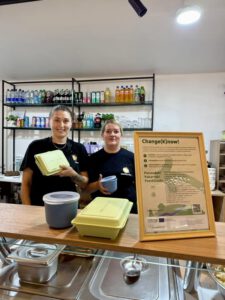
It was challenging, but we went all in on visibility: national TV features, eye-catching stickers at participating spots, and continuous community engagement. At first, there was skepticism, but over time, we saw a real shift because people started bringing back containers without a second thought.
Every innovative project faces obstacles. What were the biggest challenges – whether from businesses, operations, or elsewhere – and how did you tackle them?
Starting from scratch is never easy. We faced skepticism from businesses, administrative workload, and concerns about container quality and lack of tracking. But we tackled each one head-on: by keeping the system simple, communicating relentlessly, and trusting in the power of community.
Anykščiai’s experience offers valuable insights for other municipalities. What are the top lessons you’d share with cities or towns looking to implement similar systems?
Key lessons include the importance of strong communication, simplicity, and mindset change. Municipal leadership and support are crucial, and such systems are easier to implement in smaller towns.
How did being part of an international project like Change(K)now shape your approach to this pilot? Did it bring new ideas, resources, or perspectives to the table?
Participation in the Change(K)now project provided structure, new ideas, and international visibility, attracting interest from larger partners.
Are there plans to expand or refine the system in the future? If so, what exciting improvements or features are on the horizon?
Absolutely! The plan is to bring more restaurants on board, upgrade container quality, and explore digital tools to streamline the process. The big vision is scaling this nationally, with schools and hospitals adopting reusable systems.

Additional links
details
-
Homepage
-
Project typeCore Project

-
ImplementationNovember 2023 - October 2026
-
StatusOngoing
-
Contribution to EUSBSRPolicy Area Innovation

-
Target groups
- Business support organisation
- Interest group
- Local public authority
- Regional public authority
- Small and medium enterprise
-
Social media
-
Additional links
-
Tags