




Project Story
23 November 2026
BSR HyAirport – Project Story
Preparing today for tomorrow’s hydrogen aircraft: How Baltic Sea airports turned hydrogen concepts into airport reality
Hydrogen-powered aircraft may still be on the horizon, but the airports that will serve them need to start preparing today. Across the Baltic Sea Region, BSR HyAirport brought airports, researchers, technology specialists and hydrogen stakeholders together to answer a practical question: what does it actually take to introduce hydrogen into an airport?
The challenge: airports face a chicken-and-egg problem
Aviation needs new solutions to reduce its climate impact. Hydrogen could become one of the energy carriers that contribute to this transition, particularly as new hydrogen propulsion concepts develop. But introducing hydrogen-powered aviation is not simply a question of developing a new aircraft: The airport has to be ready too.
Hydrogen needs to reach the airport, be stored and handled safely, and ultimately be delivered to aircraft and airport vehicles. Infrastructure needs to be planned, airport staff and authorities need experience, operational procedures need to be established, and investments need to make economic sense. The regulatory framework also has to support these activities.
At the beginning of BSR HyAirport, this knowledge was fragmented. Airports, authorities and industry stakeholders lacked tested concepts and harmonised approaches for bringing the different pieces together.
Waiting for commercially available hydrogen aircraft before tackling these questions would create another problem: Airport infrastructure and operational processes take years to develop. BSR HyAirport therefore turned the question around.
Instead of waiting for hydrogen aviation, could airports start learning how to handle hydrogen today?
From an idea to an airport ecosystem
BSR HyAirport set out to prepare airports for the storage, handling and delivery of green hydrogen for future aviation and airport operations. Between November 2023 and October 2026, the project worked on the different elements that an airport would need for a future hydrogen ecosystem. Rather than treating the subjects separately, BSR HyAirport combined work on the legal framework, hydrogen supply chains, aircraft handling, airport equipment and business cases.
The logic was simple: first understand the barriers and develop solutions. Then test and evaluate them in practice. Finally, turn the experience gained into approaches that other airports can use.
This meant asking very practical questions. How much hydrogen might an airport need? Should it produce hydrogen locally or have it delivered? Where can it be stored? How can hydrogen-powered aircraft be refuelled while maintaining efficient turnaround processes? Which airport vehicles are suitable for hydrogen? And when could the necessary investments make economic sense?
The resulting supply-chain work connected demand analysis, local production and storage, and hydrogen transport into a transferable planning approach (Report on Supply Chain: BSR-HyAirport_Supply-Chain-Synthesis-Report.pdf).
For aircraft operations, the project developed concepts covering hydrogen delivery and refuelling as well as the wider handling process around an aircraft, including parking, boarding, disembarking and baggage and freight handling (Report on aircraft handling: BSR-HyAirport_Aircraft-Handling-2.pdf).
And because airports must make investment decisions long before the future market is certain, BSR HyAirport developed a Business Case Tool that allows airports to compare different hydrogen scenarios instead of relying on one fixed forecast (Business Case tool: https://interreg-baltic.eu/wp-content/uploads/2026/11/BSR-HyAirport-Business-Case-Tool_v2.0.zip?project=bsr-hyairport).
Taking hydrogen out of the report and onto the apron
But concepts alone would not demonstrate airport readiness. That is why BSR HyAirport moved from studies and calculations to real airport environments.
Hydrogen-powered airport equipment and the associated hydrogen supply arrangements were demonstrated at Hamburg, Helsinki, Riga, Kaunas, Poznan and Tallinn airports. These pilots allowed the partners to examine hydrogen delivery, temporary storage, refuelling, permitting, safety measures and actual equipment operation under airport conditions (Report on Airport Equipment demonstrations: BSR-HyAirport_Airport-Equipment.pdf).
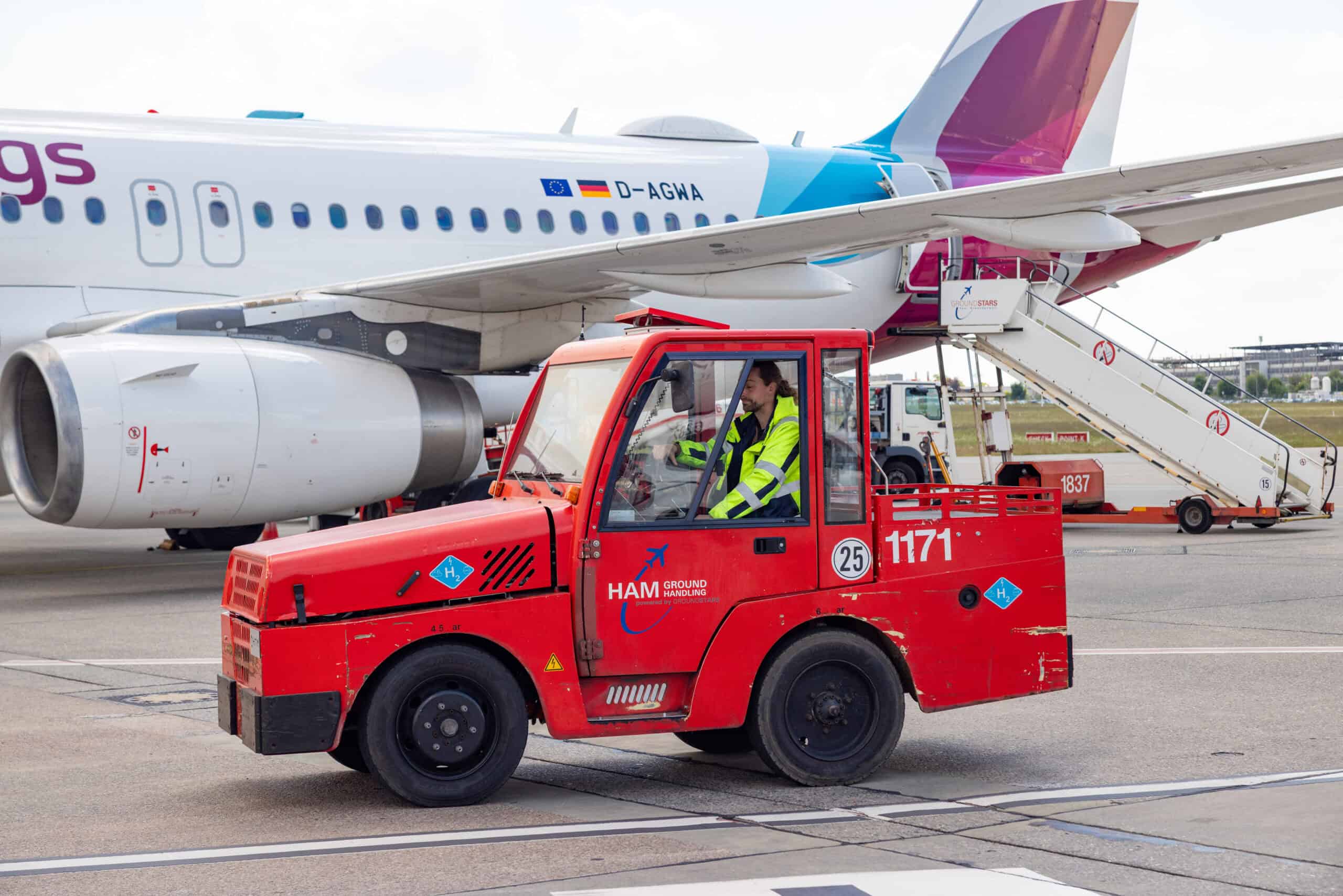
The equipment itself reflected different airport use cases. Among the demonstrations were a hydrogen-powered baggage tractor at Hamburg Airport, hydrogen-powered winter-maintenance equipment at Riga, Kaunas and Tallinn, and a hydrogen-powered bus at Helsinki Airport. Through this the project was no longer asking only whether hydrogen looked feasible in theory but actively experienced the technology themselves.
Equipment suppliers had to interact with airport procedures. Hydrogen had to be brought to operational airport environments. Safety and access requirements had to be considered. Refuelling had to work. And the partners could identify the practical differences between airports that would otherwise remain invisible in a desk study.
So, did it work?
The pilots provided an important answer: Hydrogen can already be introduced into selected airport ground operations today.
The project’s airport-equipment assessment found hydrogen technology technically feasible across the demonstrated use cases, including baggage tractors, winter-maintenance equipment and passenger transport. It found particularly strong potential where vehicles have high utilisation, perform heavy-duty or energy-intensive tasks, or benefit from fast refuelling. At the same time, wider deployment still depends on infrastructure availability, technical maturity, clear safety procedures and viable operating models.
The supply-chain demonstrations at Hamburg, Helsinki, Riga, Kaunas and Tallinn likewise showed that hydrogen supply chains could be implemented in airport operations, while highlighting the different permitting, infrastructure, safety and economic conditions that airports need to address.
The project replaced assumptions with operational experience.
Airports can now better identify where hydrogen makes sense, what infrastructure it requires, what barriers must be addressed, and which decisions can already be prepared. The project’s common methodologies also make that knowledge transferable. For example, the hydrogen-demand approach allows airports to calculate their own demand profiles using consistent assumptions and use those results to plan production, delivery and storage.
The Business Case Tool demonstrated another important lesson: There is no single hydrogen solution for every airport. Local electricity prices, transport distances, hydrogen procurement prices, demand volumes and required infrastructure can substantially change the economics of local production versus external supply. The tool provides a valuable ground for first calculations and assumptions for airports and airlines who are looking into hydrogen operations and want to understand what crosslinks exist in supply and demand.
Why this could only be done together
Perhaps the most important lesson from BSR HyAirport is that hydrogen aviation cannot be developed airport by airport or country by country. An aircraft crossing the Baltic Sea cannot operate within a hydrogen ecosystem that works at only one end of its route.
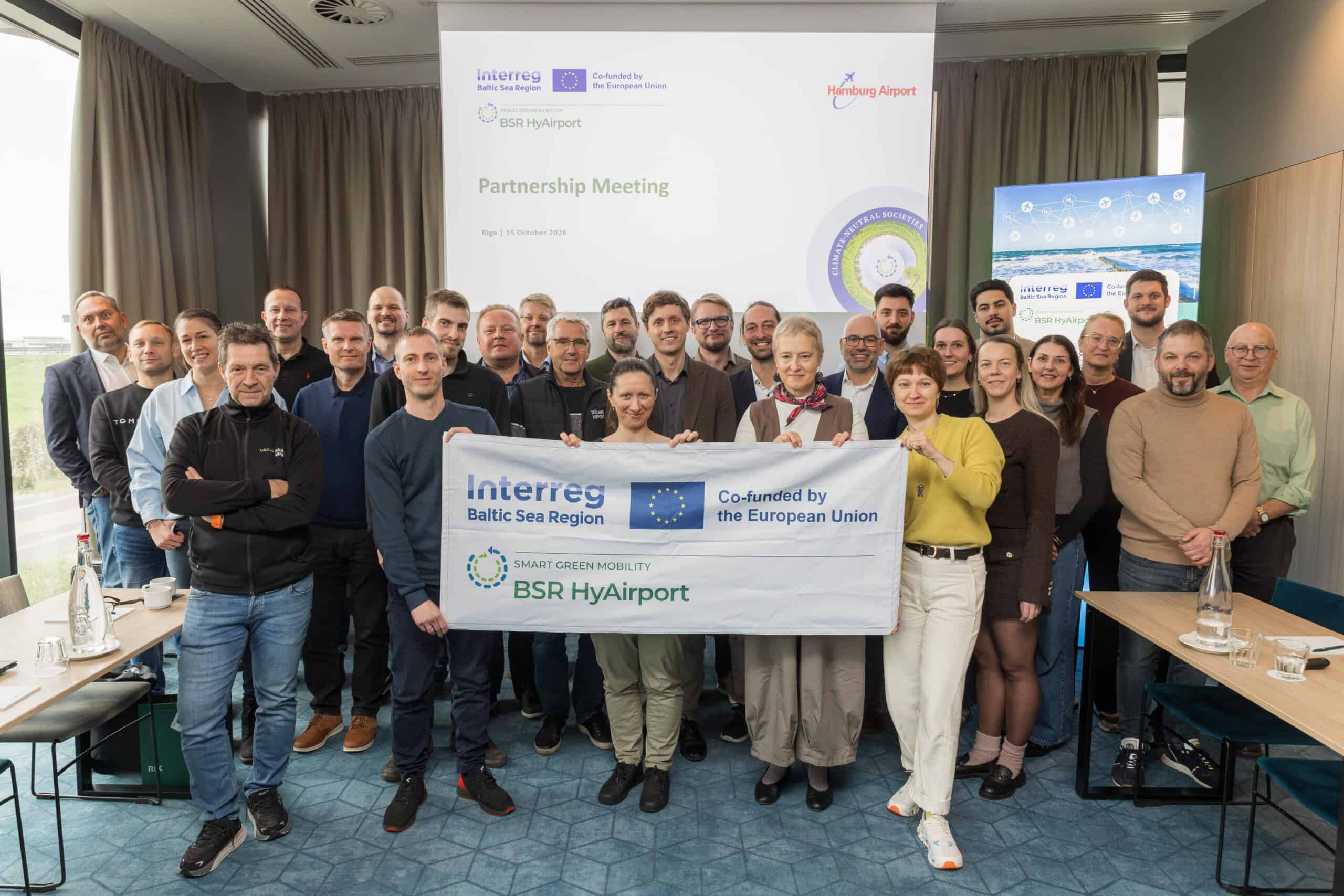
BSR HyAirport therefore brought together airports, research organisations, industry partners and hydrogen stakeholders from Germany, Poland, Lithuania, Latvia, Estonia, Finland and Sweden, led by Hamburg Airport. The airports themselves represented different operating environments, allowing concepts developed in one context to be confronted with the realities of another.
That transnational structure was not simply a way of organising the project. It was part of the solution. Partners could compare regulatory environments, infrastructure options, supply chains and operational requirements across borders. Practical experience from one airport could challenge assumptions made at another. Airports, researchers and technology specialists could combine operational knowledge with scientific and technical expertise.
This is particularly important for future hydrogen aviation because larger aviation networks will depend on multiple airports being capable of handling hydrogen-powered aircraft, not isolated hydrogen-ready locations.
The project ends, but airport preparation does not
BSR HyAirport has not answered every question surrounding hydrogen aviation. Nor was that the objective. It has done something arguably more important for airports today: It has created a practical starting point.
Its hydrogen-demand calculation methodologies, supply-chain approaches, aircraft-handling concepts, operational pilot experience and Business Case Tool form a toolbox that airports can continue to use as hydrogen technology and markets develop.
The piloting activities demonstrated that airports do not have to wait for commercial hydrogen aircraft before gaining experience. And they can begin integrating hydrogen into long-term infrastructure and investment planning and start with smaller use cases for the whole ecosystem to learn from those experiences and those of BSR HyAirport.
That is perhaps the most important legacy of BSR HyAirport.
The first hydrogen aircraft may still be ahead of us. But thanks to cooperation across the Baltic Sea Region and whole Europe, airports do not have to start preparing for them from zero.

Additional links
details
-
Homepage
-
Project typeCore Project

-
ImplementationNovember 2023 - October 2026
-
StatusCompleted
-
Contribution to EUSBSRPolicy Area Transport, Policy Area Tourism

-
Target groups
- Infrastructure and public service provider
- Interest group
- National public authority
- Regional public authority
- Small and medium enterprise
-
Social media
-
Additional links
-
Tags