



Telling the GYPREG story...
04 November 2026
BLOG 7. – June 2026: From soil samples to gypsum potential
The GYPREG partners were together again in June! This time, we gathered in Klaipėda, Lithuania, to share the latest research findings, discuss our progress and take a closer look at how gypsum could help reduce phosphorus losses across the Baltic Sea region. And there was plenty of interesting news to share!
The first day started with a deep dive into the results of our laboratory experiments. Gypsum has now been tested in all GYPREG partner countries, and the findings have been both promising and thought-provoking.
The results have varied between countries. In some cases, gypsum has been much more effective at reducing phosphorus losses than in others. However, one common pattern seems to be emerging: gypsum generally works better on heavier soils, particularly clay soils. This is also what we have learned in Finland, where gypsum treatment has mainly focused on clay-rich agricultural fields.
One particularly interesting experiment was carried out at the Finnish Environment Institute (Syke), where soil samples from all partner countries were brought together for joint testing. Different gypsum materials identified in the project countries were also included.
In total, around 220 small pots were used in the experiment, carefully studied by our master’s thesis student Rudolfs.
The soils were kept in pots for four weeks and watered once a week. Some samples were then dried at 40°C for further analysis.
And the differences were visible even to the naked eye! The soils treated with gypsum showed improved structure, while the untreated soils appeared noticeably more compact.
The experiment also explored another important question: how much do laboratory methods affect the results? For example, filtering or not filtering the water samples produced different results. This reminded us that it is not only what we measure that matters, but also how we measure
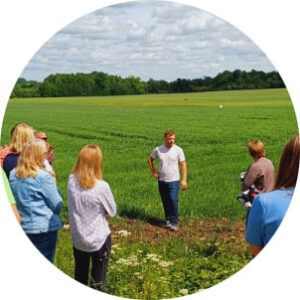
GYPREG project participants visiting a local farmer in Lithuania. © GYPREG
it. There is still room to improve and harmonise our research methods.
Another exciting topic was the geographical potential of gypsum treatment. Our GIS analysis suggests that approximately 7 million hectares of agricultural land could be suitable for gypsum application across the GYPREG partner countries. It already gives us an idea of the potential that gypsum treatment could offer. Another encouraging finding from the experiments was that no negative effects on crop yields were observed.
Our meeting was not all about soil samples and phosphorus. We also discussed the project’s upcoming final reporting, communication activities, survey findings and educational materials. We also watched a video showing historical gypsum application in Lithuania and visited a local farmer to learn more about agricultural practices in the region.
These visits and discussions are an important reminder of why we are doing this work. Research findings are valuable, but turning them into practical solutions for farmers and cleaner waters requires cooperation, knowledge sharing and understanding of local conditions.
Once again, our meeting showed how much we can learn by bringing together experiences from different countries.
BLOG 8. – September 2026: Three years of GYPREG – more than just gypsum!
When GYPREG kicked off three years ago, we started by getting to know each other also outside of work role. We discovered e.g. that many of us had dogs, and quite a few enjoyed mushroom picking. Now, as the project comes to an end, we can report that the number of dogs has grown. But quite a few other things have changed along the way, too!
At our final meeting, we took a moment to reflect on what these three years have meant to us – not just in terms of research results and project achievements, but also on a more personal level.
For some, GYPREG was the reason they were able to join their organisation in the first place. For others, it was their first Interreg project, their first international project in English, or an opportunity to widen their expertise. Along the way, we have gained new skills, confidence, friendships and professional connections that will last beyond the project.
Even those already familiar with gypsum discovered new perspectives, while others gained confidence in working more with soils and agricultural research. And for some, the project even changed conversations at home – what started as explaining gypsum research to farming family members gradually turned into a genuine dialogue.
Perhaps most importantly, GYPREG has brought people together. Our partner meetings, field visits and discussions with farmers, advisors and researchers have built trust and opened doors for future cooperation. New colleagues joining along the way have been warmly welcomed, and partnerships that had been hoped for over many years have finally become reality.
In countries where gypsum treatment was still largely unknown, the journey started with uncertainty. Today, farmers are showing growing interest, and partners are eager to continue testing, learning and sharing knowledge.
One colleague, who hopes to inspire future generations as a teacher, summed up an important message she wants to carry on to her future pupils: the Baltic Sea is not lost. There is still much we can do.
And like another partner put it: This is not the end. It is a beginning – an invitation to go deeper into the soil, deeper into the water, and further together.
And to capture these three years in a slightly different way, here is a song by some of the GYPREG staff (and AI) inspired by our journey.
The Gypsum Leaders’ Song
Verse 1
Out in the fields where the barley grows,
Following science, wherever it goes.
Maps and trials, samples in hand,
Working for healthier waters and land.
Chorus
Oh, spread that gypsum far and wide,
Keep the nutrients where they should reside.
From the drainage ditch to the Baltic blue,
We’re building solutions that really come through.
Ljudmila and Petri, working as one,
Improving our soils under the Baltic sun!
Verse 2
Meetings and reports may fill the day,
But field demonstrations lead the way.
With every hectare and every test,
We’re finding the method that works the best.
Chorus repeated
Bridge
Less phosphorus leaving after the rain,
Clean Baltic Sea is everyone’s gain.
GYPREG crew standing side by side,
Turning knowledge into practical pride.
Chorus final
Oh, spread that gypsum far and wide,
Science and farming are on the same ride.
From field plots small to landscapes grand,
We’re helping water and strengthening land.
Here’s to the leaders who guided the way,
Making a difference day after day!
Blogs by Sari Väisänen, Finnish Environment Institute (Syke)

Additional links
details
-
Homepage
-
Project typeCore Project
-
ImplementationNovember 2023 - October 2026
-
StatusCompleted
-
Contribution to EUSBSRPolicy Area Nutri, Policy Area Bioeconomy

-
Target groups
- Interest group
- International governmental organisation
- National public authority
- NGO
- Regional public authority
-
Social media
-
Additional links
-
Tags