




From pilots to systems: Change(K)now! closes with a call to scale up reuse
28 October 2026
On 23 October 2026, the final conference of the Interreg Baltic Sea Region project Change(K)now!, Reusable Food Packaging Systems – European Experiences and Solutions, brought together municipalities, businesses, NGOs, researchers and system operators at Gate 21 in Albertslund, near Copenhagen. After three years of work by 23 partners and 25 pilot projects across the Baltic Sea Region, the shared conclusion was that working reuse solutions already exist, and the task now is to scale them up.
Three years of testing reuse in real life
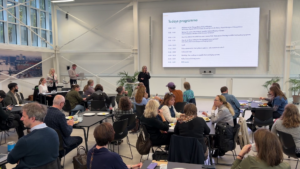
Since 2023, Change(K)now! partners have tested alternatives to single-use food packaging in public catering, events and festivals, takeaway services and food markets, and urban public spaces. After opening remarks by Mette Boye, Deputy Director at Gate 21, and Aija van der Steina, Project Manager of Change(K)now!, the pilots presented their results in the exhibition area – sharing what worked, what didn’t, and where solutions could be replicated.
“We ran 25 pilots, from small takeaway businesses to large public events, to find out whether reusable packaging works in real life. It does, but there is still a lot to do before individual solutions become an established system in Baltic Sea Region cities. I am truly proud of our partners: in many places they were pioneers and inspired others. What we can offer now are not theoretical ideas, but tried-and-tested models that other cities can replicate and build on”, says Aija van der Steina, Project Manager of Change(K)now!.
See all the pilots on the interactive map.
EU policy: implementing the PPWR ambitiously
Setting the scene from Brussels, Rasmus Nordqvist, Member of the European Parliament, spoke about the latest developments in the implementation of the EU Packaging and Packaging Waste Regulation (PPWR) and the upcoming Circular Economy Act. He underlined that the way Member States implement the PPWR will decide how far reusable packaging can go.
Designing for behaviour change
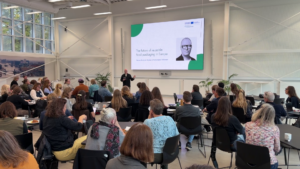
Rules on their own will not change habits if single-use packaging stays the easier option. Behavioural design and nudging expert Sille Krukow argued that reuse depends largely on behaviour. People are busy and rarely stop to weigh sustainability, so returning a cup or a container has to take no extra effort. Her examples showed that small design choices, such as the colour of packaging or signage, can noticeably change what people pick.
From pilots to systems: who needs to do what?
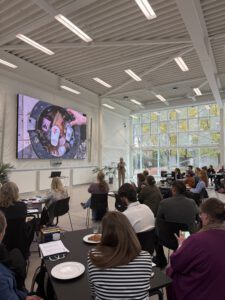
The Change(K)now! Policy Recommendations were presented by their lead author, Heidrun Fammler, Chairperson of the Board at the Baltic Environmental Forum Germany. “Pilots prove that reuse works, but cannot transform the market alone. Policymakers must turn isolated solutions into functioning systems through clear rules, public procurement, shared infrastructure and economic incentives. Coordinated action is key to making reuse the new normal,” she said.
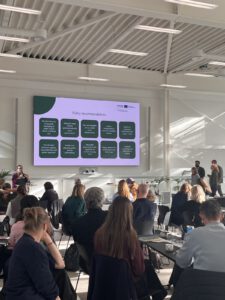
The following policy conversation brought together municipal, national, European and industry perspectives, with Sarosh Qureshi (City of Copenhagen), Iara Beekma Reis (New European Reuse Alliance – New ERA), Sanna Due (European Environment Agency), Hanna Salmenperä (Finnish Environment Institute, Syke) and Anders Barsøe (New Loop).
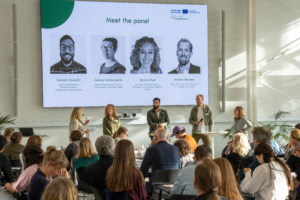
The discussion focused on how to create demand for reuse, build systems that work across sectors and regions, and overcome the regulatory, financial and organisational barriers that still stand in the way of large-scale implementation. In the afternoon, participants worked on their own roadmaps towards reusable food packaging systems.
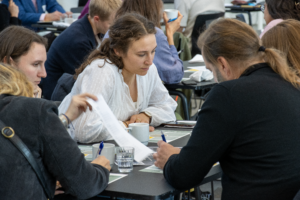
The day closed with a dedicated NGO session on citizen engagement, waste prevention and the communication approaches that best build public support for reuse. “Our campaign showed that people want simple, practical steps, not complicated explanations. Reuse becomes a habit when it fits into everyday routines and when local services make it easy“, says Eugeniy Lobanov, project partner at Coalition Clean Baltic (CCB), who coordinated the NGO session and led the Change(K)now! behaviour campaign on social media.
What comes next
Scaling up reuse needs municipalities, businesses, policymakers, NGOs and citizens working towards the same goal. The new Change(K)now! Replication Report shows that this is already happening beyond the pilots. It documents 56 cases in eight countries where organisations have taken up and adapted solutions from the project: 41 have reached practical implementation, and 27 involve organisations outside the project partnership.
The report also shows that transferring a solution is only the first step. Lasting use depends on local adaptation, convenience for users and staff, viable operations and institutional support.
Change(K)now! ends this autumn, but its pilots, reports and recommendations remain a starting point for municipalities, businesses and NGOs that want to move from single-use to reuse.
Many thanks to Gate 21 for hosting the conference, and to all Change(K)now! partners for three years of collaboration!
The conference was part of the Change(K)now! Project, co-funded by Interreg Baltic Sea Region.

Additional links
details
-
Homepage
-
Project typeCore Project

-
ImplementationNovember 2023 - October 2026
-
StatusOngoing
-
Contribution to EUSBSRPolicy Area Innovation

-
Target groups
- Business support organisation
- Interest group
- Local public authority
- Regional public authority
- Small and medium enterprise
-
Social media
-
Additional links
-
Tags