




StartSun presented at the Citizen Energy in Central and Eastern Europe Conference in Budapest
09 May 2025
StartSun was presented at the Citizen Energy in Central and Eastern Europe (CEE) Conference, held in Budapest on 8 and 9 May 2025. The two-day event took place at the German-Hungarian Chamber of Industry and Commerce, with the German Environment Foundation (DBU) and the Environmental Assessment Research Group at TU Berlin opening and closing the programme. It was held in-person in English, and gathered EU-level policymakers, national and local authorities, funding bodies, research and education project managers and energy community experts.
The conference focused on how funding for research and educational model projects can support the development of energy communities in CEE countries. Over the past four years, DBU has dedicated a special funding focus to this topic and has supported 16 projects in 11 countries in the region. The conference gave these projects a chance to reflect on lessons learned, compare them with other funding initiatives and discuss how to improve access to financial mechanisms and strengthen the institutional frameworks around energy communities. The conference materials name the lack of financing, regulatory and legal obstacles and insufficient public awareness as the main barriers to wider adoption.
The first day was dedicated to project financing, consultancy and networking. It opened with keynote presentations on pathways for supporting energy communities in Europe through 2050, given by a representative of DG ENER, and on the national funding scheme for citizen energy initiatives in Austria. Good practice examples from Hungary and North Macedonia followed. In the afternoon, a panel discussion looked at available funding for developing energy communities through research and educational projects. The panel included representatives of DBU, WECF, REScoop, Frank Bold Czech Republic, OSF Western Balkans, TU Berlin and Uppsala University.
StartSun was presented within the Uppsala University contribution to this panel, prepared by Associate Professor Heracles Polatidis of the Department of Earth Sciences, Campus Gotland. The presentation introduced four EU-funded projects: REACT (Horizon 2020), RESTOR (a Clean Energy Transition Partnership project annexed to Horizon Europe), RURACTIVE (Horizon Europe) and StartSun (Interreg Baltic Sea Region, co-funded by the European Union). StartSun was the final project in the line-up.
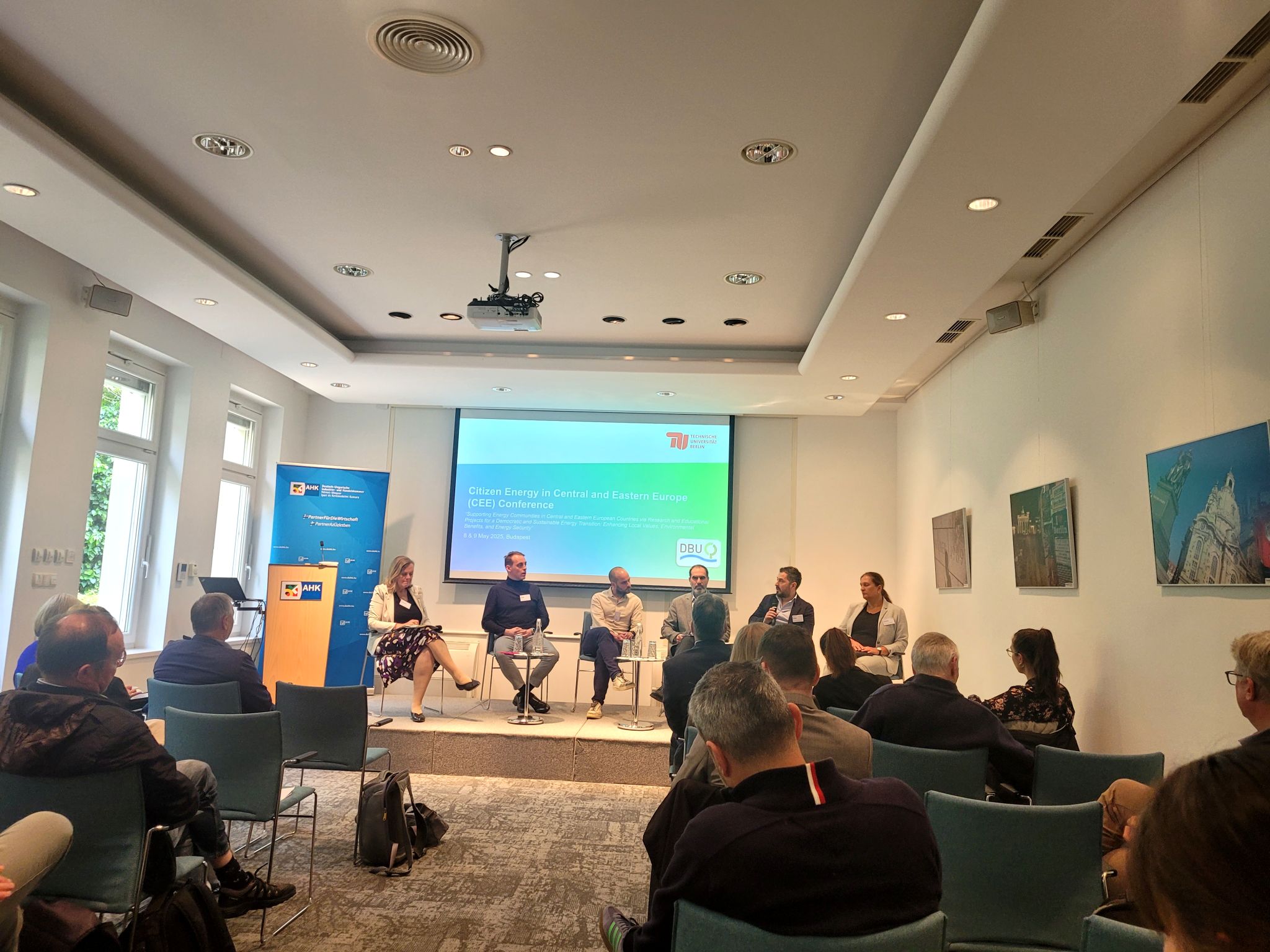
Picture of the panel discussion where the StartSun project was represented among others. Photo by Uppsala University
StartSun, short for Start-ups for Solar Energy Communities, was described as a project that tackles the start-up challenges of establishing energy communities by creating the necessary knowledge, documentation and first-experience pilots in the Baltic Sea Region. The project provides a Start-Up package for establishing energy communities and pilots five different types of energy communities. It also aims to strengthen and speed up the creation of energy communities in the Baltics through the exchange of experience. The consortium has 13 partners, including universities, regional authorities, local cooperatives, consultancies, regional energy agencies, municipalities and NGOs. The project runs for three years with a total budget of 3.2 million euros, of which 0.5 million euros is allocated to infrastructure and works.
The presentation also listed the challenges the project works with: differing national regulations, different electricity market structures, different definitions of the legal form of an energy community, financing and grid codes. Several of these, namely financing and regulatory and legal obstacles, are also among the barriers the conference itself identified.
The second day moved from funding to practice. It included a dialogue on what makes an energy community project successful, good practice examples from Greece, North Macedonia, Albania and Romania, and a World Café with five breakout groups on the steps needed to scale up energy communities in CEE. Topics ranged from capacity building and empowering marginalised citizens to developing pilot projects, long-term financial viability and institutionalising community energy knowledge. The conference closed with a site visit to the Kazan community energy project in Budapest, which showed rooftop solar installations, energy efficiency measures and the benefits of retrofitting for the local community.

Additional links
details
-
Homepage
-
Project typeCore Project
-
ImplementationNovember 2023 - October 2026
-
StatusOngoing
-
Contribution to EUSBSRPolicy Area Energy

-
Target groups
- Interest group
- Local public authority
- National public authority
- Small and medium enterprise
-
Social media
-
Additional links
-
Tags