




A strong energy community starts with a real need and grows step by step
08 October 2026
What makes an energy community financially sustainable? The answer is not only in numbers.
At a StartSun conference panel discussion, Inka Leppänen from Karelia University of Applied Sciences, Johanna Liljenfeldt from Uppsala University, and Nele Ivask and Marten Saareoks from Tartu Regional Energy Agency discussed how communities can make sound investment decisions while still keeping sight of the wider value they want to create.
The discussion showed that energy communities do not need to start with a perfect business model or a large investment. They can begin with a clear local need, test cooperation, use available expertise and funding, and grow step by step as confidence and experience increase.
The calculator can help, but it cannot decide
Financial calculations are an important part of any investment, but the panel repeatedly stressed that they are only one part of the decision.
Johanna Liljenfeldt pointed out that financial feasibility depends on what the community is actually trying to achieve. If the goal is lower electricity costs, the calculation may be relatively straightforward. But if the aim is greater resilience during power outages, some of the value may not appear directly in the figures.
Avoided losses, continued access to electricity in a crisis or the ability to keep important equipment running all have value, even if that value is difficult to express in euros.
Inka Leppänen added that the local electricity market also matters. In Finland, for example, selling electricity to the grid can sometimes bring only a very small return, while using locally produced electricity within the community can create greater value.
Nele Ivask similarly highlighted the need to balance financial results with the wider aims of the community. Not every benefit can be given a clear monetary price, but that does not make it irrelevant.
Liljenfeldt summarised the role of calculators clearly: they should be treated as decision-support tools, not as decision makers. They can help communities compare options, test assumptions and understand relationships between different factors, but the final decision still belongs to the people involved.
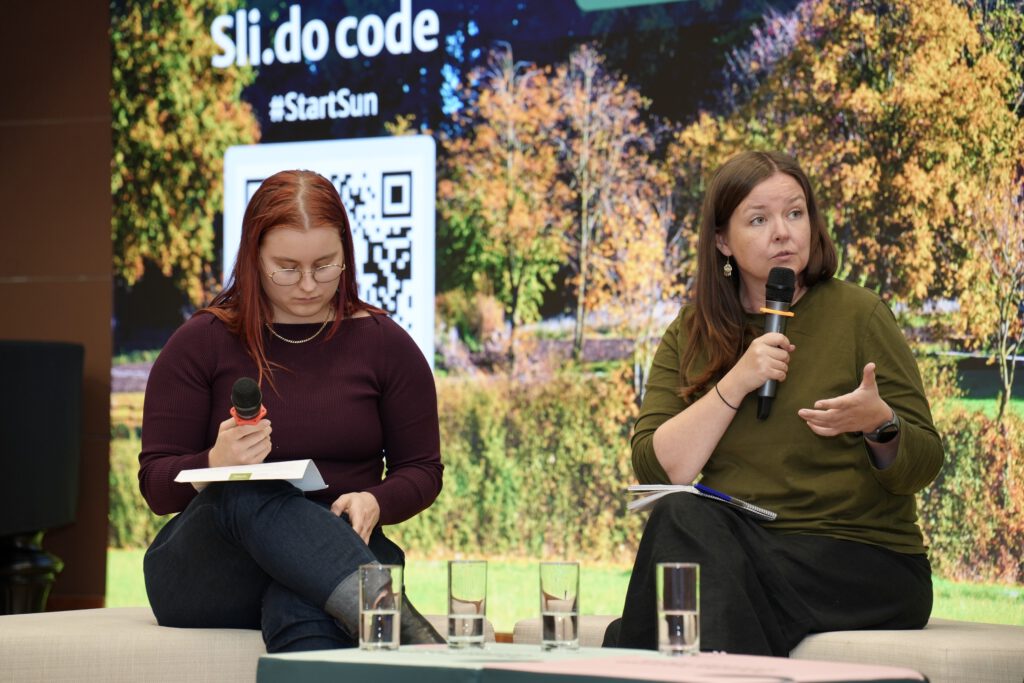
Inka Leppänen and Johanna Liljenfeldt. Photos by Sander Pärn and Laura Killak (EMÜ)
Resilience can be part of the value
One of the positive messages from the discussion was that a project does not have to maximise short-term profit to be worthwhile.
Ivask noted that an investment with a lower financial return may still make sense if the community agrees that it provides important resilience benefits. The key is that members understand the trade-off and make the decision together.
The value of resilience can also vary greatly depending on who is involved. For a hospital, a company or another organisation that cannot easily stop operating during a power outage, energy security may be especially important.
Liljenfeldt added that resilience is not only about advanced technology. A smaller and simpler system that the community can understand, maintain and repair itself may in practice be stronger than a large system that depends entirely on external expertise.
Saareoks made the same point from a practical perspective. A battery system does not always need to keep an entire building operating normally for several days. It may be enough to support essential lighting, communications or a water pump. A smaller solution can still meet the most important need while keeping investment costs under control.
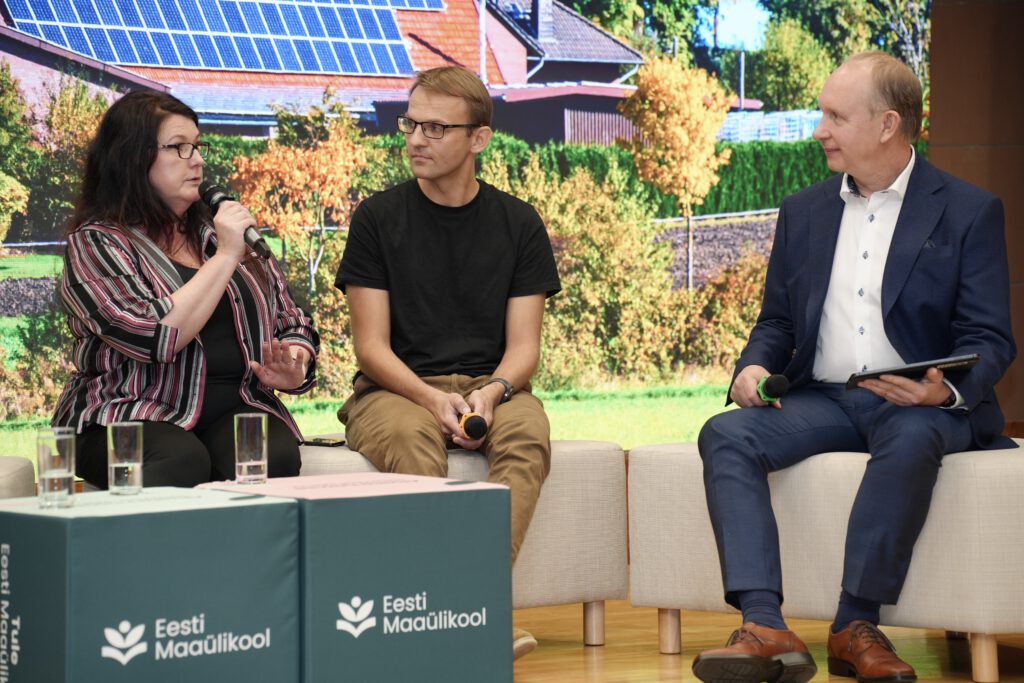
From left: Nele Ivask, Marten Saareoks, and the moderator of the discussion, Indrek Jakobson. Photos by Sander Pärn and Laura Killak (EMÜ)
Good planning creates room to move forward
Uncertainty does not mean that communities should avoid investment. It means they should plan for more than one possible future.
Leppänen suggested testing different scenarios and asking what would happen if future returns were considerably lower than expected. Ivask also recommended using several scenarios, from conservative to optimistic, to get a more realistic picture of possible outcomes.
This kind of planning gives communities a clearer understanding of risk and helps them avoid becoming dependent on one favourable assumption.
The same applies to temporary support measures. Saareoks noted that subsidies and other benefits can play an important role in helping the first projects get started and showing others that a model can work. At the same time, communities should aim to become sustainable beyond the initial support period. Johanna Liljenfeldt added that long-term planning should cover the full lifetime of the technology, not only the first years of an investment.
Communities do not have to start big
Another practical takeaway was that a new energy community does not need to do everything at once.
When discussing how new communities can avoid financial problems in the early stages, Liljenfeldt recommended assessing different options, looking for available funding and seeking advice from experts. Most importantly, the investment should respond to a real problem and can be developed gradually.
Ivask shared an Estonian example where a pilot energy community first approached experts for support. Over time, the cooperation developed further and eventually led to an Interreg proposal and external funding.
Saareoks also highlighted the value of keeping some financial reserves instead of investing every available resource at once. This gives a community more flexibility if costs or conditions change.
For Leppänen, available funding can also help communities test new solutions. She pointed to options such as national funding organisations and EU support, which can make it easier to develop ideas that have not yet been tried locally.
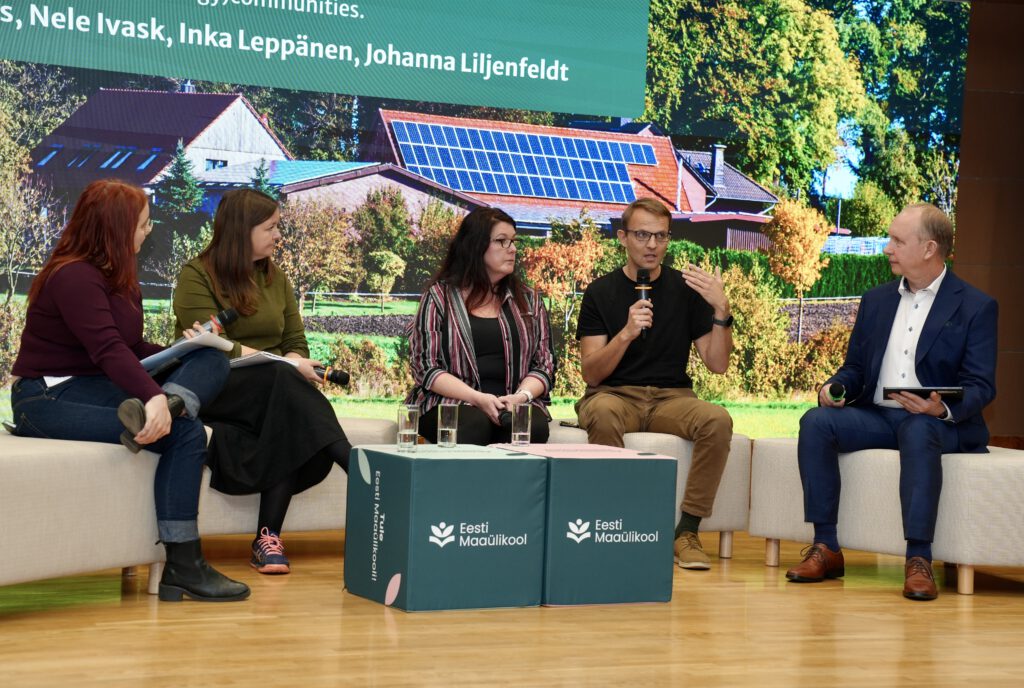
Panelists of the discussion. Photos by Sander Pärn and Laura Killak (EMÜ)
Before investing in technology, test the need and the cooperation
The final part of the discussion brought many of the earlier points together.
Before making a major investment, communities need to look at the local reality. Is there a real need? Does the solution fit local infrastructure? Are people willing to cooperate? Can the community manage the system in the future if key people leave?
Ivask suggested testing cooperation before formally establishing an energy community. Even a simple cooperation agreement can show whether people are prepared to work towards a common goal. Technical questions such as grid connections and roof capacity still matter, but they are only part of the picture.
Liljenfeldt then reduced the issue to its most basic point: first test whether there is a need at all. Without a real need, there is little reason to build the community around a technology.
That may also be one of the most encouraging conclusions from the panel. Energy communities do not need to predict the future perfectly or begin with the largest possible investment. They need a clear purpose, realistic planning and people who are willing to move forward together.
A strong energy community can start small, learn from experience and grow over time.
Want to learn more?
This panel discussion was part of the Interreg-funded StartSun final conference “From Concept to Community: Launching Solar Energy Communities”, which took place on 22 September 2026 at the Estonian University of Life Sciences. Access the PDF files and full recordings of each presentation here.

Additional links
details
-
Homepage
-
Project typeCore Project

-
ImplementationNovember 2023 - October 2026
-
StatusOngoing
-
Contribution to EUSBSRPolicy Area Energy

-
Target groups
- Interest group
- Local public authority
- National public authority
- Small and medium enterprise
-
Social media
-
Additional links
-
Tags