

This wrap-up has been compiled by the Programme
PROGRAMME 2021-2027
Priority 3 Climate-neutral societies
Objective 3.1 Circular economy
FoodLoops:
Wrap-up of project achievements
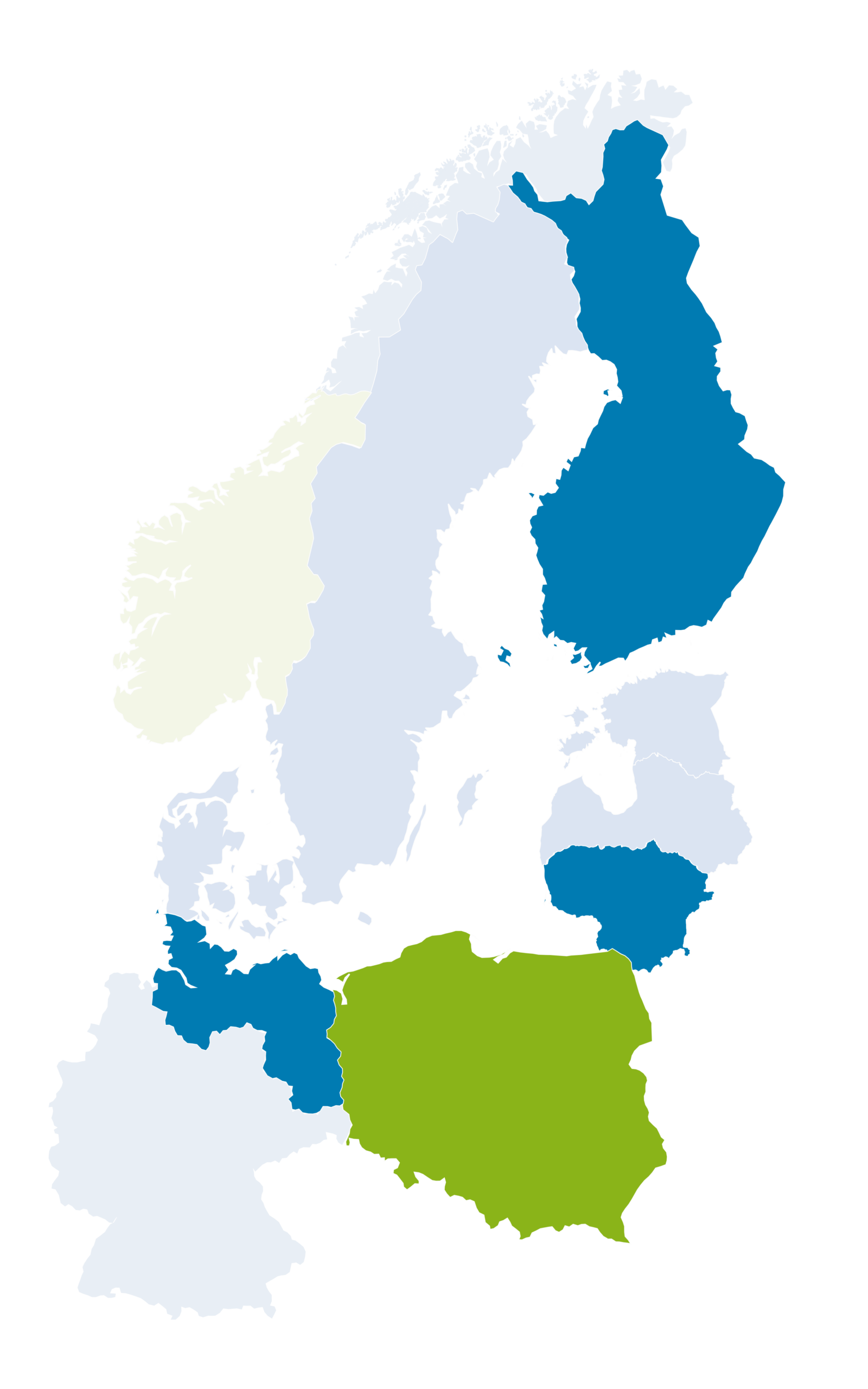
More cooperation means less food waste: the Interreg project FoodLoops addressed fragmented cooperation in school food systems in Finland, Poland, Lithuania and Germany. The project brought municipalities, schools, caterers, farmers and waste-management service providers together and developed a cooperation model to prevent food waste, improve bio-waste sorting and put unavoidable food waste back into use through composting.
Highlights
FoodLoops
Highlights
FoodLoops
FoodLoops helped move from isolated food-waste actions towards more coordinated circular food practices, offering a replicable cooperation model:
- FoodLoops Manual: Local Cooperation for Circular Bio-Waste in Schools and Beyond – a practical guide on how to prevent food waste, improve bio-waste sorting, and put unavoidable food waste back into use through composting
Download links
FoodLoops Manual
FoodLoops Manual
The FoodLoops Manual helps municipalities, schools, caterers, farmers and waste-management service providers close local bio-waste loops and better understand their roles in reducing food waste. It presents practical steps for mapping relevant actors, building cooperation, preventing food waste, composting and replicating.
The manual is based on hands-on experience and includes case studies and lessons from local work in Kuopio (FI), Gdańsk (PL), Vilnius and Panevėžys (LT). These examples show how local actors can move from single-school activities to more structured cooperation among public authorities, food services, and the agricultural sector.
Partners tested and validated the FoodLoops Manual through two transnational replication workshops: an online workshop in March 2025 and a hybrid workshop in Wuppertal in April 2025, bringing together municipalities, school administrations, caterers, farmers and other actors from different countries.
The value of transnational work lies in the possibility of comparing different school food systems, procurement rules, and waste-management practices. Experiences from Finland, Poland, Lithuania and Germany helped make the manual useful and adaptable to other local settings. The workshops also supported new ideas for cooperation, including a “Round Table on Circular Food” in Wuppertal. This permanent forum brings together the municipality, schools, and food-sector organisations to jointly develop and coordinate circular food solutions.
Get inspired
Interreg pays off
Follow-ups
Interreg pays off: Follow-ups
Thanks to Interreg funding and transnational cooperation, FoodLoops connected organisations that would otherwise likely deal with school food waste separately. Moreover, the project established cooperation formats that will continue beyond the project. For example, Gdańsk (PL) will build on its Green Education Programme and advance steps towards green school certification, while Wuppertal (DE) will continue its Circular Food Round Table.
Rather than working with individual schools alone, FoodLoops strengthened the capacity of organisations able to drive wider change. Municipalities improved coordination with schools, caterers, and waste-management service providers, while caterers introduced better menu planning, student feedback, and food-waste monitoring.
In numbers
10 organisations cooperating across borders
36 organisations directly benefitting from project solutions
In focus
Small stories, big gains
In focus: Small stories, big impact
The compost lesson
How yesterday’s leftovers become tomorrow’s harvest – right in a school garden
At a primary school in Gdańsk, Poland, that’s exactly what’s happening. Instead of throwing away food scraps, 40 pupils from Primary School No. 61 teamed up with a local farmer to transform 2,000 litres of organic waste into hot compost. By tracking temperature and moisture, they turned food waste into fertile soil that now nourishes the school’s garden with potato beds, experiencing first-hand the full journey from plate to compost – and back to food.
The idea reaches far beyond one school garden. Through the Interreg Baltic Sea Region project FoodLoops, schools, municipalities, farmers and caterers across Finland, Germany, Lithuania and Poland are rethinking what happens after lunch. By putting circular food systems into practice, they’re not only cutting food waste but also showing children that sustainability can start with something as ordinary as a potato peel.
.
Project
Details
Project type
Small project
Project duration
August 2023 – July 2025
Contribution to the EUSBSR
PA Bioeconomy
Budget in million
EURO
Involved
Countries
Lead partner
Project partners