




Why Internationalisation Looks Different in Every Market
13 May 2026
SMEs often approach internationalisation with the assumption that business expansion follows the same logic everywhere.
In reality, every market operates differently.
Communication styles, decision-making processes, expectations around trust and even the pace of business relationships can vary significantly between countries — including within the Baltic Sea Region itself.
What works in one market may not work in another.
Internationalisation requires adaptation
For micro-SMEs, entering a foreign market is not only about finding customers or partners. It also requires understanding how business culture shapes everyday interactions.
In some markets, decisions are highly structured and process-driven. In others, relationship-building and informal networks play a larger role.
Companies expanding internationally often need to adapt:
- communication styles
- sales approaches
- negotiation strategies
- partnership expectations
- market entry methods
This ability to adjust becomes an important competitive advantage.
Market knowledge goes beyond data
Traditional market data can explain the size of an economy or identify key industries. However, successful internationalisation often depends on less visible factors.
Questions such as:
- How quickly are decisions made?
- What builds trust?
- How formal is communication?
- How important are local networks?
can significantly influence business outcomes.
For SMEs with limited international experience, understanding these differences early can reduce uncertainty and improve market readiness.
Learning through regional cooperation
Cross-border cooperation initiatives can help SMEs gain this knowledge before entering new markets independently.
Through workshops, expert sessions and interactions with local stakeholders, companies can better understand how business environments differ across countries.
This kind of practical insight helps transform internationalisation from an abstract ambition into a more manageable and realistic process.
A Baltic Sea Region perspective
Although countries in the Baltic Sea Region are closely connected economically, they still differ in business culture, market structure and communication styles.
Understanding these nuances is often essential for successful cross-border cooperation.
Within BSR Go-abroad, project partners have explored these differences through a series of “Doing business in…” sessions focused on various regional markets.
The aim is to help micro-SMEs better understand how internationalisation strategies may need to change depending on the market they enter.
Conclusion: Successful internationalisation requires flexibility
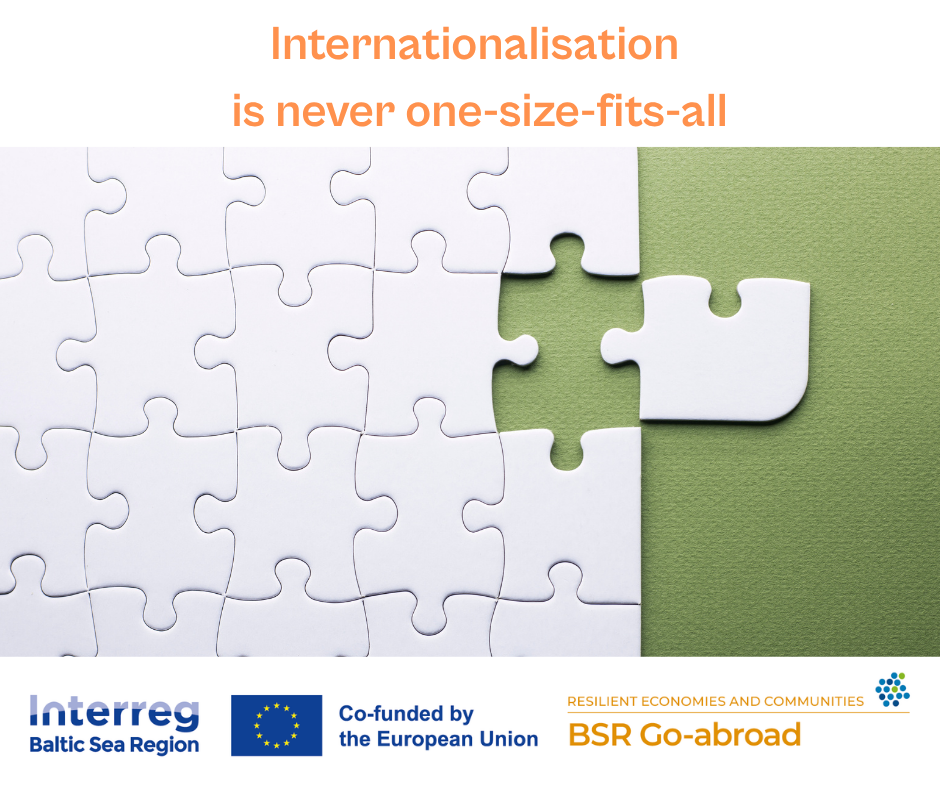
There is no single formula for entering international markets.
SMEs that recognise and adapt to local business realities are often better positioned to build sustainable partnerships and identify long-term opportunities abroad.
By strengthening cross-border knowledge-sharing and regional cooperation, initiatives such as BSR Go-abroad help micro-SMEs navigate internationalisation with greater confidence and understanding.

Additional links
details
-
Homepage
-
Project typeCore Project

-
ImplementationNovember 2023 - October 2026
-
StatusOngoing
-
Contribution to EUSBSRPolicy Area Innovation

-
Target groups
- Business support organisation
- Local public authority
- Small and medium enterprise
-
Social media
-
Additional links
-
Tags