





Greifswald, Germany
28 April 2026
Greifswald is a medium-sized university city in north-eastern Germany, located in the federal state of Mecklenburg–Vorpommern. With around 60 000 inhabitants, including a large student population, the city has a compact urban structure and a strong cycling culture. Cycling already plays a significant role in everyday mobility, supported by relatively short travel distances and a flat topography.
Within the SUMPs for BSR project, the city ran two active mobility pilots, one on data collection and a small-scale experiment.
Testing fixed and mobile bicycle parking solutions
Greifswald explored how different types of bicycle parking solutions could improve everyday cycling conditions and make more efficient use of public space. The pilot included both a permanent weather-protected bicycle parking facility as a structured, long-term solution and a mobile bicycle parking unit as a flexible, temporary measure to understand the real need for parking in certain locations. Prior to the experiment, the city had identified recurring problems related to informal bicycle parking, obstruction of pedestrian space and insufficient parking capacity near key destinations.
The small-scale pilot gave concrete insights into how different bicycle parking solutions perform in practice. While neither solution alone addresses all parking needs, together they provide a broader toolbox for the city.
Traffic counting, observation and survey for active mobility
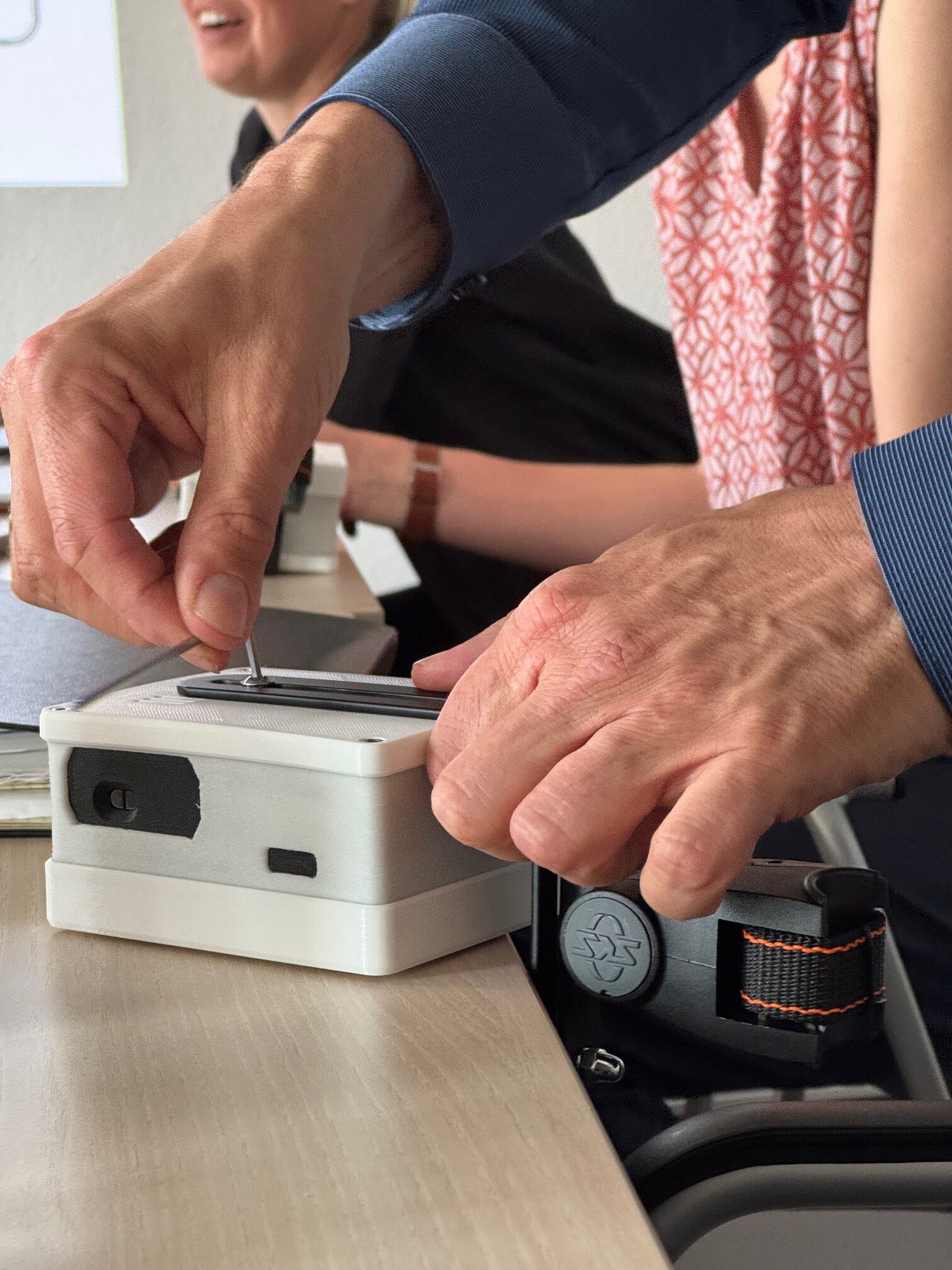
Mobile sensors for cycling data. Photo: City of Greifswald.
The evaluation and data collection pilot combined four main data collection components: traffic counting at an intersection, monitoring of mobile bicycle parking units, monitoring of covered bicycle shelters and sensor-based data collection. Indicators included the number of cyclists and pedestrians, modal split at intersections, rack occupancy rates and user satisfaction levels.
In mobility data collection, innovative and traditional methods can complement each other. The pilot improved understanding of multimodal traffic flows at a complex intersection and confirmed that AI-based video counting provides richer insights with fewer privacy risks, as no personal data are stored. While the pilot did not have a direct behavioural impact, it laid the foundation for improved long-term monitoring of active mobility trends. It also strengthened Greifswald’s capacity for data-driven planning and supported the refinement of future infrastructure investments.

Interactive map showing pilot locations. Use the arrow keys to move the map view and the zoom controls to zoom in or out. Press the Tab key to navigate between markers. Press Enter or click a marker to view pilot project details.
details
-
Homepage
-
Project typeCore Project

-
ImplementationNovember 2023 - October 2026
-
StatusOngoing
-
Contribution to EUSBSRPolicy Area Spatial Planning

-
Target groups
- Local public authority
- National public authority
-
Social media
-
Additional links
-
Tags