




Guidance towards harmonised development of S-100 products in the Baltic Sea Region
09 March 2026
Uniform navigational charts and products are needed to provide the best user experience when navigating through the sea areas of multiple countries. Guiding the way towards this objective, the Baltic Sea e-Nav project has developed harmonisation guidelines highlighting key issues to consider when starting the production of next-generation S-100 navigational products.
When developing the future of navigation through S-100 products, it’s sometimes good to take a look backwards and learn from past experiences. When developing the S-57 standard for Electronic Navigational Charts (ENCs) efforts to harmonise the products between countries were started mainly after their production had already begun. Changing an on-going process can be difficult and therefor it’s important to tackle these issues early by having guidelines to follow before starting production.
It’s here where the Baltic Sea e-Nav project steps in by developing harmonisation recommendations. Altogether, harmonisation guidelines are developed for four S-100 products: S-101 ENC, S-102 Bathymetric Surface, S-104 Water Level Information for Surface Navigation, and S-111 Surface Currents.
Towards a smooth end-user experience
The main objective of harmonisation is to provide the navigator with a smooth and consistent experience when voyaging the sea. But what can the national data producers do to make the experience better and which of these measures are relevant for the Baltic Sea region?
Let’s look at a few examples:
- In the Baltic Sea Region, there is a common agreement to use a specific vertical reference system called Baltic Sea Chart Datum 2000 (BSCD2000). While the solution in this case is simple, it can be a topic requiring consideration in some other sea areas around the world.
- Using similar spatial resolution makes the level of detail in the products uniform. However, making strict recommendations for resolution of the navigational products proved to be challenging. It was noted that it can be practically impossible to commit to a shared level of detail due to, for example, restrictions in data publicity.
- Defining display scale ranges is essential for a user-friendly experience. It becomes especially important if overlapping products of different scales exist.
- Some of the topics considered in the recommendations focus on developing good practices among the data producers, instead of harmonisation as such. An example of this is missing information, or in other words small holes, in the S-102 data. These holes make the S-102 product less usable in navigation systems.
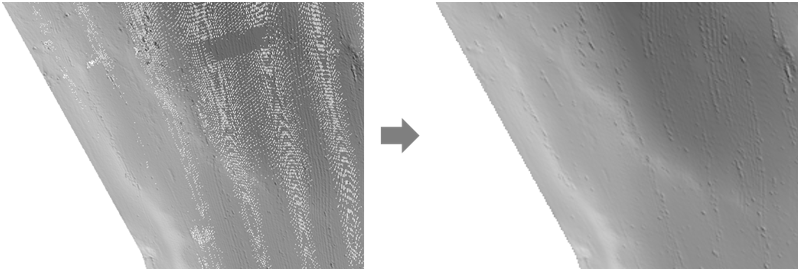
If survey data is not dense enough to support gridding at the selected S-102 resolution level, many small holes will occur. To mitigate this, coarser grid resolution or interpolation (to fill holes) should be considered. Also, the possibility of new surveys and releasing S-102 later should be kept in mind.
As shown by these examples, for some topics more precise recommendations are given while for others it was sufficient to agree that not all topics require such guidelines. A key objective of the harmonisation work was to share experiences and national viewpoints to get an overview of what kind of harmonisation needs there are. Additionally, due to the differences in the four S-100 products it’s important to note that the requirements for harmonisation guidelines between them can also vary, some requiring more precise and strict recommendations than others.
In the end, as shown by the resolution example, each Hydrographic Office knows their products and the national requirements set on them. Therefore, to some extent, the final decisions will always be made at the national level. Regardless, it is recommended that neighbouring countries agree on harmonisation of data coverage and display scales of products at shared borders.
Where are we now
The recommendations developed in the project were presented to the Baltic Sea Hydrographic Commission (BSHC) for approval. For the S-101 and S-102 recommendations the formal steps were made during 2025 to approve the first versions. The drafts of S-104 and S-111 were presented at the BSHC meeting in the autumn of 2025, but they have not yet been approved. The intention is to have them approved in the autumn of 2026.
The developed harmonisation recommendations should be seen as living documents subject to future evaluation and updates. The real test for their usefulness will happen once production starts in the different countries. Working under the BSHC, the Baltic Sea International Chart Coordination Working Group (BSICCWG) is tasked with the monitoring, maintaining, updating and yearly reporting on updates to the S-101 and S-102 harmonisation recommendations in the future. The Chart Datum, Water level and Currents Working Group (CDWCWG) will develop and monitor S-104 and S-111 harmonisation guidelines.
Authors: Vesa Arki (Traficom), Marisofia Nurmi (Traficom), Jarmo Mäkinen (Traficom), Topi Filpula (Traficom)

Additional links
details
-
Homepage
-
Project typeCore Project

-
ImplementationNovember 2023 - October 2026
-
StatusOngoing
-
Contribution to EUSBSRPolicy Area Safe, Policy Area Ship

-
Target groups
- International governmental organisation
- National public authority
-
Social media
-
Additional links
-
Tags