




Telling the GYPREG story...
19 February 2026
BLOG 5. – May 2025: Latvia and where can you get gypsum
At the end of May, our entire GYPREG project group met again, this time in Latvia. Pretty much the main focus of the whole visit to Latvia was exploring different potential sources of gypsum.
In Finland, gypsum is obtained as a by-product of phosphorus fertilizer production. It has been generated in very large quantities for decades, so while the reserves may not be literally inexhaustible, Finland still has an exceptionally large supply. However, this does not solve the gypsum availability issue in the other GYPREG countries. After all, one hectare of farmland requires about 4 tonnes of gypsum. To achieve significant impact means treating thousands of farmland hectares. Even if the gypsum already available in Finland were sufficient, transporting such huge quantities to other countries would be extremely expensive. Also, on a larger scale, emissions from transportation could outweigh the environmental benefits achieved by applying gypsum to fields. Therefore, gypsum sources need to be found closer to the other partner countries.
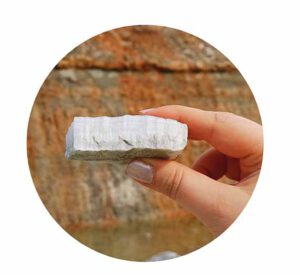
This is why, during our stay in Latvia, we visited two potential gypsum sources. First, on the agenda was a company that manufactures gypsum
© Eija Rantajärvi
boards and also mines gypsum near its production facilities. We toured their gypsum board factory and a gypsum quarry.
The next day, after our meeting, we visited another potential gypsum source: a factory producing various fire safety products. There, gypsum is generated as a by-product of production.
By-product gypsum can be problematic from a legislative perspective in some countries. It may be classified as waste, and legislation typically does not permit spreading waste on fields. Thus, in addition to ensuring through analysis that the gypsum contains nothing harmful, its legal status would need to be changed so that it is no longer considered waste. Many companies producing gypsum as a by-product have tried hard to find reuse options, but the process is far from straightforward.
It also matters what kind of gypsum is spread on fields. If the particle size is too large, it will not perform as well in the soil as more finely ground gypsum. In some cases, by-product gypsum may also contain a lot of water. Transporting water is expensive, and very wet gypsum cannot be spread on fields with existing equipment. In such cases, the gypsum must first be dried, which requires energy and may become costly.
Mined gypsum, on the other hand, is not automatically problem-free. It is not classified as waste, but mining burdens the environment in many ways. According to calculations made in Finland, the climate impact of mined gypsum can be so significant that it may outweigh the water protection benefits. In other words, from an environmental perspective, one might end up solving one problem while creating another. Mining also generates costs that do not arise with by-product gypsum.
These are all issues we evaluate within GYPREG as we study national regulations, gypsum sources, and cost-effective processing and transport solutions in each of our partner countries.
BLOG 6. – October 2025: Spreading gypsum on field and on trays in Åland
As the year was drawing to a close, we gathered once again with the entire project team in Åland — for some of us, the second time that year!
Despite the late season, we still got to get our hands dirty, as we say in Finland — or at least we ended up with plenty of clay stuck to the soles of our boots. On top of our project meeting, we had the chance to observe how gypsum was applied to a local field during a farmer and media event in Åland.
Our colleague from Syke was also there to give a small-scale demonstration, showing everyone how quickly gypsum clears up water on the field — meaning it reduces both phosphorus and suspended solids in runoff t water. So even if water does run off the field, the gypsum helps keep much of the phosphorus in the soil, where it belongs.
Blogs by Sari Väisänen, Finnish Environment Institute (Syke)
See for yourself in the video:

Additional links
details
-
Homepage
-
Project typeCore Project

-
ImplementationNovember 2023 - October 2026
-
StatusOngoing
-
Contribution to EUSBSRPolicy Area Nutri, Policy Area Bioeconomy

-
Target groups
- Interest group
- International governmental organisation
- National public authority
- NGO
- Regional public authority
-
Social media
-
Additional links
-
Tags