




GYPREG’s Circular Economy Solutions at EUSBSR Forum 2025 in Poland
21 January 2026
The Forum brings together decision-makers, experts, businesses, and project practitioners to share solutions that address key challenges facing the Baltic Sea Region. At the 2025 Forum, discussions strongly highlighted the need for practical, scalable circular economy solutions that can reduce pressures on the Baltic Sea while supporting sustainable economic activities.
Circular Gypsum Use to Reduce Phosphorus Runoff
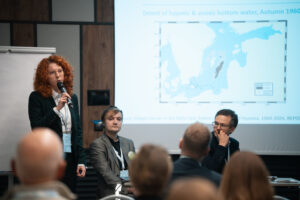
The Business Manager at the Race For The Baltic gives a presentation. © Lukasz Tokarczyk, Pomeranian Voivodeship
GYPREG contributed to these discussions during the “New Circular Economy Solutions” panel, where Aleksandra Najda, Business Manager at the Race For The Baltic, presented the project’s approach to nutrient management and circular resource use. The GYPREG project focuses on reducing phosphorus runoff from agricultural fields, a major contributor to eutrophication in the Baltic Sea. Central to this approach is the use of gypsum as a soil amendment, which improves soil structure and significantly reduces phosphorus losses to waterways.
Importantly, the gypsum used in GYPREG is not a primary raw material, but a waste product or by-product from industrial processes. These include gypsum generated as a by-product of flue gas desulphurisation, gypsum originating from the fertiliser production process, and recycled gypsum from construction and demolition waste. By repurposing these materials for agricultural use, GYPREG demonstrates how industrial by-products can be transformed into valuable resources within a circular economy model.
Strong Interest and Forward-Looking Discussions
The “New Circular Economy Solutions” panel received strong engagement from the Forum participants, reflected in an active discussion and numerous practical questions from the audience. Much of the interest focused on the on-farm application of gypsum, including how its use compares to traditional liming practices, how farmers could be supported financially, and what funding opportunities may be available for wider implementation.

A pile of gypsum ready to be spread on the field. © Eija Rantajärvi
Participants also raised important questions regarding the long-term availability and sustainability of different gypsum sources, particularly in light of the ongoing transition away from coal-based energy production. These discussions highlighted the relevance of using diverse gypsum streams, including industrial by-products and recycled gypsum, and the need to assess their suitability and scalability in different national contexts.
The dialogue at the Forum confirmed the high relevance of GYPREG’s work and provided valuable input for the project’s next steps. The questions and insights shared will continue to shape discussions within the project and guide the development of practical operating models tailored to each partner country, ensuring that GYPREG’s circular solutions are both effective and sustainable in the long term.

Additional links
details
-
Homepage
-
Project typeCore Project

-
ImplementationNovember 2023 - October 2026
-
StatusOngoing
-
Contribution to EUSBSRPolicy Area Nutri, Policy Area Bioeconomy

-
Target groups
- Interest group
- International governmental organisation
- National public authority
- NGO
- Regional public authority
-
Social media
-
Additional links
-
Tags