




ESG Tool at COP30: Baltic Sea collaboration supporting Global Climate Action
20 December 2025
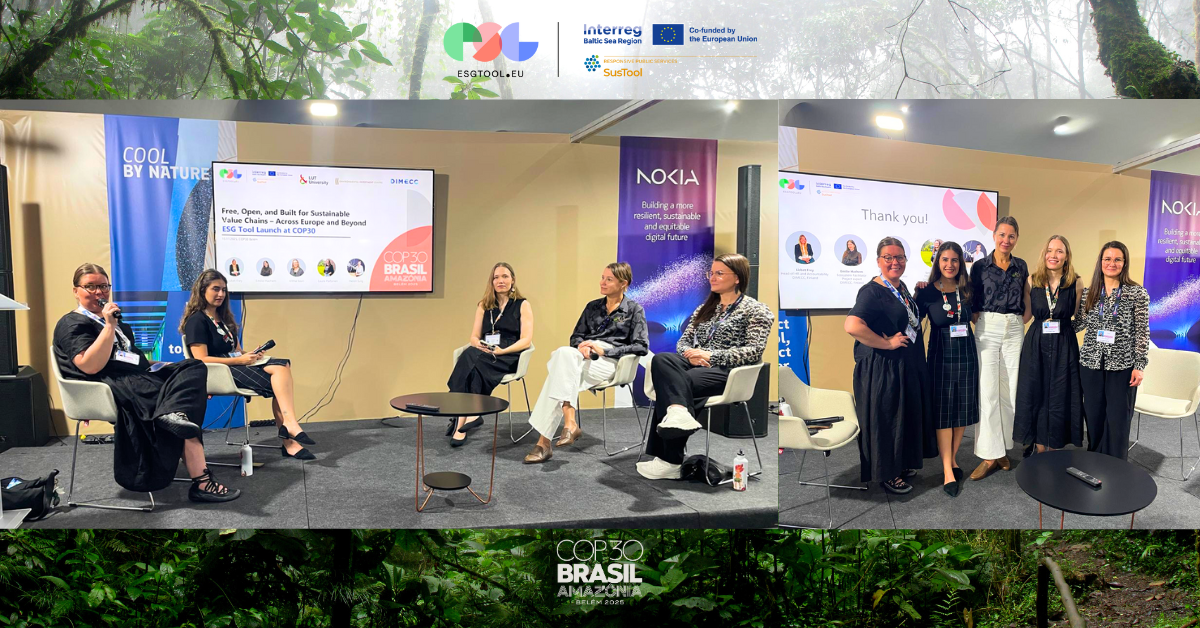
On 15 November 2025, DIMECC presented the ESG Tool at COP30 during a Transfer Seminar hosted at the Finland Pavilion in Belém, Brazil. The seminar was an official activity of the Sustool project and used the Finland Pavilion as a platform to share a concrete European sustainability solution with a global audience.
COP30, the 30th United Nations Climate Change Conference, brought the international climate community to the Amazon region at a time when the need for implementation-driven climate action has never been clearer. The Amazon rainforest, one of the world’s most critical ecosystems for climate regulation and biodiversity, offered a powerful setting for discussions about responsibility, transparency, and real-world solutions.
The ESG Tool responds directly to this global challenge. Developed to support companies in aligning with the Corporate Sustainability Reporting Directive (CSRD) and the European Sustainability Reporting Standards (ESRS), the tool provides a free and open-access, step-by-step approach to sustainability reporting. It helps organisations map their value chains, assess double materiality, identify impacts, risks, and opportunities, and translate sustainability insights into business strategy.
Co-funded by the EU Interreg Baltic Sea Region Programme, ESG Tool is the result of close cross-border collaboration between partners in Finland, Estonia, Latvia, and Lithuania. While rooted in European legislation, the tool addresses challenges that are global in nature. Climate change, supply chain risks, and sustainability impacts do not stop at national borders, and neither do corporate responsibilities.
The Transfer Seminar, titled “Free, Open, and Built for Sustainable Value Chains – Across Europe and Beyond”, highlighted both the technical foundations of ESG Tool and the collaborative process behind its development. The speakers represented the Sustool project team, academic expertise, and public sector engagement.
Lisbet Frey, Head of HR and Accountability at DIMECC, has led the Sustool project implementation in Finland. In her role, she has been responsible for coordinating national project activities and ensuring that the ESG Tool aligns with both regulatory requirements and the practical realities faced by companies. Her contribution emphasized the importance of accountability, governance, and long-term value creation in sustainability work.
Vilma Saari and Emilie Hachem, both part of the Sustool team at DIMECC, played a crucial role throughout the project. They provided hands-on support in the development of the ESG Tool’s functionality and architecture and were actively involved in project activities, stakeholder engagement, and pilot work. Their contributions ensured that the tool remains user-friendly, practical, and closely aligned with the needs of companies using it in real business contexts.
Academic insight was brought to the seminar by Laura Partanen, PhD researcher and Green ICT Project Manager at LUT University. Laura became involved in the project during the pilot phase in 2024, when ESG Tool was tested with ICT companies as part of her doctoral research. Her thesis focuses on sustainability and digitalisation in the ICT sector, making ESG Tool a natural case study. Since then, she has continued to advise the Finnish project team, contributing research-based perspectives on sustainability reporting, digital tools, and double materiality.
From the public sector perspective, Helen Sulg, Head of Chamber of Development and Partnerships at the Estonian Environmental Investment Centre (KIK), shared insights on how public institutions can support the adoption of sustainability tools. As an associated partner in the Sustool project, KIK has contributed policy knowledge and practical experience in supporting companies and value chains in their sustainability transition.
Together, the speakers illustrated how research, public sector expertise, and innovation ecosystems can work together to support companies in responding to sustainability challenges in a structured and credible way.
Beyond compliance, ESG Tool supports broader climate goals. By helping companies understand their environmental and social impacts and assess climate-related risks across their value chains, the tool enables more informed decision-making and stronger climate resilience. This is particularly important for small and medium-sized enterprises, which play a key role in global value chains but often lack access to structured sustainability support.
By lowering the threshold for sustainability reporting and making ESG processes more accessible, ESG Tool contributes to wider participation in climate action. It helps translate high-level commitments under the Paris Agreement and the European Green Deal into concrete actions at company level.
Presenting ESG Tool at COP30 demonstrated how regional European collaboration can deliver solutions with global relevance. As the international community continues to move from climate commitments to implementation, tools like ESG Tool show how transparency, digital innovation, and partnership can turn sustainability reporting into a driver of real climate impact.
To explore ESG Tool and learn how it can support your sustainability journey, visit www.ESG Tool.eu.
Author: Lisbet Frey, DIMECC

Additional links
details
-
Homepage
-
Project typeCore Project

-
ImplementationJanuary 2023 - December 2025
-
StatusCompleted
-
Contribution to EUSBSRPolicy Area Innovation

-
Target groups
- Large enterprise
- National public authority
- Small and medium enterprise
-
Social media
-
Additional links
-
Tags