





Harju County, Estonia
04 September 2025
Harju County is the largest and most populous county in Estonia, housing about 650.000 residents in the northern part of the Baltic country. It is home to Estonia’s capital city, Tallinn. The region blends historical sites such as Tallinn’s medieval Old Town with modern developments and natural beauty, including forests and coastline.
BATS partner Union of Harju County Municipalities (HOL) is a regional body representing the county’s 16 municipalities. That position shapes how HOL worked in BATS: the organisation paired up with associate partner Kiili Municipality to run local experiments on the ground, while also producing knowledge that any municipality in the county (and beyond) could pick up and use. Kiili is a small municipality of around 7,500 inhabitants just south of Tallinn, offering a unique starting point for HOL (a manageable pilot arena in which to test diverse measures).
A big challenge identified by HOL and Kiili is the mobility habits of its schoolgoer population: despite short distances that teenagers could easily cover on their own, Kiili Gümnaasium saw a high volume of “parent taxis”, and cycling all but disappeared once the cold and dark set in. Within BATS, HOL and Kiili tested together the YRAM Toolkit and the Citizen Activation Guide to run its local experiments and overcome their challenges.
Campaign: year-round active mobility in Kiili Gümnaasium
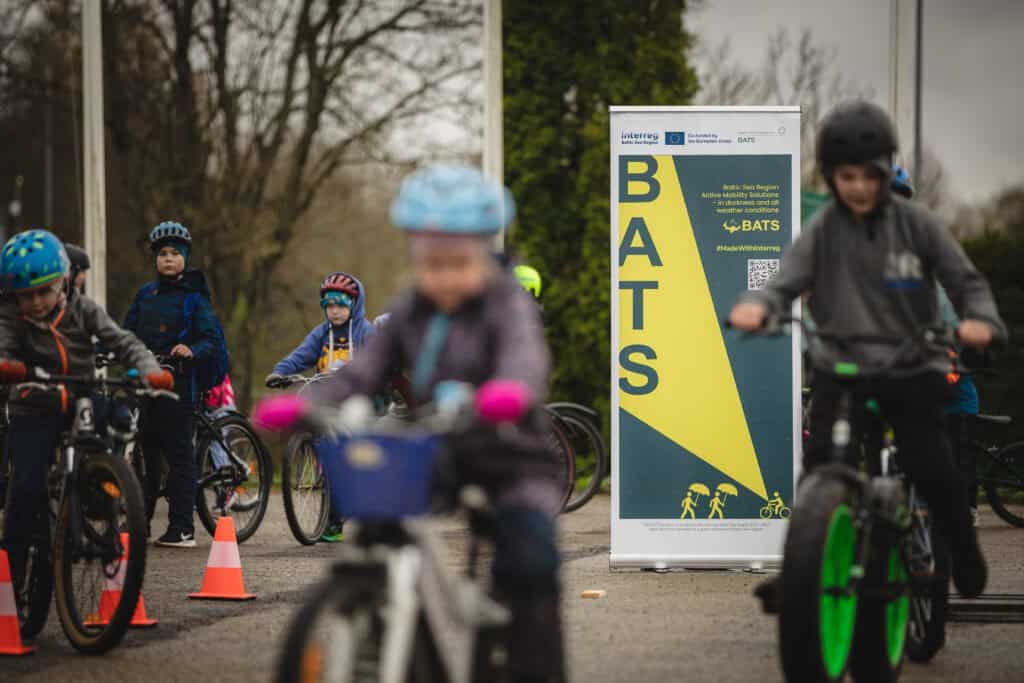
HOL’s flagship experiment, run together with Kiili Municipality and Kiili Gümnaasium, set out to make cycling and walking a normal way of getting to school through the autumn and winter, for pupils from the first to the twelfth grade. Rather than a single action, the two partners assembled a campaign package spread over the colder months, mixing cycling hikes with students, day events with cycling lessons and competitions, bicycle maintenance workshops and a strong local media campaign.
Various elements stand out among the package of campaign activities. A pop-up “bike tuning day” let students buy winter tyres at a steep discount and have them fitted on the spot, removing both the cost and the effort of a trip to a repair shop. A series of events, workshops and bike rides over an extended period helped keep the momentum up when it came to cycling-to-school culture (including competitions, inviting local influencers and other incentivising measures). A multi-channel communication approach ensured the actions reached as many ears as possible (using school intranet, social media, local news outlets, etc.). The municipality also took the opportunity to improve the infrastructure the campaign was encouraging pupils to use, installing an illuminated flashing-light pedestrian sign at the school road crossing, so that the walk to school stayed visible and safe through the dark morning and afternoon hours.
Results & Lessons. The campaign turned winter cycling in Kiili from a rarity into a habit. Bicycle counts in the school car park tell the story: in January 2024 just 5 bicycles were parked among 1,000 students, whereas by January 2026 there were around 50, and on a considerably colder day (around -15°C rather than 0°C). The same pattern shows in the counts across the school year, where the drop from autumn to December softened markedly between the 2024/2025 and 2025/2026 academic years, with a good share of the December bikes now running studded tyres. Feedback from students and parents was mostly positive, with parents particularly appreciating the school’s direct communication.
The wider lesson is that practical, hands-on measures (fitting winter tyres, maintaining bikes) do a great deal to build the confidence needed to ride on snow and ice, and that in a small municipality, changing the habits of schoolgoers can shift the mobility culture of the whole settlement.
A study into winter maintenance design for active mobility
Alongside the work in Kiili, HOL took on a challenge it had identified across the county: municipalities on the “starting” end when it comes to YRAM maturity lacked detailed, practical knowledge of how to design and maintain active mobility infrastructure for winter conditions. In response, HOL set out to investigate existing active mobility infrastructure maintenance around Tallinn, identify the main issues, and gather existing practices from other cities that could easily tackled such challenges gathering the missing know-how into a single reference booklet.
The result is a practical booklet featuring over 100 challenge-driven small interventions for both walking and cycling infrastructure, presented in the form of good practice cards alongside street design recommendations for effective winter maintenance. Because it was produced by a regional body rather than for one city, it is designed to be picked up by any municipality facing the same winter conditions, and it stands as HOL’s most transferable contribution to the project.

Interactive map showing pilot locations. Use the arrow keys to move the map view and the zoom controls to zoom in or out. Press the Tab key to navigate between markers. Press Enter or click a marker to view pilot project details.
Additional links
details
-
Homepage
-
Project typeCore Project

-
ImplementationNovember 2023 - October 2026
-
StatusOngoing
-
Contribution to EUSBSRPolicy Area Transport

-
Target groups
- Infrastructure and public service provider
- Local public authority
- Regional public authority
-
Social media
-
Additional links
-
Tags