




This wrap-up has been compiled by the Programme
Priority 2 Water-Smart societies
Objective 2.1 Sustainable waters
BalMarGrav:
Wrap-up of project achievements
In the south-eastern Baltic Sea, missing gravity data had made navigation and offshore planning less reliable. The Interreg project BalMarGrav brought together national agencies, scientists, and the maritime sector to close data gaps and harmonise gravity measurements, laying the grounds for safer navigation, resilient offshore infrastructure, and smoother sea traffic management.
Highlights
BalMarGrav
Highlights
BalMarGrav
The BalMarGrav project established a transnational network of experts from Denmark, Estonia, Germany, Latvia, Lithuania, Norway, Poland and Sweden. Together, they reprocessed fragmented historical data to create a harmonised set of validated open data products. The project also produced detailed gravity anomaly maps, offering a shared and reliable data foundation for navigation, offshore planning, and sea traffic management.
In a nutshell, the project developed:
- Report on modern marine gravity data for selected areas of the Baltic Sea
- Report on availability and re-processing procedure of the historical marine gravity data
- Report on the homogenized historical marine gravity data of the southern and eastern Baltic Sea
- Maps of gravity anomalies of the southern and eastern Baltic Sea
Download links
Project
Details
Project type
Small project
Project duration
October 2022 – September 2024
Contribution to the EUSBSR
PA Safe
PA Spatial Planning
Budget in million
EURO
Involved
Countries
Lead partner
Project partners





Project Details
Project type
Small project
Project duration
October 2022 – September 2024
Contribution to the EUSBSR
PA Safe
PA Spatial Planning
Budget in million EURO
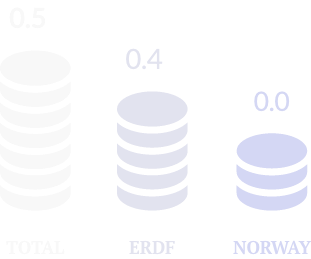
0.5 total // 0.4 ERDF // 0.0 Norway
Involved Countries
Lead Partner: Poland
Project Partners: Latvia // Lithuania // Germany // Sweden // Norway // Estonia // Denmark
Harmonised marine gravity data of the southern and eastern Baltic Sea
Harmonised marine gravity data of the southern and eastern Baltic Sea
The BalMarGrav project had a clear ambition: to bring decades of scattered marine gravity data into a single, reliable source for the Baltic Sea. What once existed as fragmented records in archives, has now been transformed into a unified dataset, ready to serve the needs of sectoral agencies, national authorities, and scientific institutions working with geodetic reference systems, gravity databases, and geoid models.
At the heart of this effort was the recovery of 15 historical marine gravity datasets carefully reprocessed and validated against 16 modern datasets to ensure their accuracy and consistency. The resulting homogenised dataset revives valuable legacy measurements and aligns them with today’s scientific standards. Notably, the revitalised data proved comparable in quality to modern observations, as confirmed by comparisons with regional and global gravity models.
Testimonials
Interreg pays off
Solutions in use & spin-offs
Interreg pays off
Solutions in use & spin-offs
- Future geoid model calculations
- Offshore engineering and renewable energy projects
- Geoscientific research
- Improved navigation and route optimisation, helping reduce fuel use and environmental impact
- Blueprint for revitalising historical gravity data elsewhere
In numbers
17 organisations cooperating across borders
19 organisations directly benefitting from project solutions
Project Wrap-Up
Thanks to Interreg funding and transnational cooperation, the BalMarGrav project significantly advanced knowledge of the Baltic Sea by closing long-standing gaps in marine gravity data. Today, sectoral agencies, maritime and hydrographic organisations, and researchers across the region can rely on a unified dataset that enhances ship navigation safety, supports offshore wind energy, and fuels new scientific and technical innovation.