




Looking Back – Towards the Future
30 November 2025
At WaterMan’s final conference in Kalmar, Sweden, in November 2025, the partners and external guests took time to look back at everything that had been achieved over the course of the project. But sitting back and simply enjoying the moment does not really come naturally to this group of hands-on pragmatists: in conversations on the sidelines of the event, new initiatives and collaborations were already beginning to take shape. A new approach to water management in the Baltic Sea Region is taking shape.
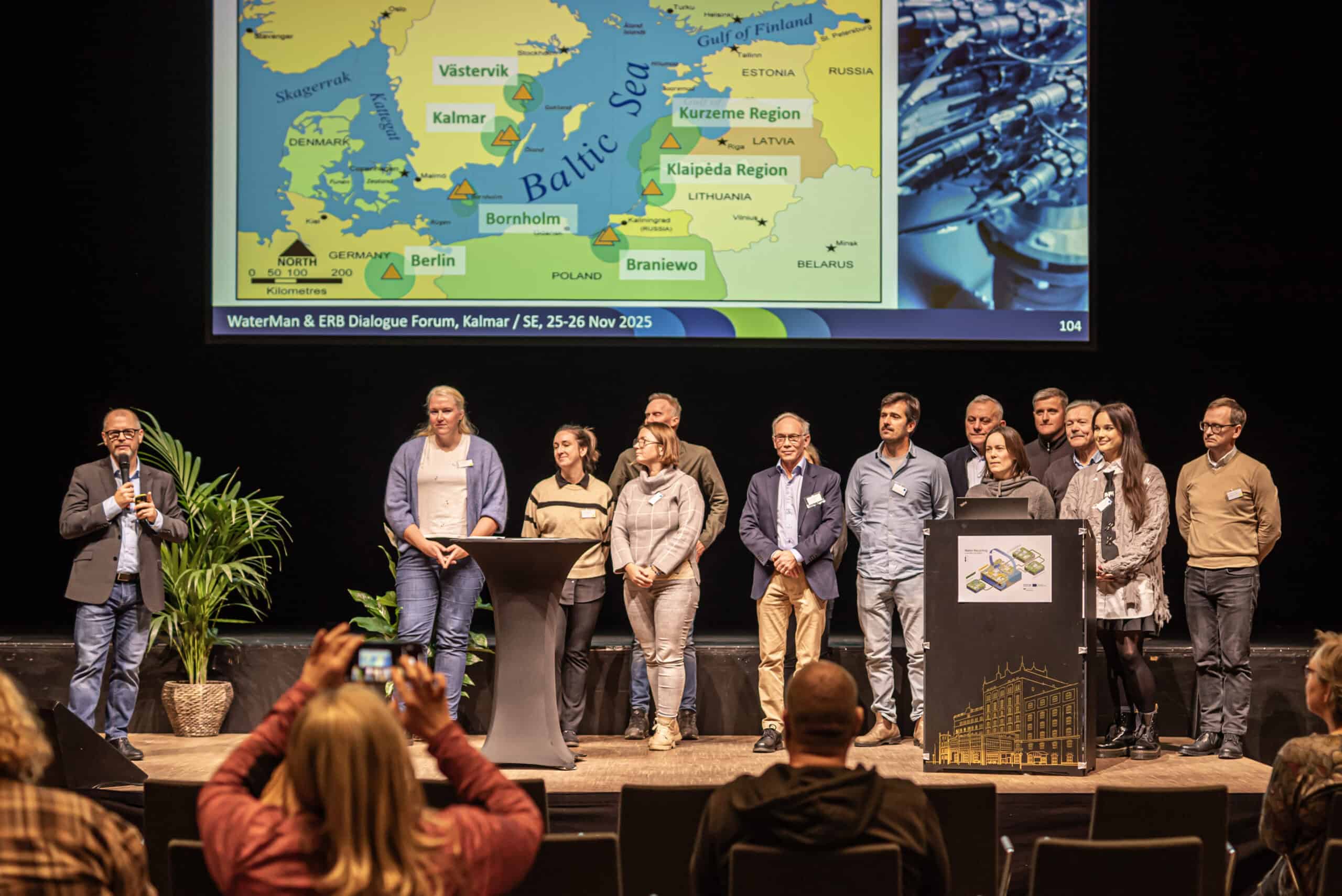 WaterMan’s grand finale is really the starting point for what comes next. The venue, Kalmarsundsalen, where the “WaterMan & ERB Water Core Group Dialogue Forum” is taking place with a number of external guests, is impressive in scale. The imposing venue directly by the harbour puts the project and its results on the big stage one more time – quite literally. The hall can accommodate several hundred people when fully seated.This is the kind of place where heads of state might sign ceremonial agreements or balloons might rain down from the ceiling at the grand finale of an electoral campaign. In a figurative sense, something similar is happening here today – in a form much more in keeping with WaterMan’s solution-oriented spirit: through presentations and talks showcasing the project’s results.
Climate change will hit Central and Northern Europe particularly hard
Lead Partner Tobias Facchini and Project Coordinator Jens Masuch remind the roughly 60 partners and external stakeholders in attendance what WaterMan set out to achieve: to build on proven, readily available technologies and pragmatically add smaller recycling loops to the natural water cycle, thereby easing the pressure on water supplies during periods of scarcity. The organisers are visibly proud as they present the project’s final video: six concrete real-world pilot measures, four feasibility studies and seven regional model strategies have been developed by the 17 partners from six countries over the three years of the project. Together, they provide key building blocks for a new approach to water management in a region that will remain humid, but where the alternation between too much and too little rainfall is expected to become increasingly extreme. For Facchini and Masuch, the fact that this challenge can itself be turned into an opportunity for new solutions is part of WaterMan’s optimistic conclusion. After two years of WaterMan, there is now concrete evidence of what works, along with approaches that can be transferred to other places and regions around the Baltic Sea. Professor Jörgen Forss, a climate researcher at Linnaeus University, then underlines just how urgently these measures are needed. New scientific findings show that Central and Northern Europe will be particularly hard hit by the effects of climate change in the years ahead.
After these sobering facts from climate science, it is reassuring that several further WaterMan contributions follow, showing that there are ways to secure local water supply in the future. Possible courses of action become particularly tangible through the pilot measures and studies presented by host city Kalmar, one of the pioneers of water recycling in the Baltic Sea Region. A new feasibility study is presented for an already installed dual-pipe system designed to supply fit-for-purpose water to the local hospital where it should be used next to drinking water. The audience also hears about the pilot involving a mobile container for UV disinfection of effluent from the local wastewater treatment plant, which has already been used to irrigate green spaces since summer 2024. And, of course, there is great pride in presenting Kalmarsundsverket, the state-of-the-art water recycling plant currently under construction at a cost of around 220 million EUR. It is scheduled to begin operating in 2028 and will then be able to produce different qualities of fit-for-purpose water – including drinking-water quality – from municipal wastewater. So there is clearly a great deal that can be done. But more on that later: tomorrow’s programme includes on-site visits.
What inspires the most hope are the coffee breaks
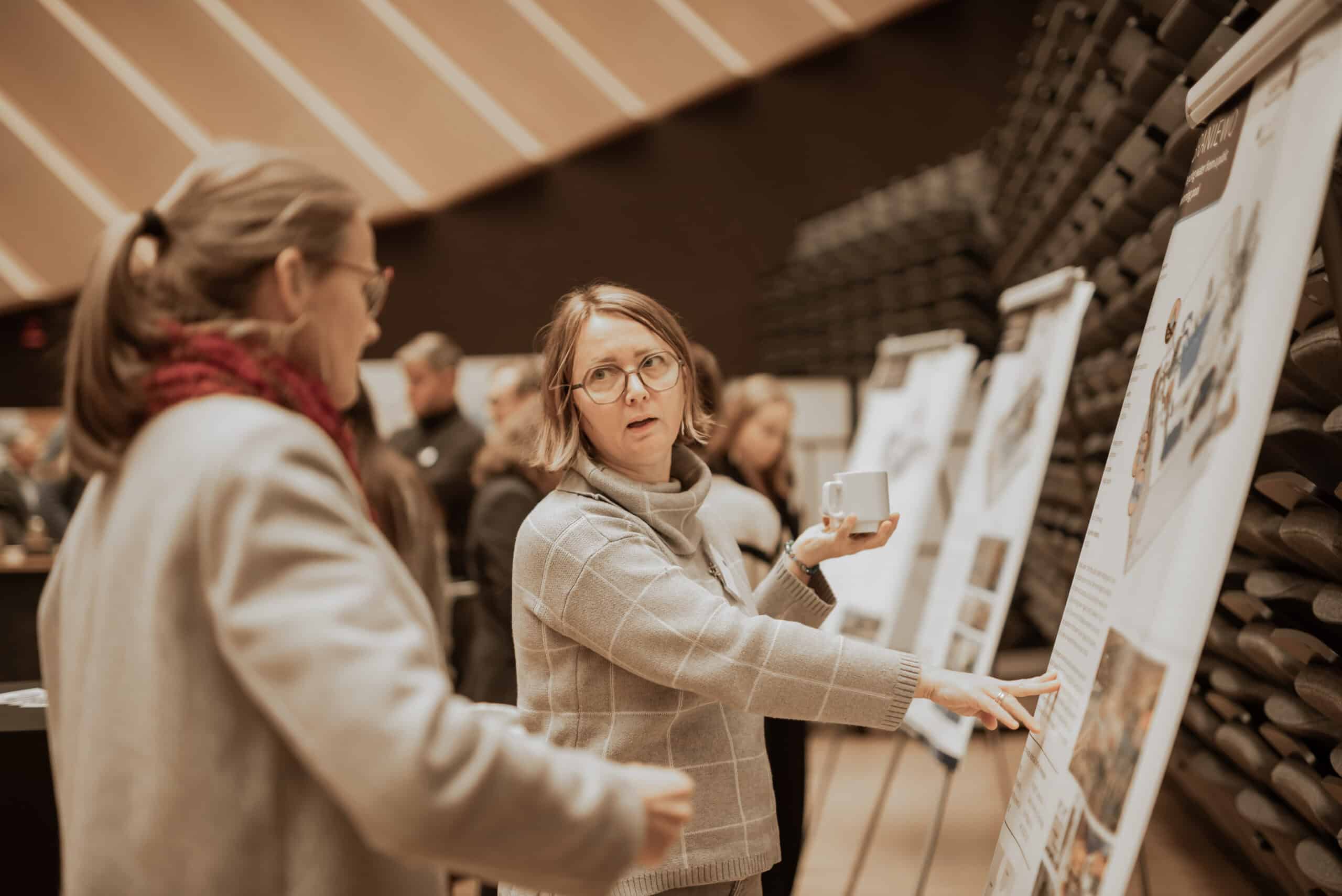
Coffee break with discussions next to the exhibition on the WaterMan pilot measures
What gives the greatest cause for optimism today, however, are the coffee breaks. And that is meant quite seriously. As if they could hardly wait to continue working, WaterMan partners and many of the visitors immediately dive back into discussion: How did you do that? How could we implement this in our region? Have you ever thought about taking the idea further in this or that direction? The large infographics presenting the pilot measures, displayed on stands around the venue, also have exactly the intended effect of providing impulses for conversation.Pairs and small groups gather in front of them for informal technical discussions. The subtitle of today’s event is “Water Recycling in the Baltic Sea Region – Practical Examples and Way Forward”. These exchanges over coffee are quite clearly part of that way forward.
Jens Masuch, who coordinated WaterMan and is co-moderating the event, sums it up: “I have never experienced a project in which so much was achieved in just three years, in such a constructive atmosphere, and with such a strong interest in learning from partners in other countries.” Was it simply the right topic at the right time? “That too. But above all, we had exactly the right people involved. In many ways, all you had to do was regularly bring these practitioners and experts together in one big room and let them get on with it.” Ideas and pilots almost seemed to take shape by themselves. The task now, Masuch says, is to spread these new approaches to water recycling throughout the Baltic Sea Region with exactly the same spirit. That is why the most important success story of the day is, in fact, how well the partners and many external visitors have connected and shared ideas. “Opportunities to meet the hands-on experts of the WaterMan project team in person for hands-on advice on how to get started” – that is how the programme described it. And that is exactly what happened.
Everyone wants to see everything – a logistical challenge
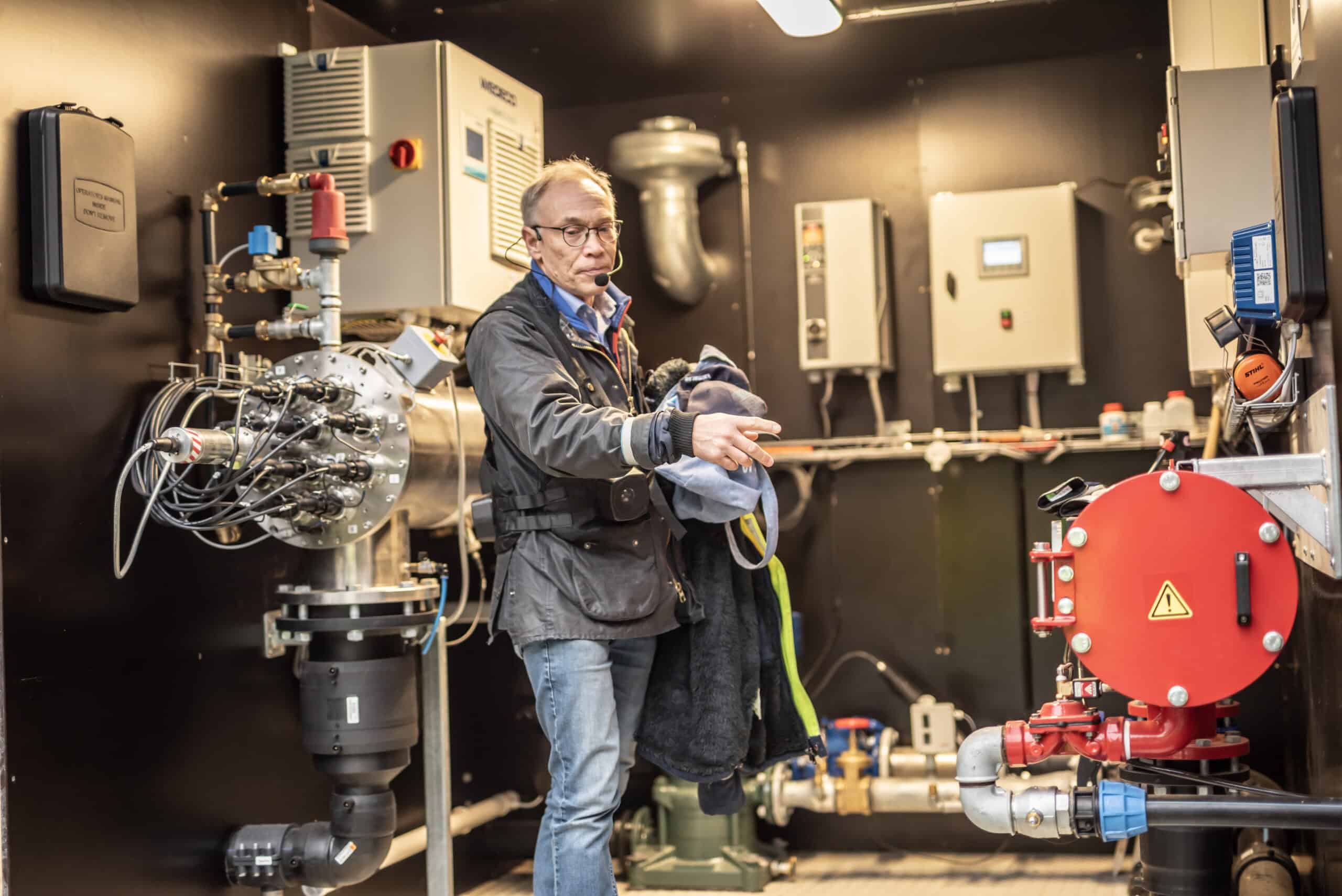
Klas Eriksson from Kalmar Municipality explaining how the mobile container for UV desinfaction of water works
Another important lesson from the project is this: presentations, infographics and explanatory videos are useful, but joint on-site visits are even better – and particularly effective at sparking new ideas. This has been demonstrated time and again during the many joint review visits to pilot measures as part of WaterMan’s peer-learning meetings in six countries, as well as on study trips to Murcia in Spain, a region that has suffered from drought for decades, and to the humid pioneering regions of Flanders in Belgium and Zeeland in the Netherlands. That is why the second day of the final partner meeting features several such on-site visits. After all, the Swedish project partners – both in Kalmar and in neighbouring Västervik – have a wealth of practical examples of successful water recycling to show. Most participants have already heard and read a great deal about the pilots. But being on site and talking directly to the hands-on experts regularly leads to new questions and new insights.
At 8 a.m. the following morning, it is time to set off. More than 50 people are waiting expectantly. Ahead of the event, participants had been asked which of the possible on-site visits in Kalmar interested them most. In fact, everyone had ticked everything: the construction site of the new water recycling plant, the mobile container, and the municipal hospital with its dual-pipe system. For Masuch and Facchini, this created a very real challenge: there was only one bus and one morning available. So, working late into the night, they devised an intricate schedule and logistics plan so that a blue group and a yellow group – Sweden’s national colours – could rotate between the different sites using the same bus and still manage to see every pilot.
The best questions and insights emerge in conversation on site
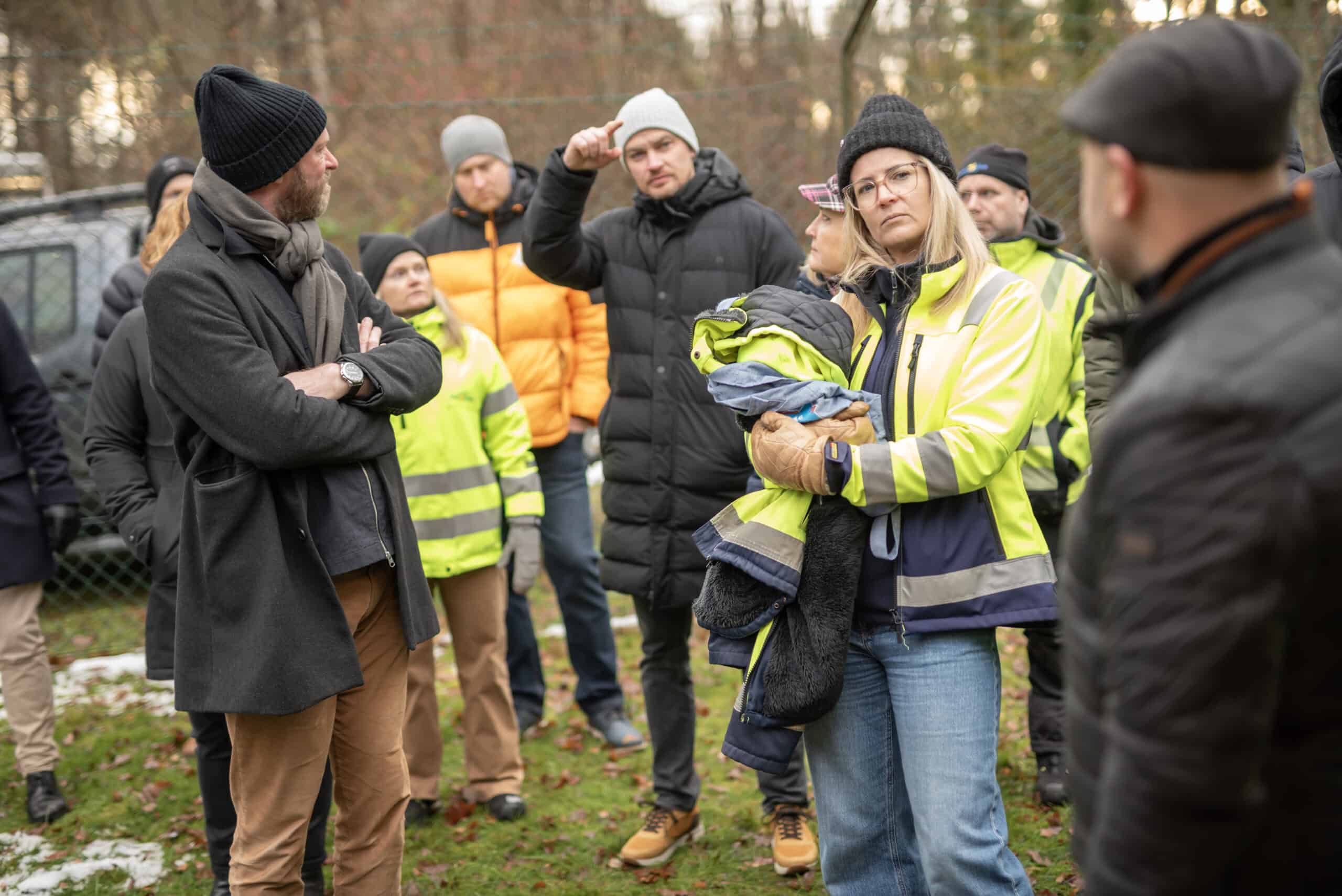
Discussions with the supplier in front of the mobile container
The effort pays off. During an open discussion between the blue group and Klas Eriksson in front of his “baby”, the mobile container for UV disinfection of water from the wastewater treatment plant, one fact becomes clear: this technology has already been used in agriculture for more than ten years. Those who still had doubts about its reliability were likely reassured by that. What is more, anyone interested has the chance to speak directly to the supplier, who is also present today. Tommy Bengtsson from Blekinge Bevattning och Energi AB confirms that he would be happy to supply the turnkey system internationally. The hospital visit is another eye-opener. As the group walks through the building’s underground infrastructure, it is confirmed that the second pipe network for fit-for-purpose water could, in principle, be put into operation tomorrow. One question remains unresolved, however: how will the water from the new water recycling plant Kalmarsundsverket actually reach the hospital? The group learns that one option under consideration is to install a new water pipe inside an existing old pipeline for large parts of the route. This would significantly reduce both effort and costs. At the final stop of the tour – the new water recycling plant itself – there are further insights to take away. Equipped with safety shoes, helmets, headsets and protective glasses, the blue group makes its way across a site the size of three football pitches and can see for themselves: although Kalmarsundverket is still officially a construction site, it already looks almost complete. There is even a facility for low-odour processing and packaging of sewage sludge as a raw material for biogas production – and that, too, is already in place. If WaterMan is about developing pragmatic solutions using existing technologies across a spectrum from low-tech to high-tech, then this visit has clearly reached one end of that scale. The visitors’ approving nods speak for themselves.
By lunchtime, everyone has already taken in a huge amount of information and impressions. The subsequent 140-kilometre bus journey north along the coast to Västervik comes at just the right time, giving everyone a chance to process it all while looking out over snow-covered Swedish forests. Once in Västervik, however, there will be no time to lose yet again. By late November, darkness falls early in the afternoon at these latitudes, and there is still plenty more on the programme. Even so, upon arriving at a newly created stormwater retention pond, time is made for a brief musical interlude. Akko Karlsson, who supports the WaterMan pilots on behalf of Västervik’s municipal housing company, begins by singing the Pippi Longstocking song for the group. Exactly 80 years ago today, Astrid Lindgren’s famous children’s-book character was created. Even at a transnational project meeting, there has to be a moment to celebrate a Swedish national icon with worldwide appeal.
Peer learning pays off – even between neighbours
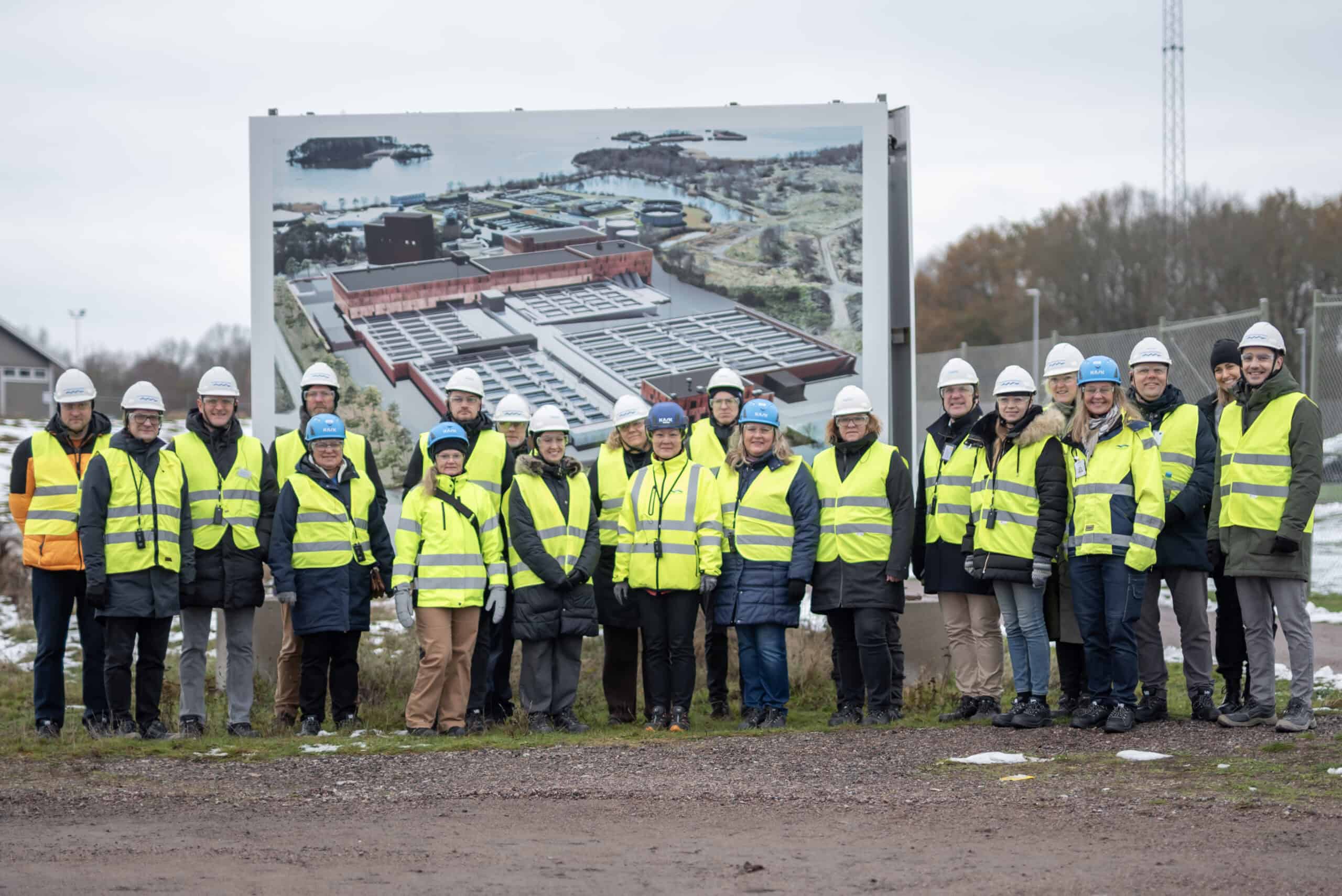
The „blue group” at the construction site of Kalmar’s new water recycling plant Kalmarsundsverket
The next stop is another example of Swedish ingenuity with the potential to travel well beyond its borders: the “next-generation multi-dams”. Their development over the past few years has been a process of one idea leading to another, and one insight building on the next: how can a proven tool – retention ponds for flood management – be developed further, using existing resources, into an effective asset for water recycling? It started with larger stormwater retention ponds that were equipped for the first time with abstraction points for fit-for-purpose water. The concept then evolved towards a growing number of smaller ponds located closer to potential users: industrial companies, a snowmaking facility for a popular cross-country ski trail, municipal works depots, sports facilities and others. Transporting water over long distances by tanker truck to users had quickly proved to be a major cost factor. Locating smaller ponds closer to users was a way of reducing those costs significantly. The team also began consulting historical maps to identify locations where natural ponds and wetlands had existed hundreds of years ago, before being drained for agricultural use. Even today, the soil in such places is particularly well suited to retaining water naturally. This means that when such “mini multi-dams” are constructed there, expensive rubber pond liners are often unnecessary.Ingela Karlsson and Anders Fröberg, who are responsible for water recycling at Västervik Municipality and its utility, stand in bright yellow reflective jackets in the gathering dusk in front of the multi-dam in Kastorp, explaining all of this to their interested audience. Even water recycling expert Klas Eriksson from Kalmar still has plenty of questions. Peer learning pays off – even between neighbours.
With just a slight change of lyrics: ABBA’s “Waterloo”
That is enough for one day. The WaterMan partners now gather for one final dinner together at a hotel surrounded by water on an island in the archipelago off Västervik. The hotel belongs to ABBA’s Björn Ulvaeus and offers yet another showcase for water recycling: it has its own seawater desalination system to meet its water needs. The beautiful setting inspires Akko, the group’s enthusiastic singer and guide, to break into another song: ABBA’s ‘Waterloo’. With just a small change to the lyrics, it could easily become the project anthem. And with that, it is finally time to celebrate.
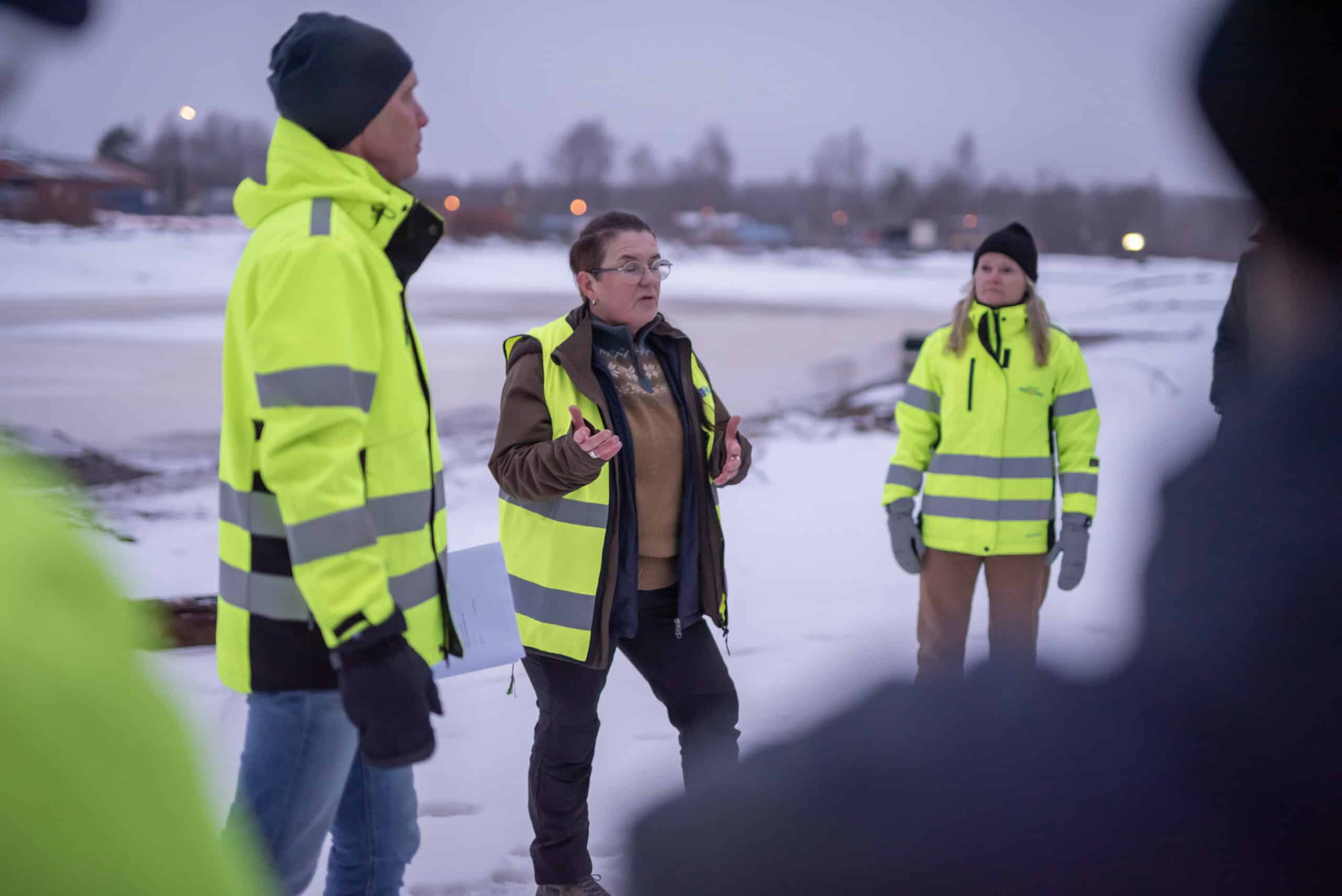
Anders Fröberg, Akko Karlsson & Ingela Karlsson in front of the „next-generation multi-dam” in Västervik-Kastorp
Tomorrow, there will be one final internal partner meeting as well as a joint look at the digital “BSR Water Recycling Toolbox” and the Helpdesk. Through these platforms, the partners will continue to make their solutions available to other municipalities across the Baltic Sea Region. They will also remain available as ‘hands-on experts’, offering practical advice based on their own experience to other municipalities across the Baltic Se a Region in the years ahead – well beyond the project’s formal end on 31 December 2025. After all, what does ‘the end’ really mean for a project whose real impact will only become fully visible in the future?
About the “WaterMan” project
Due to climate change, periods of drought are becoming more frequent in the Baltic Sea Region and drinking water, which is mainly obtained from groundwater here, can get scarce in certain periods. For that reason it will be necessary to use water of different qualities and to tap into other sources of “usable water” in the future. “WaterMan” supports municipalities and water companies in adapting their strategies. A region-specific approach to water recycling uses the alternation of too much and too little water, which has become typical in the Baltic Sea Region, to make the local water supply more resilient.

Additional links
details
-
Homepage
-
Project typeCore Project
-
ImplementationJanuary 2023 - December 2025
-
StatusCompleted
-
Contribution to EUSBSRPolicy Area Nutri

-
Target groups
- Infrastructure and public service provider
- Interest group
- Local public authority
- National public authority
- Regional public authority
-
Social media
-
Additional links
-
Tags