




Fish Duckboards – Testing a New Method for Pike Spawning Habitat Restoration
09 April 2026
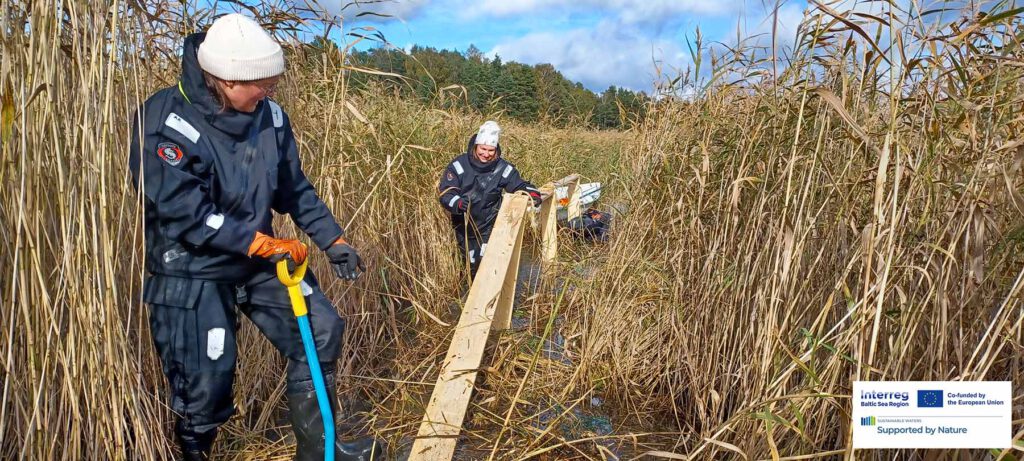 The fish duckboards are anchored to the bottom of the reed bed with the vertical planks (shown in the image) which are pressed into the ground. Photo: Heli Kanerva-Lehto
What are Fish Duckboards?
Fish duckboards are handcrafted wooden structures installed on the bottom of a reed bed to create a swimming route for fish toward their spawning areas. The structures are designed especially for pike, but the same principle can be applied to other species that need access to sheltered spawning areas.
Basic Concept
- The structures consist of rough-sawn planks (150 mm wide) tied together.
- At each connection point, an approximately 1.5-meter-long anchor plank is placed perpendicular to the duckboard and pushed into the bottom of the reed bed.
- The planks are tied together with natural rope, making the structure entirely biodegradable.
- Construction can be done by a small volunteer team using simple tools: drill, saw, knife, sledgehammer, shovel.
Fish duckboards can be preassembled as modules on land and transported into the reed bed for installation. Before installation, the clearest route from the sea to the spawning area—such as an old, overgrown channel — is identified. If necessary, roots can be removed with a shovel or hoe to ensure sufficient water depth.
The structures are designed to be left in nature to decompose after their use, reducing environmental impact and maintenance needs.
Instead of traditional channel excavation, fish duckboards can provide a cost-effective and environmentally friendly alternative. Materials—rough-sawn planks and natural rope—are inexpensive, and the work can be carried out by volunteers. The method may also be suitable for areas where digging is not permitted or otherwise impractical. Fish duckboards are suitable for areas where the water depth is sufficient for fish to pass through the area.
Fish duckboards Tested in Practice
In Kimitoön, at the Sjölax Gård estate, pike spawning habitat restoration was carried out in 2024, with an extension done November 2025. As part of the Sjölax restoration work, fish duckboards are being tested; different fastening options are being developed, and their winter durability is being studied. A total of 50 meters of fish duckboards has now been installed in the restored pike spawning areas.
In spring 2026, the presence of young pikes, breeding birds, and the functionality of the structures will be monitored. The findings will guide further development of the method.
Artificial intelligence was used in editing this text.
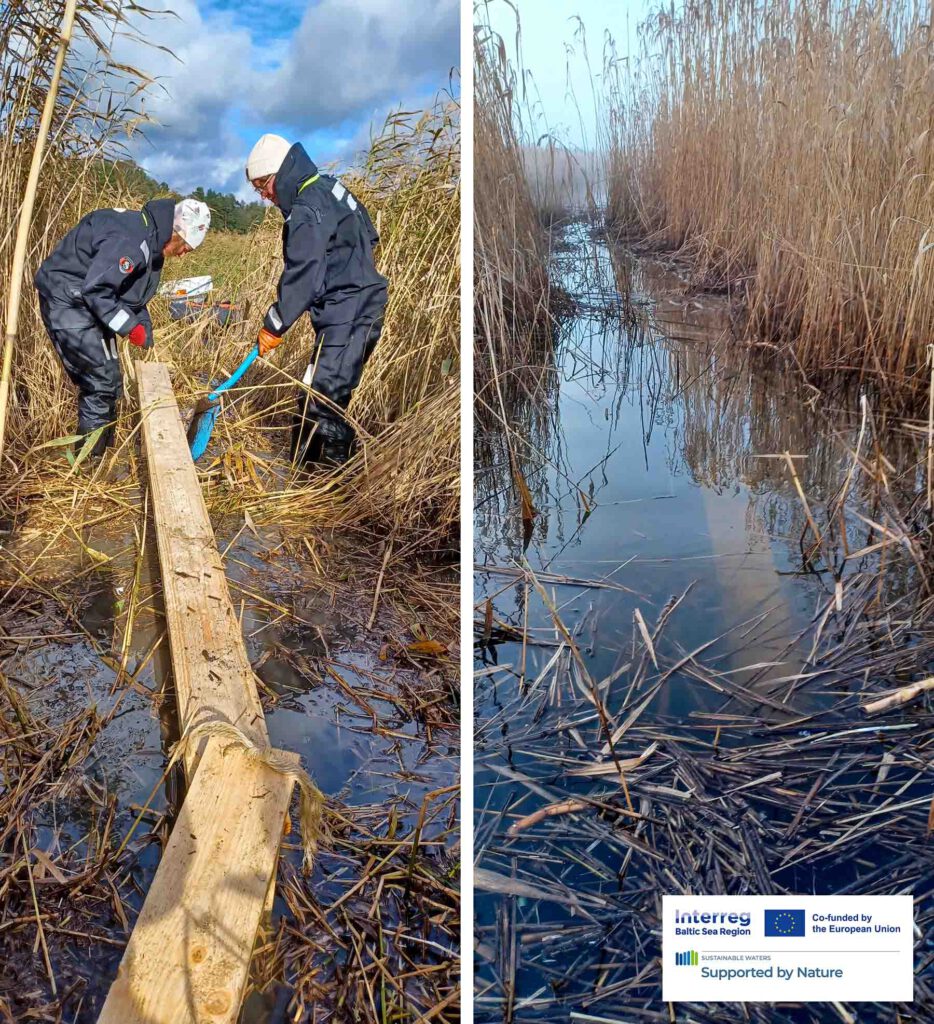
When installing the fish duckboards, roots can be removed, for example with a shovel. After installation, the fish duckboards remain submerged. Photos: Heli Kanerva-Lehto (edited)

Additional links
details
-
Homepage
-
Project typeCore Project

-
ImplementationNovember 2023 - October 2026
-
StatusOngoing
-
Contribution to EUSBSRPolicy Area Nutri

-
Target groups
- Higher education and research institution
- Interest group
- Local public authority
-
Social media
-
Additional links
-
Tags