




Sarkandaugava Swap Shop: Where Things Get a Second Life
10 September 2026
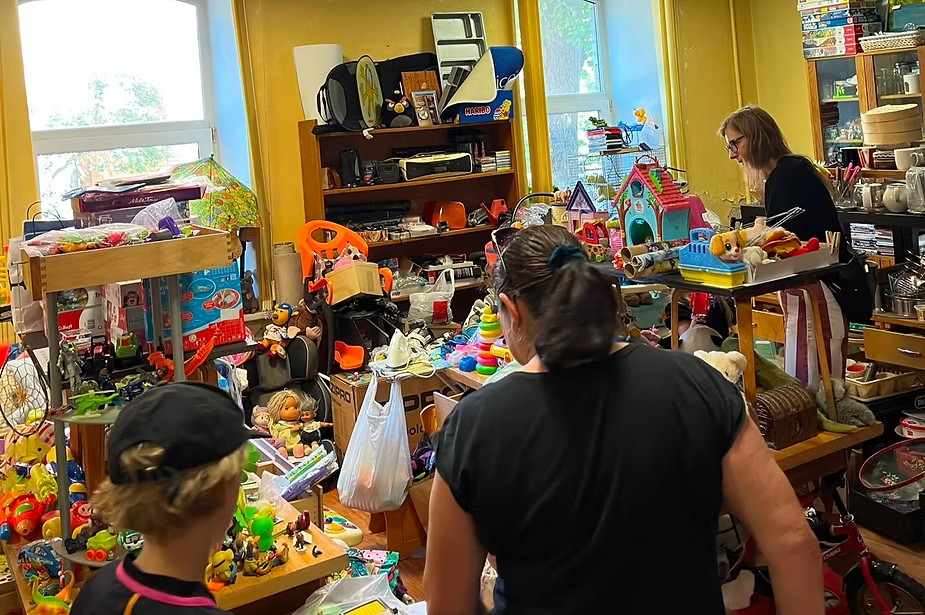
In Sarkandaugava, Riga, an old schoolroom has found a new purpose. Filled with skates, puzzles, dishes, toys, books and countless other everyday objects, it has become a place where things get a second life. Welcome to the Sarkandaugava Swap Shop.
On a Tuesday evening in Sarkandaugava, you can walk into a former schoolroom and find yourself surrounded by things that, not long ago, belonged to complete strangers.
A pair of rollerblades. Puzzles and board games. Cups and plates. Children’s clothes. Tools. Books. Fancy hand bags. Small electrical appliances. It looks a little like a jumble sale, except there are no price tags and no cash register.
This is the Sarkandaugava Swap Shop and here the most important currency is not money but usefulness.
The idea is disarmingly simple: bring something you no longer need, and you may find and take something you need. Or simply leave an item behind for someone else. And if you happen to arrive empty-handed, you can still ask whether there is something you can take.
One room, one idea
The swap shop began in spring 2025, when Sarkandaugava Community Centre, eS14 entered the premises of a former school. The idea came from one motivated person – Andrejs Ļebedevs. The idea had germed in his mind for some time. He saw the space as an opportunity to create a place where objects could keep circulating, having a new life and new owners.
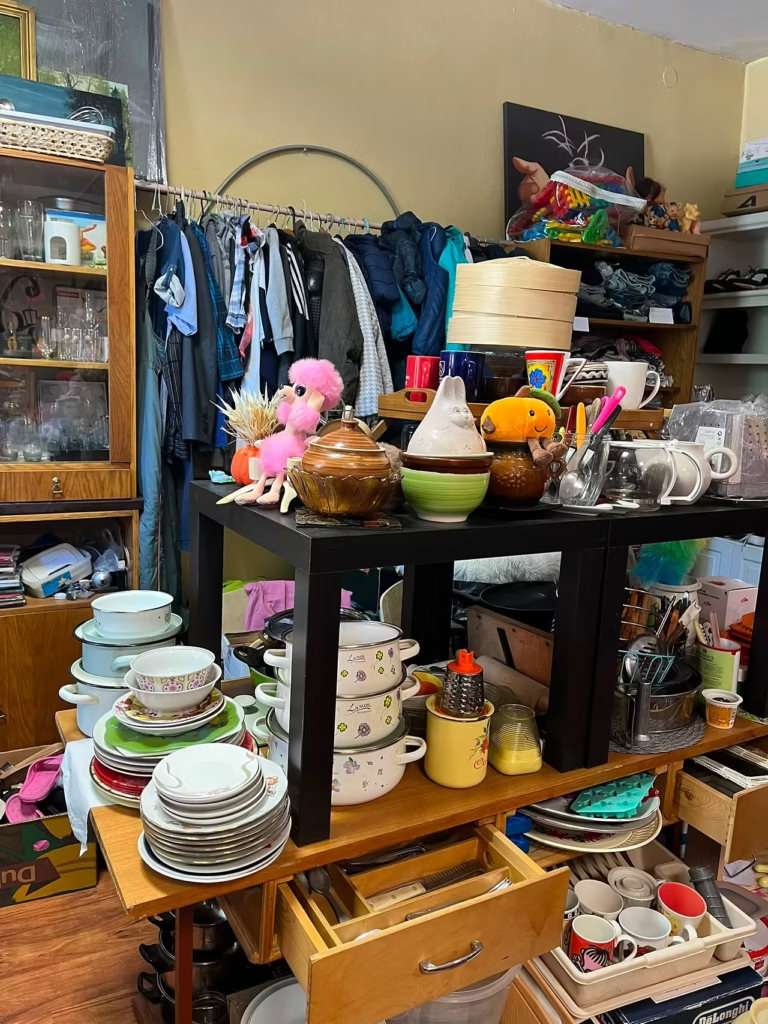
Over time, Andrejs was joined by another volunteer, Jolanta. Together, they now keep the swap shop running, spending their own time sorting donations, organising the shelves and being there when visitors arrive.
What can you find there?
Almost anything that might be useful in everyday life.
Children’s clothes and shoes, toys, sports equipment, dishes, household items, tools, small electrical appliances, educational and practical books — the selection changes constantly as new things arrive and others leave with their new owners.
You can come looking for something you need, bringing another useful item to exchange. You can also simply drop off things you no longer need, even if you are not looking for anything in return.
And sometimes, you can come empty-handed and still find something useful. Visitors are welcome to ask what can be taken without an exchange.
Making the exchange fair
The swap shop has not always worked exactly as it does today.
Initially, there was no points system. This occasionally resulted in some visitors taking many of the most valuable items without leaving anything of comparable value in return.
The points system was introduced to make the process fairer.
When someone brings an item, it is assessed and assigned a number of points. The value depends on what the item is, its condition, what is already available at the swap shop and how much demand there is for it. The points can then be used to choose other items available at the time.
It is not about putting a price tag on everything. Rather, the system creates a simple way of keeping the exchange balanced and preventing the most desirable things from disappearing all at once.
Of course, not everything can be accepted. Items should be clean and in good enough condition to be useful to someone else. The basic rule is simple: if you wouldn’t be happy to receive it, don’t bring it.
The bigger idea: buy less, waste less
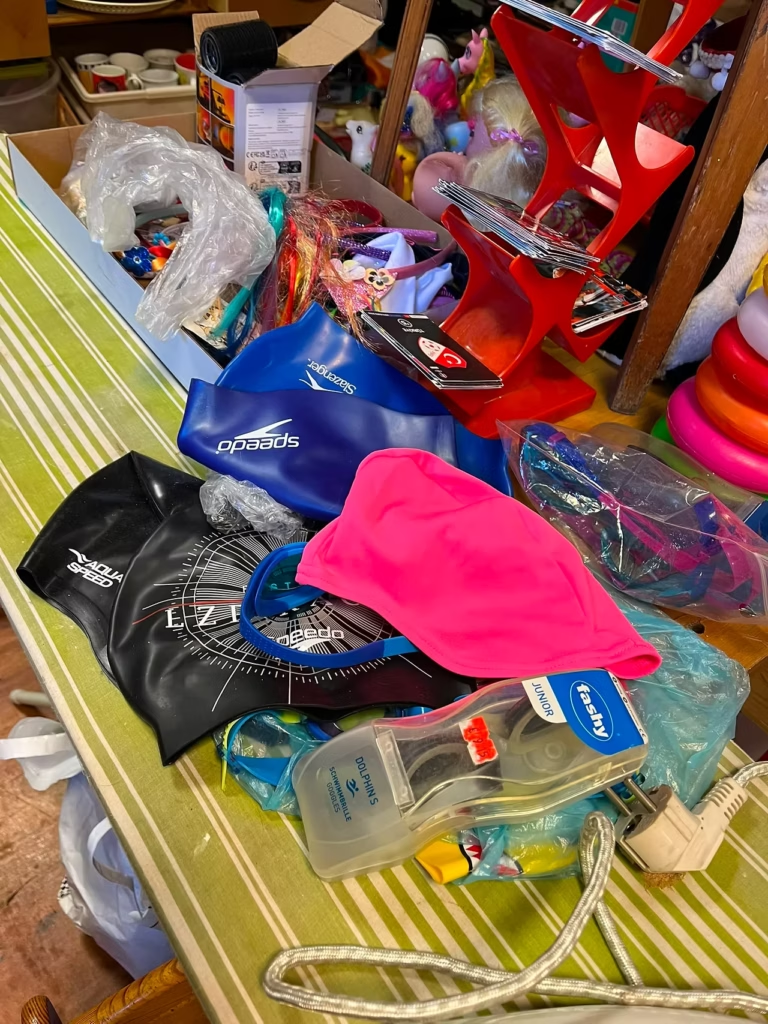
Behind the cheerful chaos of the swap shop lies a serious environmental idea.
The goal is not simply to find a new home for unwanted objects. It is to reduce the number of new things we buy and, as a result, reduce the amount of waste we generate.
Before buying something new, why not check whether you can find it second-hand?
And before bringing something new into your home, it is worth asking another question: Is there something I already own that I no longer use?
Instead of allowing cupboards and storage rooms to fill with things that are rarely used, we can let those objects move on to someone who needs them.
After all, a perfectly good pair of rollerblades sitting unused in a cupboard is not doing anyone much good. In the hands of another person, they could become part of a summer adventure. And sometimes, that is all “waste” ever was: something useful waiting for the right person to find it.
That is the essence of the swap shop: keep things in circulation for as long as possible. It is a modest change in behaviour, but multiplied across a community, it starts to look rather different.
Not just about waste
For Evija Ozola-Ozoliņa, head of the association Zero Waste Latvija, initiatives like this have value that goes far beyond waste reduction.
“This is a great initiative, and hopefully there will soon be many more places like this, both in other neighbourhoods and in other cities,” she says. “Sometimes all it takes is one enterprising person and one space to start something wonderful.”
And Sarkandaugava is far from the only place where this is happening.
In Trikāta, local women have created their own “mantu kambaris” — a place where people can pass useful things on to others. In Līvāni, young people are involved in a similar initiative, while in Pelēči, Preiļu municipality, a socially active local worker has helped establish a place for exchanging things. Libraries and community spaces in other parts of Latvia are also taking on similar roles.
A map of places where people can exchange or reuse things can be found on the platform Lieto vēlreiz.
For Evija, these initiatives have another important benefit: they can help people live better with fewer financial resources.
“Such places not only reduce the amount of waste, but also create opportunities for people to socialise and allow many of us to live more comfortably, because things we need in everyday life are available for free,” she explains.
Part of a bigger European movement
Swap shops are not a uniquely Latvian phenomenon.
Across Europe, swap shops, free stores, libraries of things and reuse centres are increasingly becoming part of the circular economy.
Their formats vary. Some focus on clothing swaps or book exchanges. Others allow people simply to give things away or take what they need. Larger reuse centres may collect unwanted goods, inspect them, repair them and put them back into circulation.
The underlying principle remains the same: a product does not necessarily become waste simply because its first owner no longer wants it.
The European Commission also promotes sharing, clothing swaps, repair initiatives and other forms of reuse as everyday ways to support the circular economy, extend the useful life of products and reduce the need for new purchases.
The Sarkandaugava Swap Shop may be small by comparison, but the principle is exactly the same.
Could you start one?
According to the people behind the Sarkandaugava initiative, the formula is surprisingly straightforward. The model is low-tech.
First, you need a space. It could be a room provided with support from a municipality, or space in a community centre, library, association or another local organisation.
Then come the practical things: shelves, hangers, tables and storage boxes. These do not necessarily need to be bought. Second-hand furniture can often be found through local online groups and classified ads, or donated by people in the neighbourhood.
But the most important ingredient is people.
One enthusiastic person can get things started. A small team makes it much easier to keep the place organised, sort incoming items and make sure visitors can actually use the space.
You do not need a complicated business plan or a large investment. You need a place, some basic rules and people who believe that things deserve more than one life.
Visit the Sarkandaugava Swap Shop
The Sarkandaugava Swap Shop is located at the eS14 Community Centre, Sīmaņa Street 14, Riga. It is open on Tuesdays from 19:00 to 21:00, as well as during selected community events and celebrations.
The eS14 Community Centre also hosts the Lietu bibliotēka (Library of Things), run by Zero Waste Latvija, where visitors can borrow a range of useful items free of charge.

Additional links
details
-
Homepage
-
Project typeCore Project

-
ImplementationMarch 2025 - February 2028
-
StatusOngoing
-
Contribution to EUSBSRPolicy Area Innovation

-
Target groups
- Interest group
- Local public authority
- NGO
- Small and medium enterprise
-
Social media
-
Additional links
-
Tags