




Who Plans the Coast? Baltic PlaNet Workshop in Lääne-Harju Maps How National and Local Levels Work Together
08 October 2026
When the sea erodes a beach, it does not stop at the border between two municipalities. Planning for the coast in Estonia, however, is organised by administrative borders. So who is responsible for the coast as a whole? This was the question at the heart of a Baltic PlaNet workshop held on 8 October 2026 in Lääne-Harju Parish, on the Estonian coast.
Representatives of coastal municipalities, national ministries and agencies, the county association and research partners spent the day working together. The workshop was organised by Lääne-Harju Municipality, Tallinn University and the Climate Service Center Germany (GERICS), part of Helmholtz-Zentrum Hereon.
The starting point: who looks after the scale in between?
In Estonia, the state sets the rules for planning, while municipalities feel the effects of storms, floods and erosion and are responsible for local plans. Between the two sits the regional scale, which has no single, clearly designated owner: county governments were abolished in 2018, and municipal associations can bring people together but cannot make binding decisions. Whether this matters for coastal climate adaptation, and what, if anything, should be done about it, is an open question. The workshop set out to explore it together rather than to give a ready-made answer.
What we did
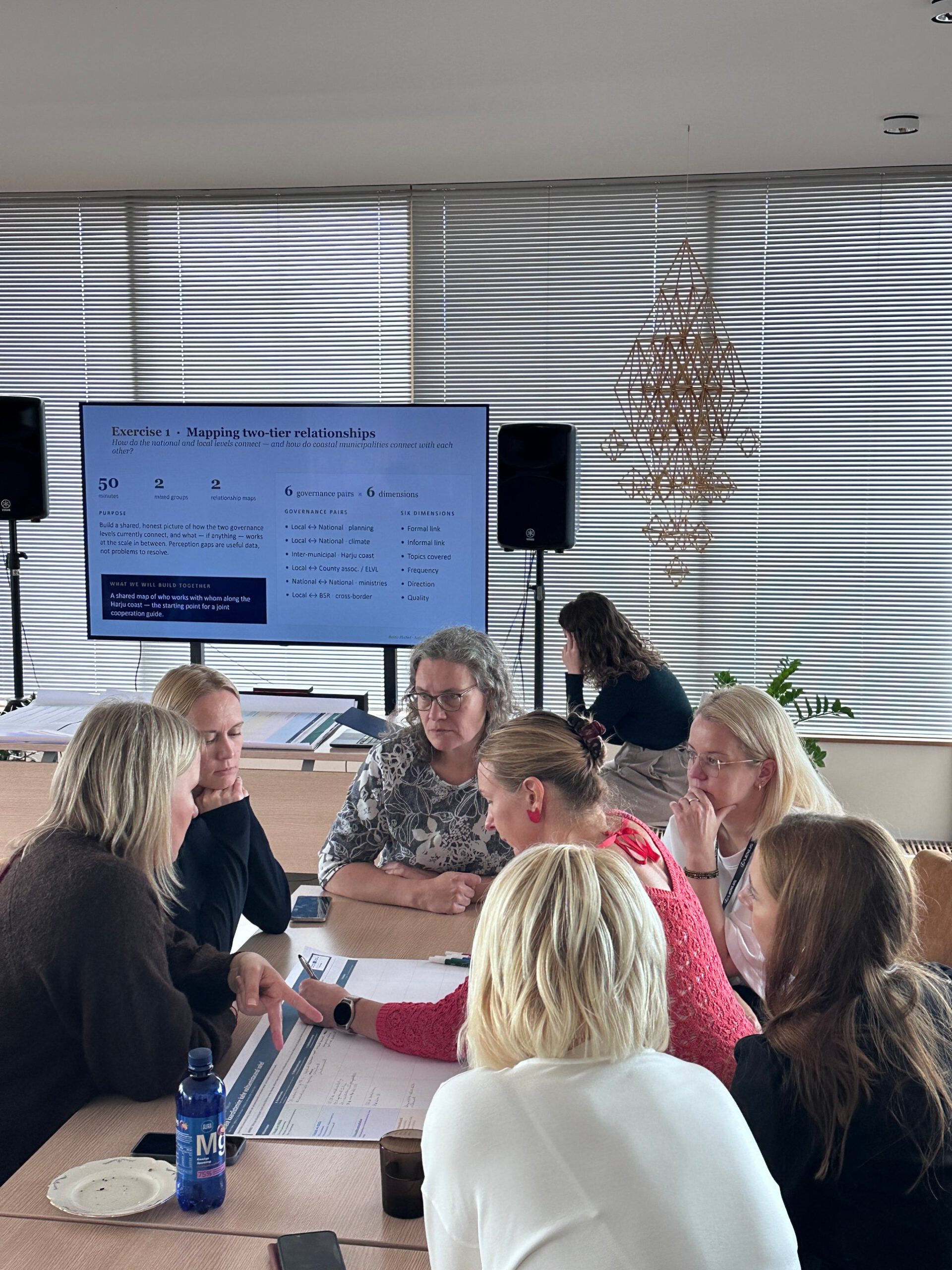
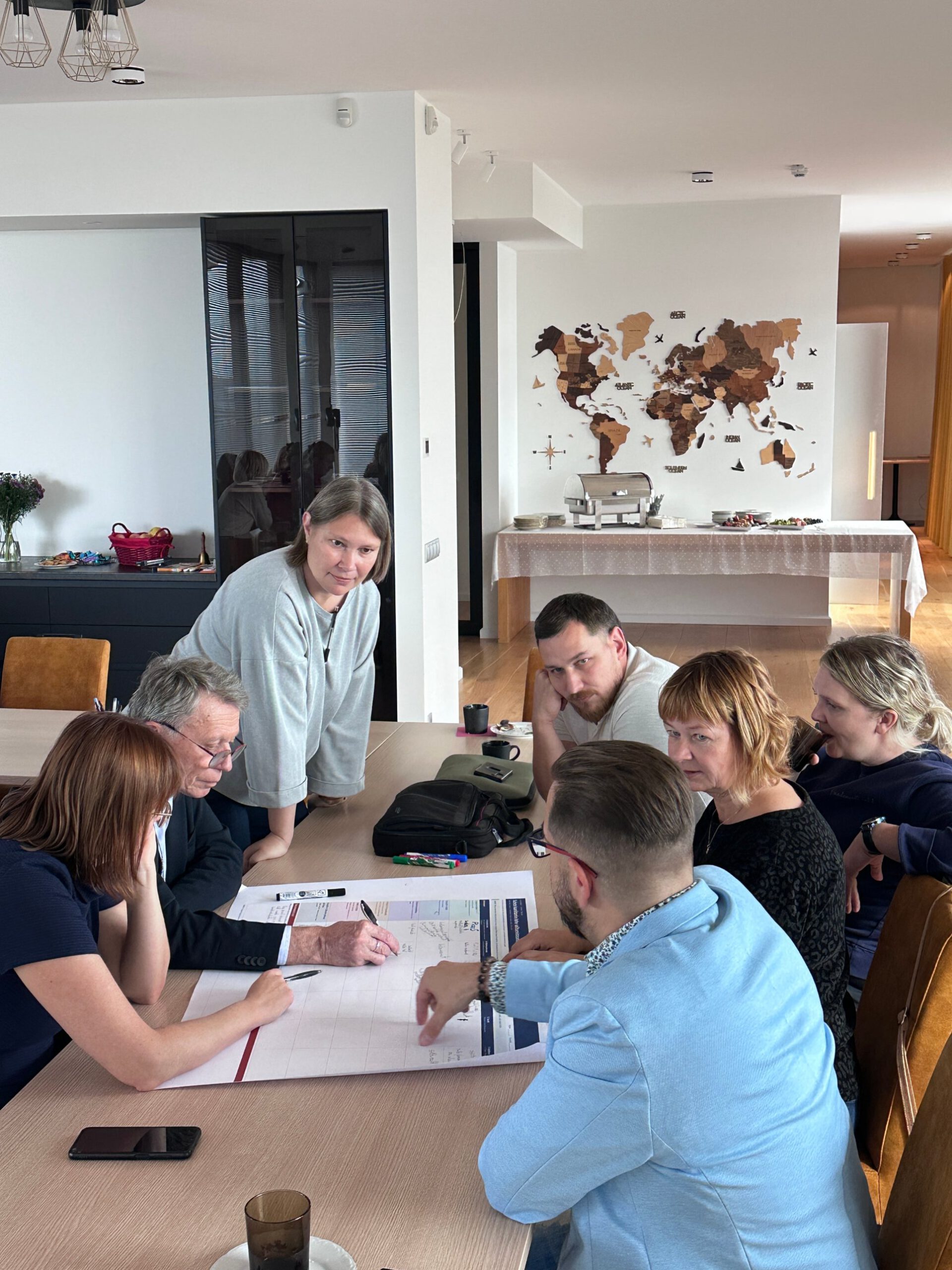
Instead of presentations, participants spent the day working in mixed groups of local and national representatives, around large paper maps on the table.
- Who talks to whom? In the first exercise, groups mapped how municipalities, ministries and other bodies are connected today: how often they are in touch, whether the contact is formal or informal, which topics they discuss and how well it works.
- Where does it get stuck? In the second exercise, local and national participants looked separately at what is missing, what gets in the way and what is already possible, from sharing information and data to rules, resources and trust.
Differences in how the two sides saw the same relationship were not treated as a problem. They were treated as useful information.
What we heard
- Personal contacts keep things moving. Informal meetings, such as regular “coffee mornings” between local and national colleagues, are not part of any official procedure, but they build trust and help people keep up with new rules.
- But people cannot be the only solution. In a small country, much depends on who knows whom. Participants agreed that good cooperation should not depend on individuals alone.
- Views on the regional level differed. Some participants felt that, since the counties were abolished, information does not always flow easily between national and local levels. It was also not clear to everyone that the regional level would be the fix, and the workshop did not aim for a single position.
- Rules change quickly. Local authorities find it hard to keep up with new legislation, while national rules were described as strict, leaving little room for local solutions.
- A possible role for regional cooperation. Several participants saw room for stronger cooperation at regional scale. This was not a call to bring back the old counties, but an idea to explore in a form that fits today’s needs.
Two views of the same challenge
When the groups reported back, a few more points stood out from the national and the local side.
- National view: Climate policy should remain a central government responsibility, led by the climate and environment ministries and supported by their agencies. Participants pointed to the Ministry of Environment as the main home of flood expertise. A new national planning framework is being prepared and is expected to give much clearer direction, with the focus on regional plans.
- Local view: Municipalities have two versions of their role: the official one and the one they live every day. Day to day, they keep returning to the constitution as the basis of their mandate, and in practice they often carry out their tasks without adequate funding.
What happens next
The maps created in the workshop show who works with whom along the Estonian and Harju coast. They are the starting point for a joint cooperation guide. The results will also feed into a Baltic PlaNet report with recommendations for an action plan on cooperation between national and local authorities, so that coastal communities are better prepared for climate change.
Many thanks to Lääne-Harju Municipality for hosting, and to all participants for their open and constructive discussions.
Baltic PlaNet is co-funded by the Interreg Baltic Sea Region Programme. It is coordinated by the Climate Service Center Germany (GERICS), Helmholtz-Zentrum Hereon.

Additional links
details
-
Homepage
-
Project typeProject Platform

-
ImplementationJuly 2025 - June 2028
-
StatusOngoing
-
Contribution to EUSBSRPolicy Area Spatial Planning, Policy Area Secure

-
Target groups
- International governmental organisation
- Local public authority
- National public authority
- Regional public authority
-
Social media
-
Additional links
-
Tags