




Turning Evidence into Action: Arts on Prescription in the Baltic Sea Region - a successful project story
09 February 2026
Mental health challenges affecting people of all ages continue to place growing pressure on public services across the Baltic Sea Region. Traditional clinical pathways are often ill-equipped to address mild to moderate conditions such as stress, depression or social isolation at scale. At the same time, robust evidence (e.g. WHO, 2019, WHO, 2025, European Commission, Directorate-General for Education, Youth, Sport and Culture, 2025) shows that participation in creative, group-based arts and cultural activities can strengthen psychological resilience, enhance social connectedness and improve mental well-being. However, these benefits have largely remained outside mainstream health systems, and structured referral mechanisms linking social and health care services with the cultural sector have been underdeveloped – with the outcomes of our Arts on Prescription project, this is about to change.
Key challenges
Healthcare professionals frequently lack resources and tools that bridge the gap between clinical care and preventive support. Cultural organisations, meanwhile, remain peripheral to health strategies despite their clear potential to foster community, inclusion and improved quality of life. There was a clear need for a model that operationalises engagement in arts and culture as a prescribable health promotion intervention, adaptable to diverse health systems and cultural contexts.
Our solution
The Arts on Prescription (AoP) model, co-developed under the Interreg Baltic Sea Region programme, responds directly to this need. The Arts on Prescription in the Baltic Sea Region project built on small-scale programmes previously tested in countries such as the United States, Australia, Sweden and Denmark, and transformed them into a transferable, evidence-based Baltic model. Framed as a model of social prescribing, AoP enables health and social care professionals, as well as other referral channels, to recommend sustained participation in group-based arts and cultural activities as an alternative or complementary support alongside conventional care.
For a more details on the Baltic AoP Model and the generic programme concept developed and tested in this project, please visit our Arts on Prescription Guide. It is a comprehensive online guide for public authorities and practitioners working in public health, social and cultural sector. It provides you with the necessary background information, tools, best practices, audiovisual guidance, and information on how to plan, implement, evaluate, and invest in Arts on Prescription programmes. An additional pixi book introduces you briefly to the guide’s different themes and chapters, including QR codes with direct access to the online chapter. Enjoy the reading!
Insights from our pilot programmes
Thirteen partner organisations from seven Baltic Sea Region countries co-created a transferable, generic Arts on Prescription (AoP) programme concept. This concept was piloted in seven locations across five partner countries between September 2023 and November 2024. In total, 24 distinct pilot programme cycles were implemented across Denmark, Germany, Poland, Latvia and Sweden. Each pilot involved small groups of participants meeting regularly over 8–12 weeks for creative activities ranging from painting and sculpture to theatre, music and museum visits, among others.
Short introductions to the individual pilot programmes are available for the following locations:
- Arts on Prescription in Odense, DK
- Arts on Prescription in Bremen, DE
- Arts on Prescription in Westpomeranian Region, PL
- Arts on Prescription in Szczecin, PL
- Arts on Prescription in Cēsis, LV
- Arts on Prescription in Saldus, LV
- Arts on Prescription in Norrbotten, SE
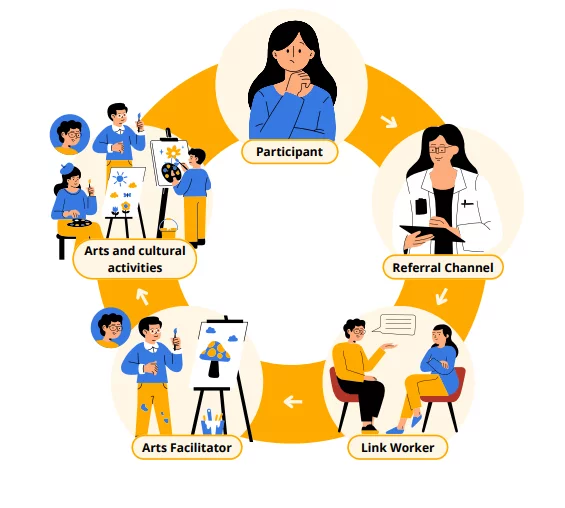
Participants were referred through healthcare, employment, and social services, as well as other referral channels, and were supported throughout the programme by trained arts and cultural facilitators and link workers. They ensured an inclusive and safe environment and fostered positive group dynamics, while also supporting each participant according to their individual needs and opportunities for creative expression. Facilitators and link workers were further supported through a tailored train-the-trainer programme, practical resources from the online Arts on Prescription Guide, and close mentoring by project experts. All pilots were accompanied by evaluation focusing on mental well-being, social inclusion and policy relevance.
The following video footage provides examples and insights from piloted AoP programmes in Latvia and Germany. For additional video material and practical guidance, please visit the online Arts on Prescription guide:
Museums on Prescription Programme in Cēsis, Latvia:
Arts on Prescription in Saldus, Latvia:
Kunst auf Rezept in Bremen, Germany:
Evidence – Participant and Professional Voices
By spring 2025, 24 pilot groups had been delivered and data from 255 participants had been evaluated across five countries. Sweden, Latvia and Poland each implemented six pilot groups, while Denmark and Germany delivered three each. Activities were assessed using both qualitative and quantitative methods, allowing the model to be refined iteratively. Evaluation results show improvements in mental well-being, reduced feelings of loneliness and increased self-confidence among participants.
The impact of Arts on Prescription (AoP) is directly reflected in participant experiences:
It brought remarkable changes in my life. I found motivation for something new… a motivation to seek a permanent job, said Asnata Žēpere, participant in the Museums on Prescription pilot in Cēsis, Latvia, emphasising the programme’s role in reigniting agency and purpose.
I came here exhausted and isolated. Through the programme, I found structure, connection and confidence again, participant, Bremen pilot.
From Sweden’s Norrbotten pilot, Dr Henrik Wikström, ST doctor and former participant, shared:
It was good for me to get out and be forced to do something… Arts on Prescription helped me let go of perfectionism and lower the demands I place on myself. Following the programme, he returned to full-time work and now actively refers patients to the model.
Healthcare and project professionals also observe clear structural value and tangible changes:
Arts on Prescription gives us a concrete, humane tool to support people before their situation worsens, health professional involved in the Swedish pilot.
Today, there is a lot of research showing it is a successful method, said Susanne Lindquist, project coordinator in Region Norrbotten, noting that several participants were able to return to work after completing the programme.
Across the Baltic Sea Region, pilots have engaged adults on extended sick leave, individuals experiencing anxiety or depression, NEET (Not in Education, Employment or Training) groups, and people seeking social connection. Results consistently indicate improvements in mental well-being, confidence and community participation. This growing evidence base has positioned AoP as a recognised model for social prescribing, presented at Nordic and European public health conferences and referenced in EU-level discussions and international publications on culture and health.
Vision and Value of Interreg Cooperation
Interreg Baltic Sea Region funding enabled the sustained co-creation, implementation, evaluation and refinement of this transnational AoP model. By bringing together health and social services, cultural institutions, universities and local authorities, the project translated evidence into practice and produced an online practitioner guide, an evaluation framework, training modules and multimedia resources that support replication beyond the project’s lifetime.
The project’s policy relevance was echoed at high-level events, including the Acting on Health conference in Vilnius, where Marija Jakubauskienė, Lithuania’s Minister of Health, stated: AoP and social prescribing contribute to building a healthy and resilient society.
Through the International Social Prescribing Collaborative and the newly established International Arts on Prescription Collaborative (IAPC), AoP now contributes to an emerging global dialogue on cultural routes to health, with ongoing expansion into youth initiatives, rural communities and broader public health practice, for example:
Follow-up and spin-offs
In 2026, the City of Bremen will establish a Competence Centre for Art, Culture and Health, jointly funded by the city’s health and culture departments and the Bremen Adult Education Centre (Bremen vhs). Operating as an open network, the centre will strengthen interdisciplinary expertise, support professional exchange and further develop projects at the intersection of art, culture and health at local and supra-regional level.
In Latvia, the newly established NGO Culture and Health Latvia brings together professionals from the cultural, health and social sectors to promote long-term cross-sector cooperation. Based in Cēsis Municipality at the Eduards Veidenbaums Museum Kalāči, the organisation will ensure the continuation of the Museums on Prescription programme and support networking and capacity-building within the emerging culture and health community.
In Denmark, seven municipalities on the island of Funen have received DKK 7 million (approx. EUR 940,000) from the Danish Agency for Culture and Palaces to launch Fynsk KulturRum. Funded under the national Culture Pass Initiative, the project uses culture, sport and community activities to support the mental well-being, inclusion, education and employment prospects of vulnerable young people aged 15-24. More information – see the project news here.
In Poland, a micro-grant fund for Arts on Prescription will be launched in 2026. Led by the West Pomeranian Region and the Media Dizajn Association, the scheme will support grassroots AoP activities and strengthen regional experience in art-based social prescribing, paving the way for future national funding solutions.
In Sweden, Sunderby Folk High School and Region Norrbotten will expand transnational knowledge exchange through ArtWell Net – Arts for Health and Well-being Network, co-financed by the Swedish Institute. Together with partners from Poland, Ukraine and Sweden, the project fosters cross-sector collaboration, peer learning and innovation in culture-based health promotion. Moreover, Region Norrbotten has decided to integrate the AoP model permanently into primary care and outpatient psychiatry, with a county-wide roll-out beginning in autumn 2026 – see project news here.
Funding was secured for the continuation of the project Arts on Prescription in Norway funded by the Norwegian Ministry of Health and Care Services and led by the Norwegian Resource Centre for Arts and Health. In the second year of the project, the AoP concept will be piloted in the municipalities of Bergen, Bærum, Sarpsborg and Veral. Furthermore, a transfer event in Estonia is planned to be organised in summer 2026.
Finally, the Baltic Sea Mental Health Platform (BSR Mental Health), co-funded by Interreg Baltic Sea Region and coordinated by NDPHS, scales up results from Arts on Prescription and 12 other EU-funded projects. The platform translates evidence into concrete policy recommendations, supporting the wider adoption of community-based, non-medical mental health interventions across the region.
Further reading – key publications
- Arts on Prescription in the Baltic Sea Region (2025). Project brochure: Introducing the Arts on Prescription approach to mental healthcare.
- European Commission: Directorate-General for Education, Youth, Sport and Culture (2025). Culture and health – Time to act. Publications Office of the European Union.
- Hinrichsen, C., Hassing, H. R., Mairey, I. P., & Broholm-Jørgensen, M. (2026). Identifying and defining implementation strategies for arts on prescription programs – a realist informed scoping review. Arts & Health, 1–20.
- Hinrichsen, C., Arp, S., Mairey, I.P. (2025). Piloting Arts on Prescription in the Baltic Sea Region. Evaluating health outcomes, costs and implementation strategies. National Institute of Public Health, University of Southern Denmark.
- Laitinen, L., Linnossuo, O. (2025). Arts on Prescription (AoP) in the Baltic Sea Region – Qualitative evaluation of the 24 pilot AoP programmes. Reports from Turku University of Applied Sciences 312.

Additional links
details
-
Homepage
-
Project typeCore Project
-
ImplementationJanuary 2023 - December 2025
-
StatusCompleted
-
Contribution to EUSBSRPolicy Area Health, Policy Area Culture

-
Target groups
- Local public authority
- National public authority
- NGO
- Regional public authority
-
Social media
-
Additional links
-
Tags