




Piloting in Poland
28 April 2026
APRIORA becomes practical – goal of piloting the approach:
To make sure our developed solution works well, we were testing the approach in five river catchments across the Baltic Sea Region countries Finland, Germany, Latvia, Poland and Sweden. This included all three modules from monitoring, modelling and risk assessment as well as learning and teaching how to apply the QGIS tool. Regional authorities in charge took care of the piloting, working alongside scientific experts to ensure the solution meets their actual needs.
Piloting in Poland – this is their story
The Łeba catchment – a coastal river with many functions
Catchment background
The Polish pilot, conducted by Gdańsk University of Technology, examined the Łeba River catchment, a sensitive coastal system with a short pathway to the Baltic Sea. It carries water and wastewater from inland areas through coastal lakes to marine waters. Its environmental sensitivity, limited dilution capacity and multiple uses make it vulnerable to micropollutants, especially in summer when population pressure can rise even tenfold.
Pilot area description
The catchment covers 1,694 km². Before reaching the Baltic Sea, the Łeba flows through Lake Łebsko in Słowiński National Park and serves as potential salmon and sea‑trout habitat. Its long‑term mean outflow is about 18.13 m³/s, though backwater and storm surges can affect local conditions. Human activities are dispersed, with seasonal tourism and small industrial sites, and only a few small potentially burdensome facilities such as agro‑food plants, fuel stations, wastewater treatment plants (WWTPs) and waste‑management sites.
Pilot focus: WWTPs under seasonal pressure
The Polish pilot focused on small and medium WWTPs, where risk-based criteria are particularly important. The dataset covered four of the six WWTPs in the catchment: Kożyczkowo, Tłuczewo, Lębork, and Łeba, all serving agglomerations below 100,000 PE. Samples included raw and treated wastewater, plus river water upstream and downstream of discharge points (Figure 1). During summer, wastewater systems serve many more people, causing higher and variable WWTP inflows, while low river flows reduce dilution and increase pollutant concentrations.
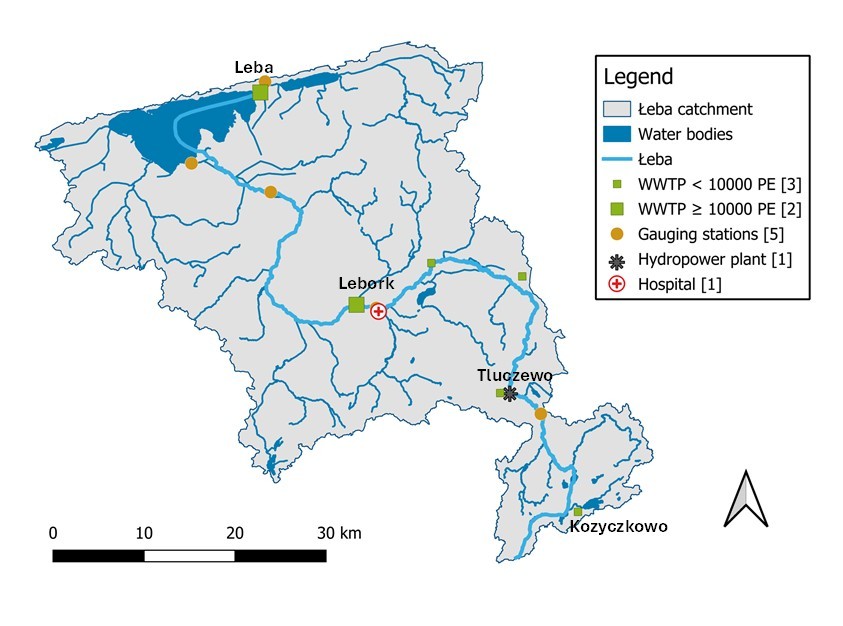
Figure 1. Map of the Łeba river catchment
Findings from the Polish case study
Samples were collected seasonally from autumn 2024 to summer 2025, including 24‑hour composite wastewater samples from WWTP influent and effluent and grab samples from river sites upstream and downstream of WWTP discharge points.
The results indicate that conventional treatment processes at the investigated WWTPs would generally not achieve the required 80% removal for the tested active pharmaceutical ingredients (APIs). For carbamazepine and venlafaxine in particular, the removal rates were low (<50%) (Figure 2), confirming the need for risk‑based prioritisation of WWTP upgrades.
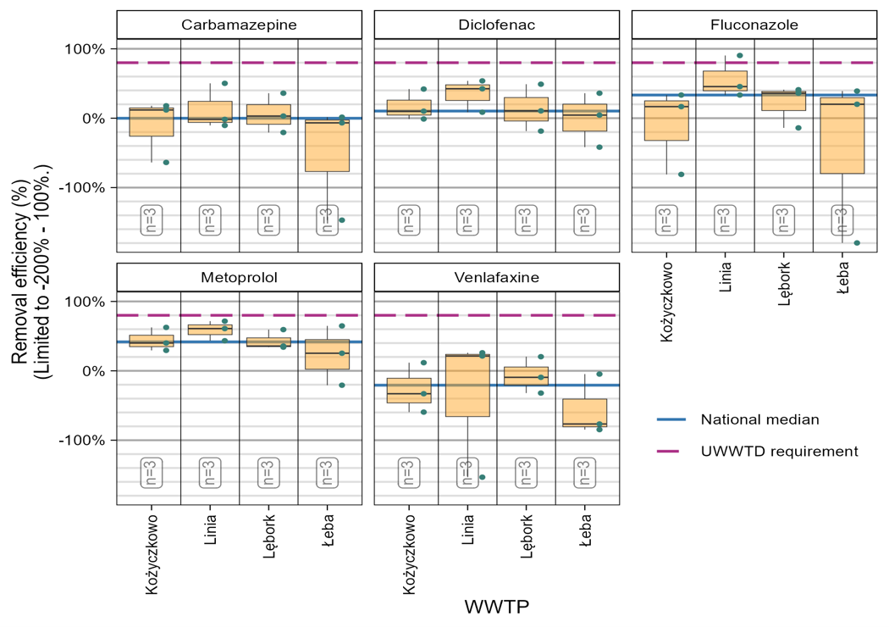
Figure 2. Removal rate variability of five indicator APIs in WWTP influent and effluent samples.
Diclofenac (Figure 3) and venlafaxine exceeded their EQS/PNEC thresholds along almost the entire river, although concentrations remained below threshold in the estuarine section.
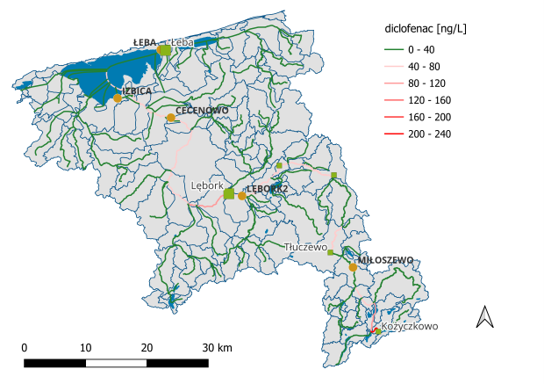
Figure 3. Diclofenac concentration map of the Łeba River catchment
What the results mean for risk assessment
The results were interpreted from three perspectives: environmental (ERA), antimicrobial‑ resistance (AMR‑RA) and human-health (HH-RA) risk assessment.
- Poland is characterized by high summer peaks in its river systems, and the ERA results suggest that during low-flow summer months the ecological pressure on these water bodies increases (RQ > 1).
- For AMR-RA, no standardized routine method exists to determine the lowest antibiotic concentration selecting for resistance. Within APRIORA, the Gdańsk Tech team proposed a tiered strategy. First, theoretical MIC‑based PNECR values are used as a practical and conservative screening tool. When no reliable compound‑specific threshold exists or site‑specific validation is needed, an OD‑based community assay can be applied. If no clear or reproducible threshold is obtained, the assessment moves to qPCR‑based analysis of resistance‑gene abundance. This stepwise approach balances scientific robustness, feasibility and regulatory implementation. In the Polish case study, a risk quotient for resistance selection (RQR) above 1 was observed mainly in raw wastewater. This suggests that selection pressure may already occur within sewer systems and may not always be fully reduced during wastewater treatment. In receiving waters of the Łeba catchment, this signal was recorded only once downstream of the Kożyczkowo WWTP, most likely due to temporary backwater caused by beaver dams.
- For HH-RA, the pilot does not prove direct health effects but helps identify exposure pathways in tourist coastal regions, including recreational water contact, accidental ingestion during bathing or kayaking, and angling.
Knowledge value for Poland
In Poland, systematic data on micropollutants and antimicrobial resistance in small and medium coastal rivers flowing directly to the Baltic Sea are still limited. The pilot therefore tested modelling based on pharmaceutical sales and excretion rates to estimate API releases into the sewer. The highest estimated loads were for carbamazepine and clarithromycin, showing the tool’s potential to prioritise WWTPs and river sections.
How the findings support the new urban wastewater treatment directive (UWWTD)
The revised UWWTD requires Member States to identify areas where micropollutants from urban WWTPs pose risks to the environment or human health. Not every WWTP can be upgraded at once, and public funds should be directed where they deliver the greatest benefit. APRIORA helps identify hotspots, compare WWTPs and river sections, and assess whether additional treatment would reduce risk. The QGIS workflow turns monitoring and modelling results into maps that support the prioritisation of WWTP upgrades, even when monitoring data are limited. However, formally none of the plants in the river basin would require an upgrade due to their small design capacity below 10,000 PE. This underlines the need for a differentiated, ambient water oriented risk assessment as developed in APRIORA.

Interactive map showing pilot locations. Use the arrow keys to move the map view and the zoom controls to zoom in or out. Press the Tab key to navigate between markers. Press Enter or click a marker to view pilot project details.
Additional links
details
-
Homepage
-
Project typeCore Project

-
ImplementationNovember 2023 - October 2026
-
StatusOngoing
-
Contribution to EUSBSRPolicy Area Hazards

-
Target groups
- Infrastructure and public service provider
- Sectoral agency
-
Social media
-
Additional links
-
Tags