




Hazardous chemicals: the way forward
18 September 2026
On 8–10 September 2026, the Horizon Europe – funded project ZeroPM celebrated its closure in Brussels. At the final conference “Achieving Zero Pollution of Persistent and Mobile Substances: The Way Forward”, about 170 people representing universities, public authorities, consultancies, water sector and other fields gathered to discuss the pressing topic of persistent and mobile substances. HAZGONE was present through active members of the platform consortium promoting e.g. the Achieving Zero PFAS, BalticPFASresolve, and EMPEREST projects, and the Baltic Sea PFAS network.
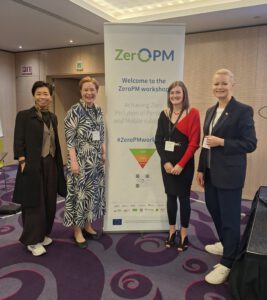
The ZeroPM final event was an opportunity for many encounters. This photo features some partners of the Achieving Zero PFAS project: Mayumi Narongin-Fujikawa (left) from IVL Swedish Environmental Research Institute, Lotta Lehti from UBC Sustainable Cities Commission, Sarah Hale from German Water Centre and Edita Baltrėnaitė-Gedienė from Vilnius Tech. Sarah Hale was also one of the leaders of the ZeroPM project. Photo: UBC SCC.
There is no question about the gravity and scale of the problem: Hazardous chemicals – or persistent and mobile substances which were the focus of ZeroPM – are everywhere in the environment and we know more and more about their negative impact on human health and on ecosystems. The scale of pollution concerning PFAS (per- and polyfluoroalkyl substances) was brought into media spotlight in 2023 when the French journal Le Monde published a map of known PFAS contamination sites in Europe. At the ZeroPM conference, journalists Stéphane Horel and Raphaëlle Aubert told the audience about the “Forever pollution project”, i.e. the work leading to the publication of the map, and of everything that has followed. Their method of “Expert-reviewed journalism” involves collaboration with a group of scientists. Further, they have developed a methodology for countering the arguments of disinformation campaigns orchestrated by the chemical and plastic lobbies which question the Forever pollution project, and act against the PFAS ban currently under preparation in the EU.
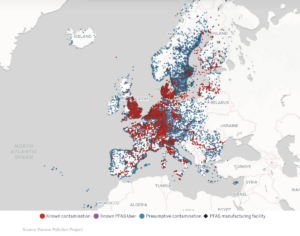
The map of Europe with known PFAS contamination sites published in 2023 paved the way for stronger general awareness of the PFAS problem. Photo: Forever Pollution Project.
For the water sector, the conference brought valuable insight into the holistic effects of water remediation. For instance, the CO₂ emissions of activated carbon technologies were presented as a valid reason for rethinking PFAS removal at any cost. From a financial point of view, Ali Ling from the University of St Thomas presented a study on the costs of PFAS remediation in the environment in Europe, with both “legacy” and “emerging” pollution scenarios. The cost of PFAS removal from soil and water is so high, with so little impact on the overall contamination situation even if all available technologies were used, that the scientists behind the study recommend not investing in PFAS removal from wastewater and that WWTPs should rather concentrate on other hazardous substances such as the ones listed in the revised Urban Wastewater Treatment Directive. Instead, it is crucial to continue removing PFAS from drinking water – as it is consumed directly by humans. Further, remediation is worthwhile at the pollution hotspots as it stops the spread of PFAS further into the environment. PFAS remediation is also needed in places where heavy contamination is clearly threatening the health of communities. Above all, the most important thing to do is to stop polluting the environment even more with PFAS. Regulation and market transition are key in this work.
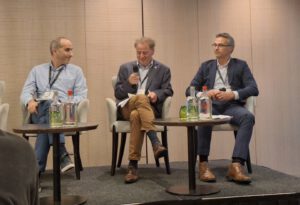
In a panel about securing water resilience to the threat of PFAS, Athanasios S. Stasinakis (left) from the University of the Aegan, Oliver Loebel from EurEau and Bert Leemans from the European Commission (DG ENV) agreed that the knowledge level and readiness of the water sector regarding toxic chemicals vary from one country to another even within the EU. Photo: UBC SCC.
Raising awareness among the public and steering public procurement towards non-toxic products are important tools in the market transition. At the conference, we heard from Swedbank Robur how private investments can also be used as a driver of change. Caroline Sundin explained that Swedbank communicates to companies that chemical dependency is a risk because upcoming legislation on the use of toxic chemicals will have an impact on company valuations. Further, Louisa Raith Sørensen from COOP Denmark described the successful transition of their grocery chain towards non-toxic food packaging and products such as kitchen utensils. COOP Denmark even managed to push manufacturers to invent PFAS-free microwave popcorn packaging!
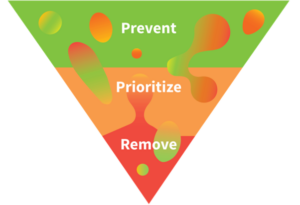
The ZeroPM project focused on eliminating persistent and mobile substances through three measures: preventing their emissions, prioritizing the most urgent ones to address and removing them from the environment.
While the HAZGONE project platform focuses on linking upstream and downstream measures, the ZeroPM project uses the terminology of prevention, prioritization and removal of toxic chemicals. In order to be successful in all these three measures, reliable and transparent data is needed. The ZeroPM project, and its 60 researchers from 15 institutes located in 10 European countries, have done a lot of work in grouping and assessment of substances, and analytics in general. The overall aim is to indicate which substances must be phased out – and to find non-harmful substitutes. The extensive work has resulted in many pilots, reports and scientific publications, but also in varied practical tools which can be used in the search for non-toxic chemicals. All tools are available via the ZeroPM project website: Welcome to ZeroPM – ZeroPM

Group photo of the conference organisers and participants. The motto of the event was: “All you need to implement the toxic-free hierarchy is love and regulatory clarity.” Photo: ZeroPM.
Text written by: Lotta Lehti

Additional links
details
-
Homepage
-
Project typeProject Platform

-
ImplementationJuly 2025 - June 2028
-
StatusOngoing
-
Contribution to EUSBSRPolicy Area Hazards

-
Target groups
- Business support organisation
- Infrastructure and public service provider
- Local public authority
- National public authority
- NGO
-
Social media
-
Additional links
-
Tags