




Workshop at IHMA Congress 2026 explores safe alternative fuel bunkering decisions
13 July 2026
At the IHMA Congress 2026 in Rotterdam, the H2Deri@BSP project partners Gasum, Viereon, Bowwave hosted an interactive workshop dedicated to one of the most pressing operational challenges in the maritime energy transition: enabling safe and effective decision-making for alternative fuel bunkering under real-world uncertainty.
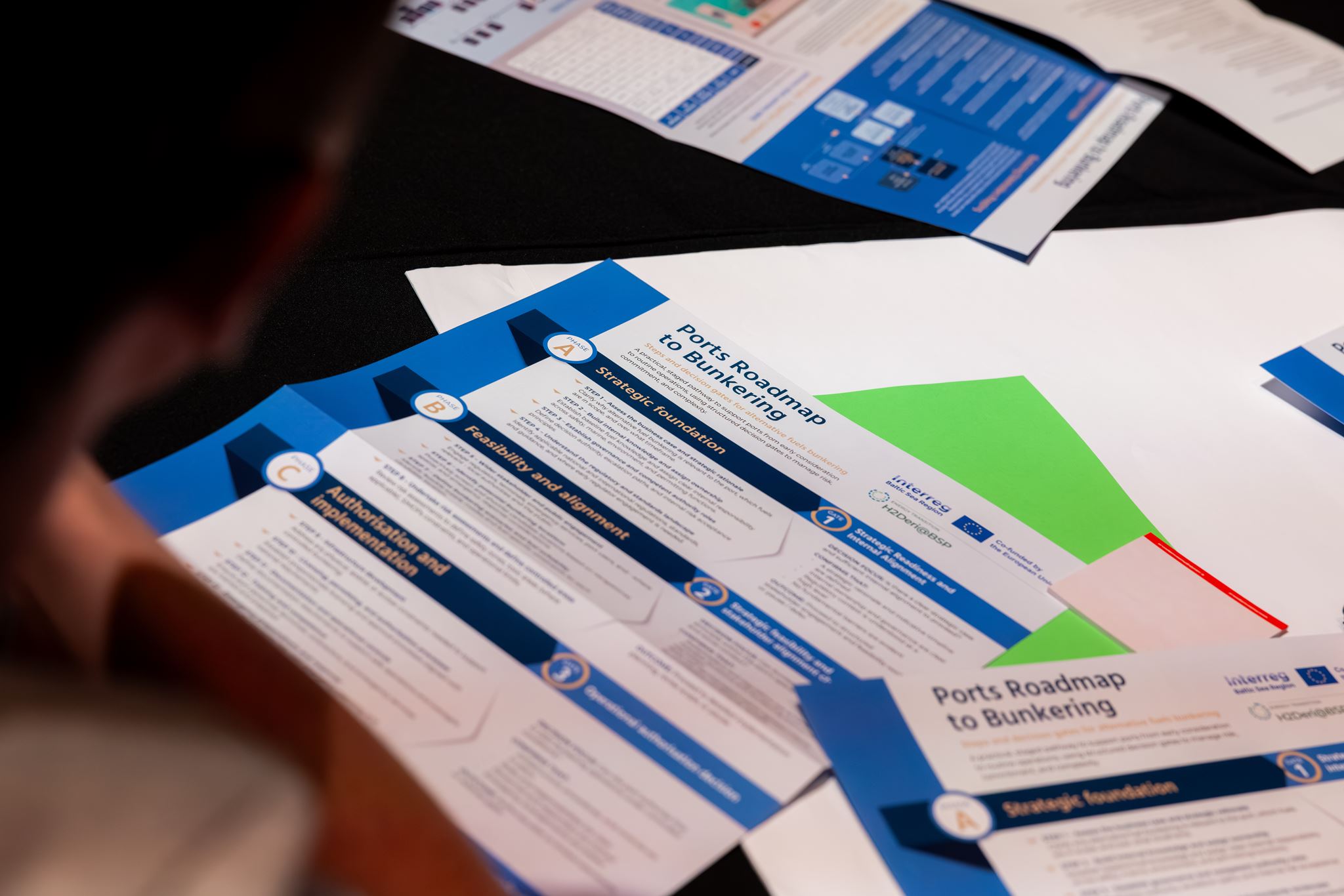
The workshop was based on the project’s regulatory framework and safety handbooks for hydrogen-derived fuels, including methanol and ammonia, developed to support port authorities in preparing for new fuel types. The session brought together port professionals, industry stakeholders, and maritime safety experts to explore how ports can move from theoretical preparedness to practical operational readiness.
Step 1 – Scenario discussion: assessing real-world bunkering operations
Participants were divided into small groups and assigned stakeholder roles reflecting real port ecosystems, including:
- Harbour Master / Port Authority
- Fuel Supplier
- Fuel Receiver
- Emergency Services
- Public and neighbouring stakeholders
Each group received a detailed scenario describing alternative fuel bunkering operations involving LNG, methanol, and ammonia under different operational contexts, such as ferry operations, container feeder vessels, and offshore support vessels. Participants were asked to:
- Identify key safety, operational, and commercial risks
- Evaluate control measures and restrictions
- Discuss operational feasibility under port conditions
- Agree on whether and how the operation should proceed
This phase highlighted that bunkering decisions require balancing multiple competing priorities simultaneously, particularly when information is incomplete.
Step 2 – Wildcard event: managing uncertainty in real time
In the second phase, participants were confronted with a dynamic “wildcard event” introducing new and incomplete information to selected stakeholders. This required groups to:
- Reassess their initial decisions
- Decide what information to share across stakeholders
- Adjust operational conditions or approvals
- Determine whether their original decision still remained valid
The exercise simulated the reality of port operations, where emerging risks or changing conditions can significantly alter operational decisions within short timeframes. This step reinforced the importance of communication, coordination, and adaptive decision-making in ensuring safe alternative fuel handling.
Step 3 – Lessons learned: translating complexity into action
In the final phase, participants were asked to capture the most important outcome of their discussion in a concise six-word summary. This exercise emphasised clarity and prioritisation in complex operational environments, reinforcing that effective decision-making must be both structured and communicable. Across groups, key messages consistently highlighted:
- the importance of coordination between stakeholders
- the need to balance safety, operations, and public confidence
- the challenge of decision-making under uncertainty
- the role of preparedness in enabling confidence
Key outcome: coordination before infrastructure
A central takeaway from the workshop was that successful alternative fuel bunkering is not achieved through infrastructure alone. Instead, it depends on:
- structured coordination between stakeholders
- clear safety and operational frameworks
- transparent communication under uncertainty
- shared understanding of risk and responsibility
This reflects a core principle of the H2Deri@BSP project: port readiness is as much about decision-making capacity as it is about physical infrastructure.
Conclusion and outlook
The IHMA Congress workshop demonstrated how structured simulation-based training can support ports in preparing for the operational realities of alternative fuel bunkering. By integrating regulatory frameworks, safety guidelines, and real-world decision-making scenarios, H2Deri@BSP continues to support Baltic Sea Region ports in building practical readiness for the transition to hydrogen-derived fuels. As alternative fuels such as methanol and ammonia move closer to large-scale deployment, such approaches will be essential to ensure safe, coordinated, and resilient implementation across the maritime sector.

Additional links
details
-
Homepage
-
Project typeCore Project

-
ImplementationMarch 2025 - February 2028
-
StatusOngoing
-
Contribution to EUSBSRPolicy Area Energy, Policy Area Ship

-
Target groups
- Business support organisation
- Infrastructure and public service provider
- Large enterprise
-
Social media
-
Additional links
-
Tags