




Finnish Biocycle and Biogas Association: Nutrients in circulation are resources for resilience – nutrient recycling as part of security of supply
16 June 2026
These themes were discussed in Helsinki, Finland, on 27 May 2026 at the seminar “The potential of nutrient recycling to strengthen security of supply”. The event was organised by the Finnish Biocycle and Biogas Association as part of the CiNURGi project. The day included perspectives from the Ministry of Agriculture and Forestry of Finland, the National Emergency Supply Agency, the Natural Resources Institute Finland, the Finnish Biocycle and Biogas Association, and companies putting nutrient recycling into practice. The seminar brought together around 40 participants from public administration, research, security of supply work, the biogas and nutrient recycling sectors and agriculture. Discussion was active throughout the day. The practical examples from companies, especially the bottlenecks and development needs they brought up, received positive feedback and sparked valuable discussion.
This text reflects on some of the key messages from the day: why nutrient recycling matters for security of supply, what kind of potential exists in Finland, and what is still needed to turn that potential into practical solutions.
From import dependency towards more resilient nutrient supply
Fertilisers are a basic condition for food production. If the availability of nutrients is disrupted, the effects can quickly reach agriculture and the wider food system. The opening part of the seminar framed nutrient recycling within the wider context of security of supply and fertiliser markets. The Ministry of Agriculture and Forestry of Finland and the National Emergency Supply Agency discussed nutrients and fertilisers from the perspective of preparedness, food security and national resilience. The Natural Resources Institute Finland provided an overview of fertiliser market developments and Finland’s dependence on imported inputs.
Finland’s situation differs between nutrients. For phosphorus, the starting point is strong: Finland has domestic phosphorus production and a solid position in the European context. For nitrogen, the situation is more vulnerable. The raw materials and production chains for nitrogen fertilisers are closely linked to international markets, energy and imports.
Recent crises have shown that fertiliser supply is also a question of preparedness, logistics and the ability of the domestic system to withstand disruptions. From a security of supply perspective, it is essential to understand where Finland is strong and where the key vulnerabilities lie.
Nutrient recycling cannot replace all industrial fertilisers or imported inputs. However, it can strengthen domestic nutrient supply, reduce dependencies and improve the flexibility of the whole system. It should therefore be seen as part of a broader fertiliser security and resilience framework.
CiNURGi provides knowledge on the potential of nutrient recycling
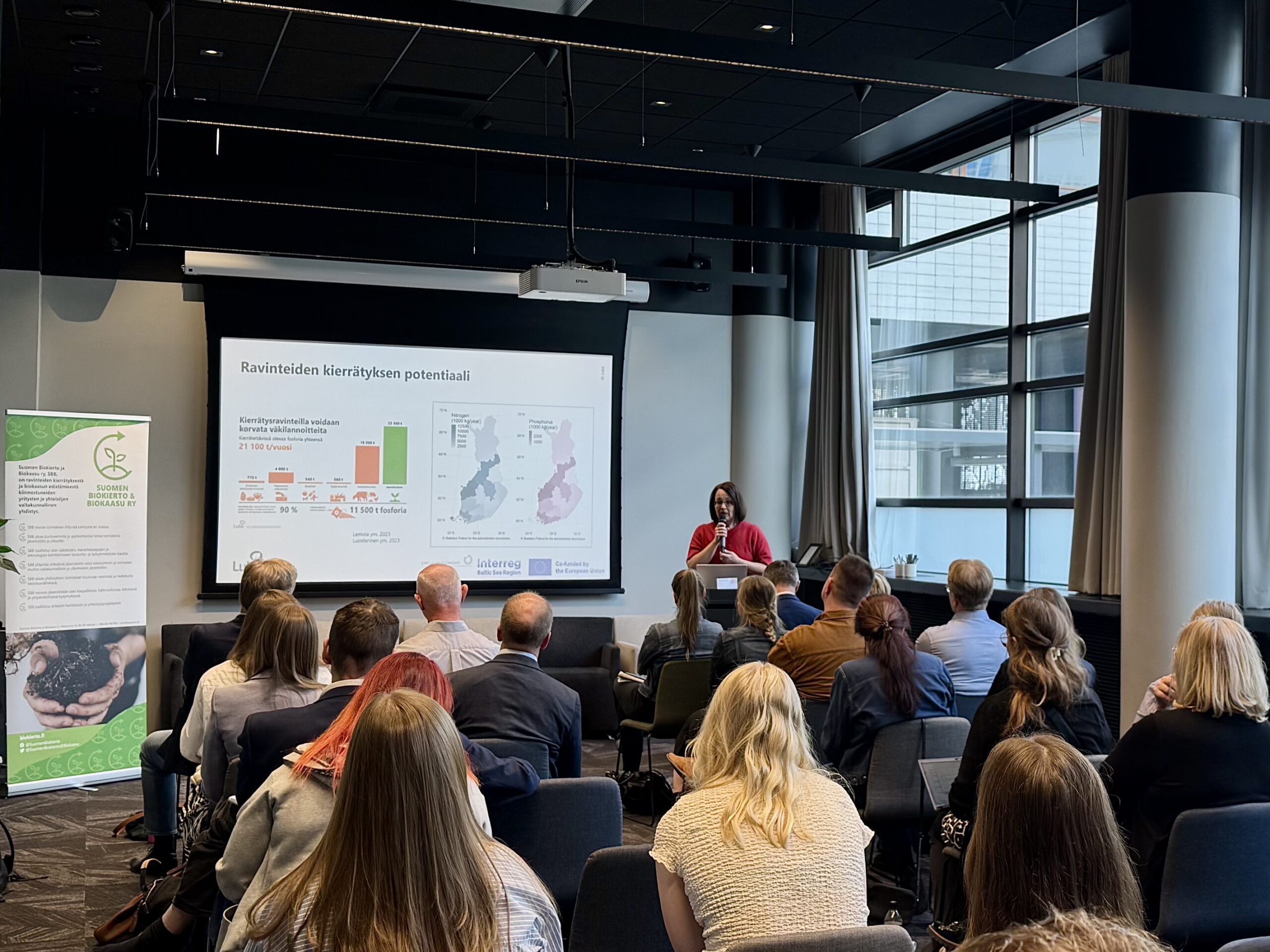
The CiNURGi perspective was deepened by Sari Luostarinen from the Natural Resources Institute Finland, a project partner, whose presentation focused on the potential of nutrient recycling in Finland. Her presentation showed that Finland has significant nutrient-rich biomass flows, but using this potential requires better knowledge, processing and coordination.
For the CiNURGi project, the key question is how nutrients can be circulated more efficiently to where they are needed. Finland generates large amounts of nutrient-rich biomasses, including livestock manure, biowaste, sewage sludge, food industry side streams and plant-based biomasses. Better use of these flows can support nutrient self-sufficiency and more sustainable food production. The potential is particularly relevant for phosphorus. Nitrogen is more complex, as it is more easily lost, more difficult to manage and closely linked to industrial fertiliser production. This makes nitrogen recovery, improved nutrient availability and better nutrient management important areas for further development.
Potential alone is not enough. Nutrients are often generated in areas where there is already a surplus, while other areas may need more nutrients. In practice, nutrient recycling depends on logistics, processing, markets and regulation. The future role of nutrient recycling will largely depend on whether nutrients can be processed into products that are easier to transport, store and use. Low-processed materials can be useful locally, but transport and spreading costs quickly become limiting factors over longer distances. Both local solutions and products with a higher degree of processing are needed.
For CiNURGi, this is a central message: nutrient recycling requires reliable knowledge of nutrient flows, their location, quality and possible uses. Without this information, it is difficult to build practical solutions, functioning markets or effective policies.
Biogas links energy and nutrient security of supply
The role of biogas was introduced by the Finnish Biocycle and Biogas Association’s leading biogas expert Anna Virolainen-Hynnä. Her presentation underlined how biogas connects energy production, waste management and nutrient recycling. From a security of supply perspective, biogas is relevant because it links domestic energy, nutrient and material flows. Biogas connects primary production, the food industry, logistics, waste management and energy production in a way that reduces dependencies related to imported fossil fuels and supports reliable domestic resource flows.
One of the key strengths of biogas is decentralised production. Biogas can be produced around the country on farms, in connection with industry and from municipal waste streams. This increases system resilience, as individual disruptions do not stop the entire production network. The injection of biomethane into transmission and distribution networks can support security of supply, as the gas network can function as an energy storage system. Local gas networks and off-grid biogas plants can further support regional energy self-sufficiency, including in situations where national infrastructure is disrupted. Biogas plants also contribute to decentralised fertiliser production. Digestate and recycled fertiliser products made from it can reduce the need for imported fertilisers and strengthen regional nutrient circulation.
As biogas production grows and becomes more closely connected with primary production, it also links the food system, waste management and energy production more tightly together. These connections, and their importance for security of supply, are not yet fully recognised. This is why the role of biogas as part of Finland’s resilience should be examined more comprehensively.
Potential becomes reality through practical solutions
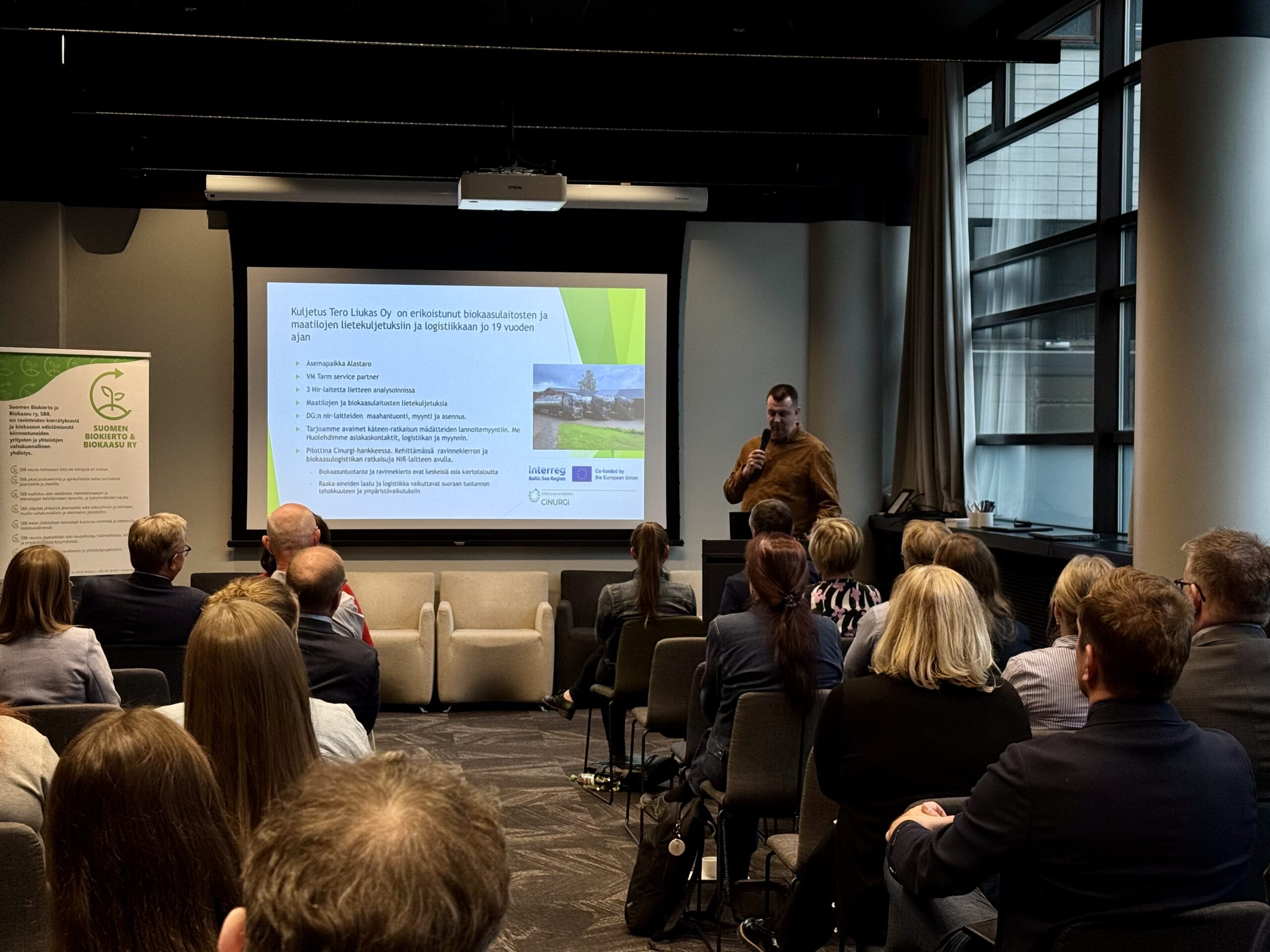
The afternoon focused on practical examples from companies working directly with nutrient recycling. These examples made visible what it takes to use the potential identified in research: biomass loads, storage capacity, transport, spreading, customer relationships and investments. Data emerged as one of the key enablers. Kuljetus Tero Liukas Oy, a Finnish CiNURGi project partner working with nutrient recycling and biogas logistics, demonstrated how NIR technology can be used to analyse the dry matter and nutrient content of slurry and digestate in real time during loading.
When nutrient contents can be measured more accurately and in real time, nutrients become a more manageable resource. Knowing what each load contains helps to plan transport, assess nutrient balances, target nutrients correctly and build a functioning market. This kind of data can support nutrient-based pricing, nutrient balance trading and more efficient logistics. The future of nutrient recycling depends on knowing what is being moved, where it should go and how it can be used in the most efficient way.
The seminar also brought attention to Finnish examples recognised through the CiNURGi Nutrient Recycling Award. BioPir and Bio10 were selected among the top six nutrient recycling solutions identified by the project. BioPir produces separation liquids and solids from pig manure-based digestate in Vehmaa, using natural settling followed by mechanical separation. Bio10, based in Kitee, produces separation liquids and solids from digestate mainly based on organic household waste, food waste and food industry waste, helping to move excess phosphorus out of the region.
These examples widened the view from agricultural nutrient flows to biowaste, food industry side streams and other organic urban and industrial materials. They also showed that many technical solutions already exist, but wider use requires more than technology. Economic viability, farmers’ ability to pay, nutrient concentrations, storage and transport costs, and regulatory predictability all affect whether a functioning market for recycled fertilisers can develop.
The discussion pointed to the need to remove unnecessary barriers. End-of-waste questions, permit procedures and differences in regulatory interpretation directly affect how smoothly recycled fertilisers can be produced, marketed and used. Quality and safety must remain at the core of recycled fertiliser use. Trust is built on quality assurance, transparency and research-based knowledge. At the same time, unclear, overlapping or disproportionately heavy regulation can slow down solutions that are needed from the perspective of circular economy and security of supply.
What comes next?
A key message from the seminar was that nutrient recycling is already happening. Existing solutions can be developed, scaled up and better integrated into the food system and security of supply planning. However, many questions still need to be solved. How can nutrients be moved from surplus regions to areas where they are needed? How can recycled fertilisers become a practical and economically feasible option for farmers? How can regulation support safe solutions without creating unnecessary barriers? How can the roles of biogas plants, logistics companies, agriculture and fertiliser markets be better connected?
This is where the work of the CiNURGi project is especially relevant. Advancing nutrient recycling requires combining knowledge, practical solutions and policy development. When nutrient flows are better understood, they can also be managed and directed more effectively.
Security of supply is built from many parts. Nutrients are one of the critical, but often less visible, parts of that system. By circulating nutrients more efficiently, we can strengthen domestic food production, reduce dependencies and build a more resilient food system.

Additional links
details
-
Homepage
-
Project typeCore Project

-
ImplementationNovember 2023 - October 2026
-
StatusOngoing
-
Contribution to EUSBSRPolicy Area Nutri

-
Target groups
- Interest group
- National public authority
- Small and medium enterprise
-
Social media
-
Additional links
-
Tags