




Piloting in Sweden
28 April 2026
APRIORA becomes practical – goal of piloting the approach:
To make sure our developed solution works well, we were testing the approach in five river catchments across the Baltic Sea Region countries Finland, Germany, Latvia, Poland and Sweden. This included all three modules from monitoring, modelling and risk assessment as well as learning and teaching how to apply the QGIS tool. Regional authorities in charge took care of the piloting, working alongside scientific experts to ensure the solution meets their actual needs.
Piloting in Sweden – this is their story
From monitoring to prioritisation
Managing micropollutants in Southern Sweden
The Swedish APRIORA pilot further developed a regional risk-based assessment framework originally established in Southern Sweden through earlier monitoring initiatives led by Kristianstad University, the County Administrative Board of Scania, and regional wastewater stakeholders. Building on these previous experiences, the pilot focused on developing a practical framework for identifying locations where environmental risks from wastewater‑derived micropollutants are highest. The approach was strengthened by integrating several new tools and methodologies, including hydrological modelling using SMHI S‑HYPE, innovative in‑field sampling with iFiST, and empirically calibrated, consumption‑based prediction models. Together, these components enabled a more integrated and hydrologically resolved assessment of how pharmaceutical emissions interact with recipient sensitivity and seasonal flow conditions under real environmental settings.
The Kävlingeån catchment: a hydrologically sensitive pilot area
The Swedish pilot area was the Kävlingeån catchment in Southern Sweden. The catchment contains several wastewater treatment plants (WWTPs) of different sizes and hydrological settings, including recipients connected to drinking water resources. Strong seasonal variations in river flow make the area highly suitable for studying how dilution capacity influences environmental risk. Four representative WWTPs were selected in collaboration with regional stakeholders and the County Administrative Board of Scania: Kävlinge, Ellinge, Södra Sandby, and Lövestad.
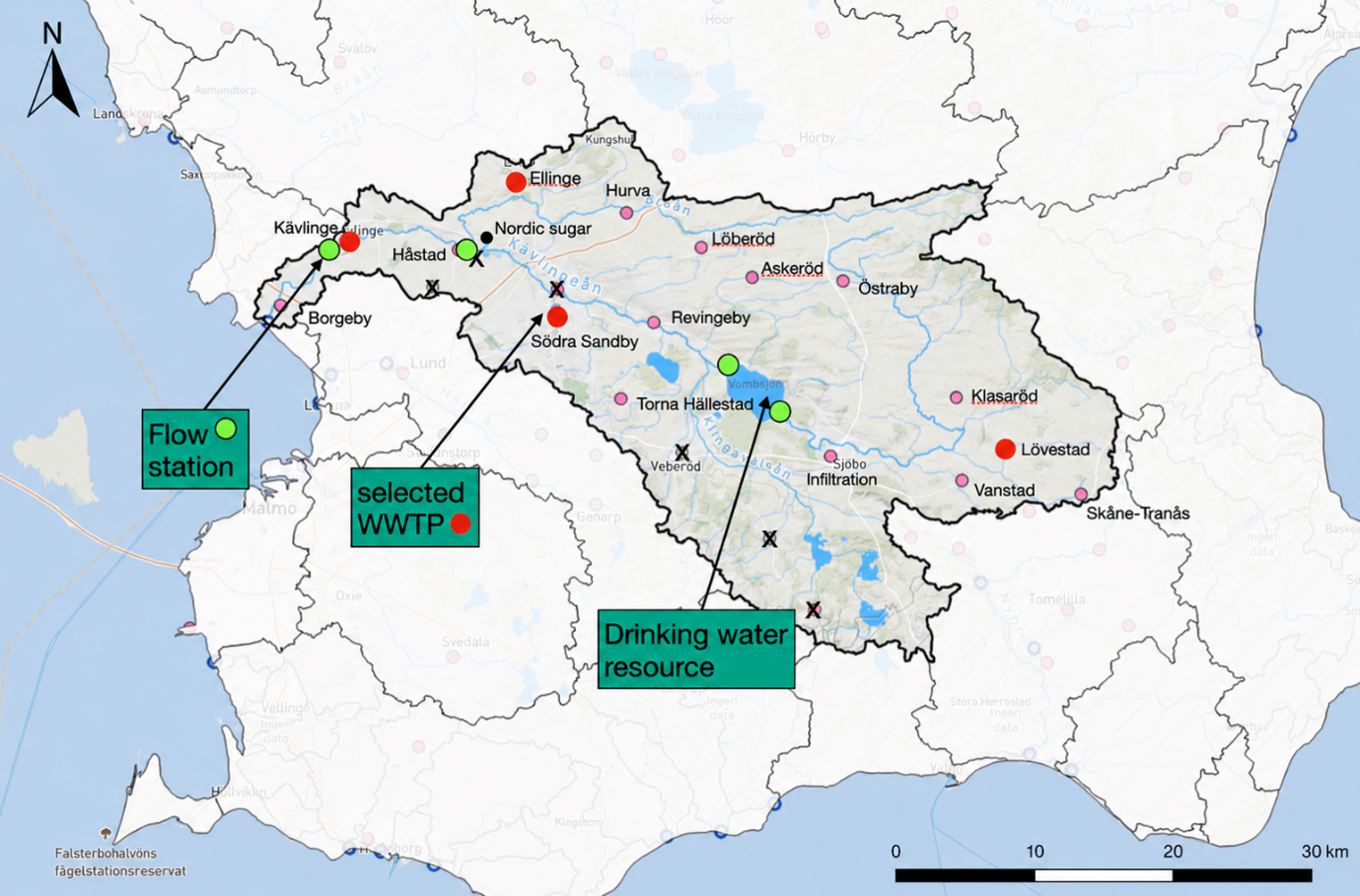
Figure 1. Map of the Kävlingeån catchment with selected WWTPs and gauge stations. Pink circles show active WWTPs and those that are x-marked are WWTPs that are no longer in operation.
Monitoring during different flow conditions
Sampling campaigns were carried out during four seasons between November 2024 and September 2025, covering both high-flow and low-flow conditions. Wastewater and river water were analysed for pharmaceuticals such as diclofenac, carbamazepine, metoprolol, venlafaxine, and trimethoprim. Hydrological conditions were modelled using SMHI S‑HYPE, enabling estimation of river flows and dilution conditions throughout the catchment. A Python-based workflow was also developed to automate handling of hydrological data from the SMHI Vattenwebb system. The combination of monitoring and hydrological modelling made it possible to identify periods and locations where wastewater discharges exceeded the dilution capacity of receiving waters.

Figure 2. Field sampling downstream of Kävlinge WWTP during the June monitoring campaign, photo by Ola Svahn.
Low flow – high risk
The results clearly showed that environmental risk is strongly dependent on river flow.
- During winter, high flows diluted wastewater discharges efficiently.
- During summer and early autumn, however, flows decreased dramatically in several tributaries, causing pharmaceutical concentrations to increase downstream of some WWTPs.
Diclofenac was identified as one of the most critical substances. In smaller tributaries such as Braån and Sularpsbäcken, concentrations repeatedly exceeded both Swedish and proposed EU Environmental Quality Standards (EQS). In some cases, wastewater effluent constituted a dominant fraction of downstream flow. Download a detailed compilation of the results here.
The study also demonstrated that risk is not determined by WWTP size alone. Small rivers and streams with limited dilution capacity may experience higher environmental stress than larger rivers receiving greater wastewater volumes.
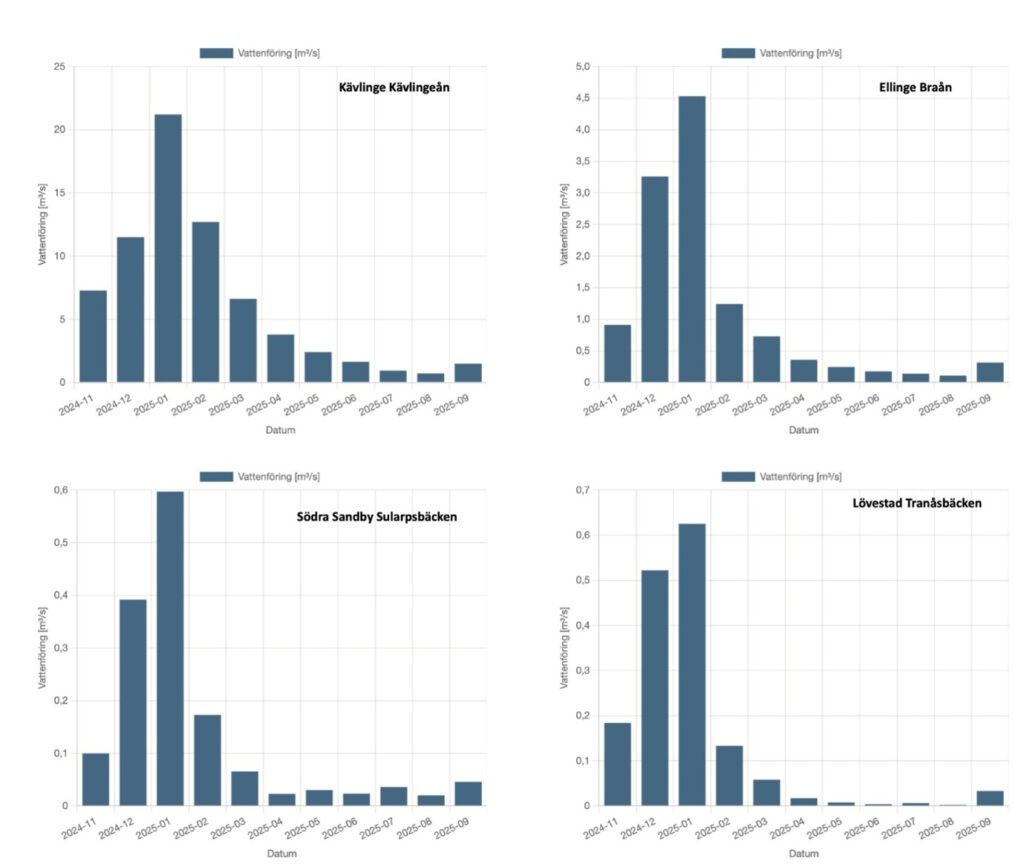
Figure 3. Seasonal flow conditions generated using SMHI S‑HYPE as monthly mean flow for the four representative WWTPs.
From consumption to prediction
The Swedish pilot also explored how pharmaceutical consumption data can be linked to real wastewater measurements. National sales statistics were combined with wastewater flow data to estimate pharmaceutical loads entering WWTPs. The results showed that traditional prediction models generally captured the correct order of magnitude, but systematic differences existed between predicted and measured concentrations. By integrating pharmaceutical consumption data with real wastewater measurements, the project developed an empirically calibrated approach that better reflects how pharmaceuticals are transferred from human use to wastewater systems under real-world conditions. This approach accounts not only for human excretion, but also for factors such as formulation type, usage patterns, and processes occurring within the sewer system before the substances reach the wastewater treatment plant. This significantly improved prediction accuracy while maintaining the scalability needed for national screening and prioritisation efforts. A detailed compilation of the study is available here.
Supporting the revised UWWTD: a practical framework for risk‑based prioritisation
The Swedish APRIORA pilot directly supports several key requirements of the revised Urban Wastewater Treatment Directive (UWWTD). The work demonstrates how monitoring, hydrology, modelling, and innovative sampling approaches can be combined to identify recipients at risk and to prioritise where advanced or quaternary treatment may be most needed.
An important component of the pilot was the development and application of the iFiST methodology (in-field sample transfer technology), which enables water samples to be prepared directly in the field onto compact SPE cartridges for subsequent laboratory analysis. The method simplifies logistics, avoids transport of large water volumes, reduces the risk of sample degradation during transport procedures, and enables harmonised and cost-efficient monitoring across geographically distributed sites. The approach also facilitates large-scale screening of WWTPs and receiving waters under real monitoring conditions, making it highly suitable for evaluating the need for quaternary treatment according to the revised UWWTD. By combining monitoring data with hydrological modelling, the framework helps identify where micropollutant emissions pose the greatest environmental risk and where advanced treatment measures are likely to deliver the most benefit.
The results showed that seasonal low-flow conditions are critical for environmental risk assessment, as reduced dilution capacity can lead to substantially elevated micropollutant concentrations downstream of WWTP discharges. The study also demonstrated that small and hydrologically sensitive recipients may require particular attention, even when wastewater loads are relatively moderate. Overall, the pilot highlighted how representative monitoring combined with hydrological modelling and the iFiST methodology can support cost-efficient national screening and prioritisation strategies under the revised UWWTD.
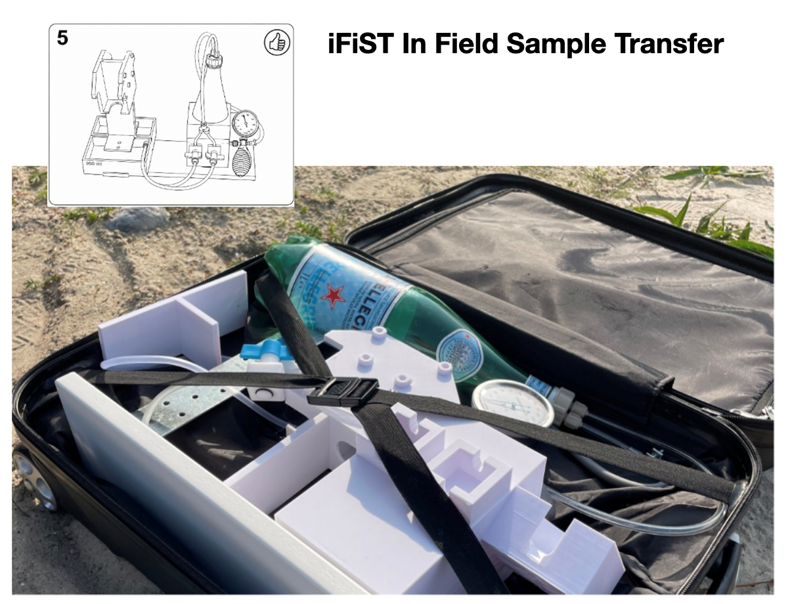
Figure 4. Portable in-field system for transferring micropollutants from water samples onto SPE cartridges, photo by Ola Svahn.
Looking forward
The Swedish pilot demonstrates how monitoring and modelling can be integrated into a practical framework for future water management. By identifying mismatches between wastewater loads and recipient capacity, the approach, which has been further developed within APRIORA, supports future prioritisation of wastewater treatment measures and implementation of risk-based micropollutant management in Sweden and potentially other European regions.

Interactive map showing pilot locations. Use the arrow keys to move the map view and the zoom controls to zoom in or out. Press the Tab key to navigate between markers. Press Enter or click a marker to view pilot project details.
Additional links
details
-
Homepage
-
Project typeCore Project

-
ImplementationNovember 2023 - October 2026
-
StatusOngoing
-
Contribution to EUSBSRPolicy Area Hazards

-
Target groups
- Infrastructure and public service provider
- Sectoral agency
-
Social media
-
Additional links
-
Tags