




Climate resilience is security: why the Baltic Sea Region must prepare for the crises most likely to come
13 April 2026
By Katie Goldie-Ryder and Amy Delis, Council of the Baltic Sea States
Many countries in the Baltic Sea Region are stepping up their defence preparedness. This is both understandable and necessary in a time of geopolitical uncertainty. Yet another, now overshadowed, challenge affecting the region is far more likely to take a different form.
Climate-related disasters are already impacting societies across the Baltic Sea Region. Floods, storms, heatwaves and droughts do not only cause immediate damage. They trigger cascading effects that disrupt essential services, strain governance systems and, in the worst cases, threaten social stability. When the next major event occurs, the question will not be whether we anticipated it, but whether we invested sufficiently in the resources, knowledge and cooperation required to withstand it.
A recent debate article[i] by researchers from the Centre of Natural Hazards and Disaster Science in Sweden highlighted the risks of prioritising military preparedness at the expense of broader crisis readiness. Their argument resonates beyond Sweden and speaks directly to the Baltic Sea Region, where security discussions are increasingly shaped by the Russian war of aggression against Ukraine and a rise in hybrid threats.
These concerns are real and require sustained attention. However, there is a risk that this focus narrows our understanding of security.
“Preparedness for climate-related disasters can also be viewed through a security lens, as water, food and energy systems under climate stress may affect societal resilience — blurring the lines between environmental and security concerns,” says Gustav Lindström, the Director General of the Secretariat of the Council of the Baltic Sea States (CBSS).
The Baltic Sea Region is already facing observable and increasing climate impacts. Extreme weather is no longer a future scenario. Municipalities are already experiencing more frequent flooding, stronger storms, and prolonged heat and drought periods. These events have claimed lives, disrupted energy and water systems, and caused significant economic losses.
The impacts are not evenly distributed. Smaller and medium-sized municipalities are often at greater risk, with more limited financial and institutional capacity to prepare for, respond to and recover from these events. At the same time, they are on the frontline of climate impacts and play a critical role in ensuring local resilience.
This is where the Baltic Sea Region has a unique strength: its long tradition of cooperation.
Part of this tradition is the CBSS, which for over three decades has served as a platform for political dialogue and practical collaboration across the region, including on preparedness and societal resilience in the face of a range of crises, among them those linked to climate change.
Initiatives such as the CBSS-led ClimaResponse project demonstrate the value of working across borders, sectors and governance levels to strengthen local preparedness. By supporting municipalities in developing risk assessments, testing response mechanisms, and engaging citizens, the region is building practical resilience where it matters most.
However, these efforts must be scaled and sustained.
Investing in climate resilience should not be seen as competing with investments in defence. On the contrary, preparedness for climate-related disasters strengthens overall societal resilience, including the ability to respond to conflict and crises, and to bounce and build back better.
The systems, capacities and relationships needed to manage floods or wildfires are often the same as those required in times of geopolitical instability. This includes functioning coordination mechanisms, clear communication channels, trust between institutions and citizens, and the ability to act quickly under uncertainty.
A society that is prepared for disruption, regardless of its origin, is inherently more secure.
This requires a broader understanding of security, one that encompasses both traditional defence and civil preparedness. It also requires political will to maintain investments in areas that may seem less urgent in the short term but are critical in the long run.
Recent developments across the region suggest that this balance is not always being maintained. In some cases, funding for climate adaptation and risk mapping has been reduced, even as climate risks continue to grow. This sends a concerning signal at a time when the need for proactive planning is particularly high.
The Baltic Sea Region is well-positioned to lead on climate resilience. It has the knowledge, the institutional frameworks and the collaborative platforms needed to lead on climate resilience. But this requires recognising that the most likely crises are not always the most visible in political discourse.
Preparing for the next storm, flood or heatwave is not separate from preparing for security threats. It is part of it.
The challenge ahead is not to choose between defence and resilience, but to ensure that both are strengthened in parallel. By doing so, the Baltic Sea Region can build a more robust, adaptable and secure future, one that is prepared not only for the threats we fear, but for those we know are coming.
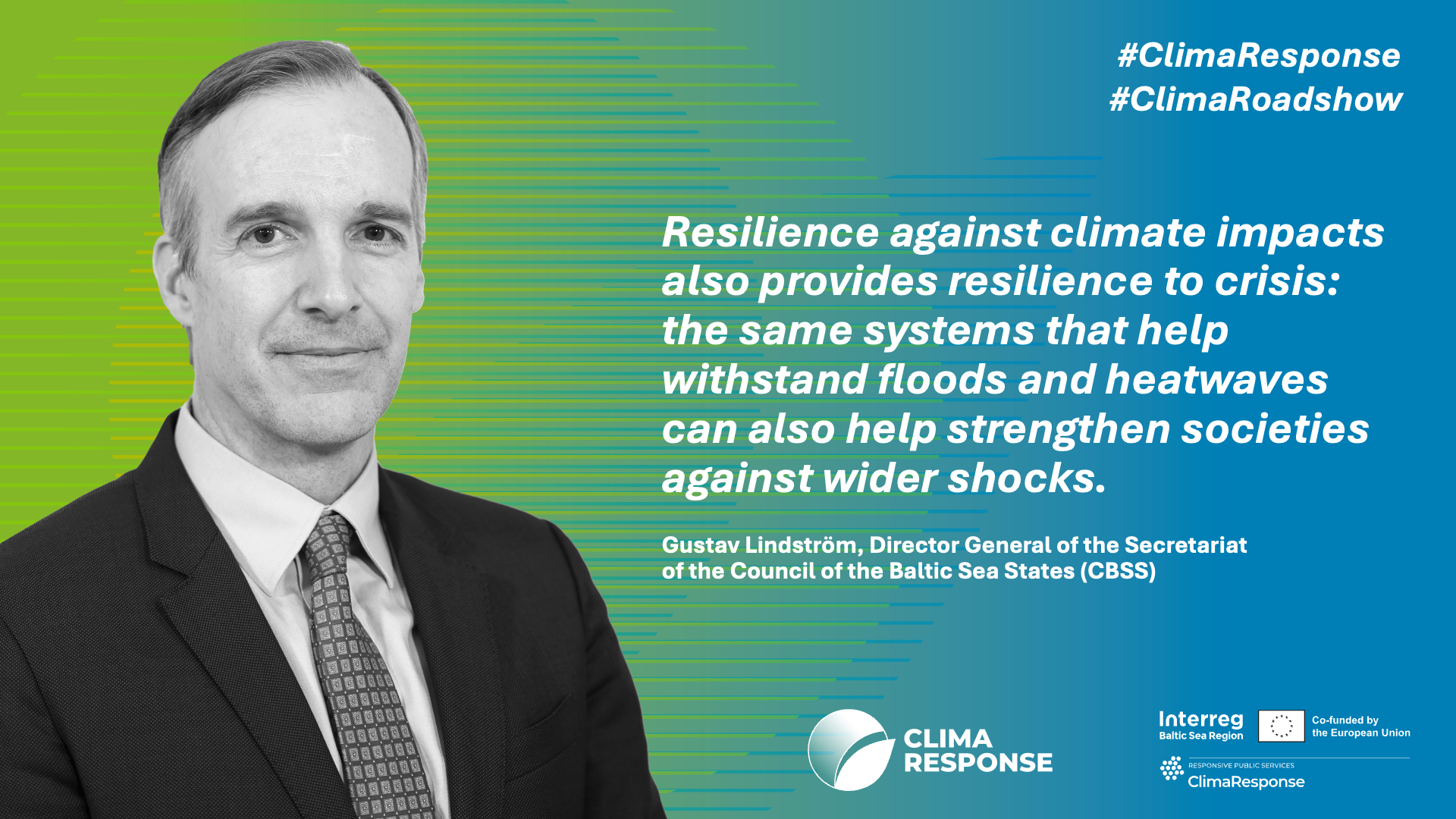
“Resilience against climate impacts also provides resilience to crisis: the same systems that help withstand floods and heatwaves can also help strengthen societies against wider shocks,” says Lindström.
—
Disclaimer: The views expressed in this article are those of the author(s) and do not necessarily reflect the positions of the Council of the Baltic Sea States (CBSS), its Member States, the CBSS Secretariat, or the partners of the ClimaResponse project.
—
[i] Dagens Nyheter Debatt (2026). “Sveriges säkerhet kräver mer än baratotalförsvar” Available at: https://www.dn.se/debatt/sveriges-sakerhet-kraver-mer-an-bara-totalforsvar/ (Accessed March 6, 2026)

Additional links
details
-
Homepage
-
Project typeCore Project

-
ImplementationMarch 2025 - February 2028
-
StatusOngoing
-
Contribution to EUSBSRPolicy Area Secure

-
Target groups
- Infrastructure and public service provider
- Interest group
- Local public authority
- National public authority
- NGO
-
Social media
-
Additional links
-
Tags