




25 March 2026
Boarding complete: last projects selected for funding
Written by Anna Gałyga
On 24–25 March 2026, Interreg Baltic Sea Region Monitoring Committee members met in Tallinn to take stock of the Programme’s progress and, for the final time in this programming period, select new projects for funding.
Chaired by Margarita Golovko from the Estonian Ministry of Regional Affairs and Agriculture, the Monitoring Committee convened for the tenth time in this programming period. From reviewing the Programme’s finances, the current focus on communication to the ongoing mid-term evaluation, Monitoring Committee members jointly examined various aspects of the Programme implementation. They also welcomed the Programme’s new desk officer at the European Commission, Karolina Jasinska-Mühleck, who will accompany the Programme’s further development.
Programme’s OSIs in action
The first eight project platforms, the Programme’s Operations of Strategic Importance (OSI), began their work a few months ago. These projects exemplify the essence of the Programme’s approach to capitalisation: building on project results to create synergies across projects and funds. Monitoring Committee members reviewed progress to date, which has primarily focused on consolidating results, expanding networks, and building links across sectors.
At the same time, the Programme’s portfolio of Operations of Strategic Importance continues to grow with the addition of newly selected platforms.
More strategic platforms for strategic cooperation
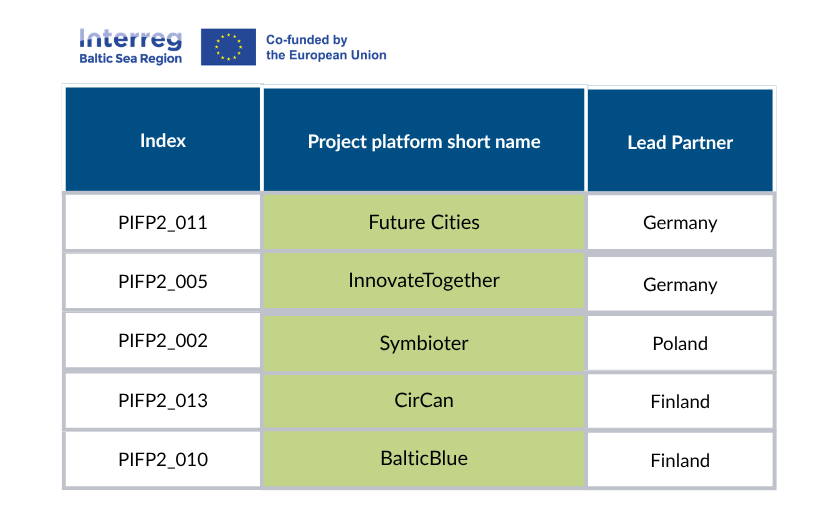
Out of 14 project platform applications submitted in the second call for project platforms, the Monitoring Committee selected five for funding, allocating a total of EUR 3.8 million from the European Regional Development Fund and EUR 0.19 million from the Norwegian National Fund.
Selected project platforms will synthesise results from Interreg Baltic Sea Region projects, as well as from other Interreg programmes and centrally managed programmes e.g. Horizon, Erasmus+, and ESF+. In doing so, they will contribute to strong knowledge transfer and policy impacts across projects and funds.
Selected platforms will address relevant topics, such as urban co-creation through culture, social innovation for resilient and smart territories, water micro-symbiosis, nutrient recovery and recycling, and safe navigation at sea. Led by partners from Finland (2), Germany (2), and Poland (1), these project platforms will involve 37 partners across all Programme countries.
It was the second and the final call for project platforms in this Programme.
28 convincing small project ideas selected for funding
Small projects are the Programme’s new instrument, designed to, among other things, ease access to the Programme. The first completed round has already delivered strong results, including practical tools, strengthened capacities, expanded networks, and developed strategic frameworks.
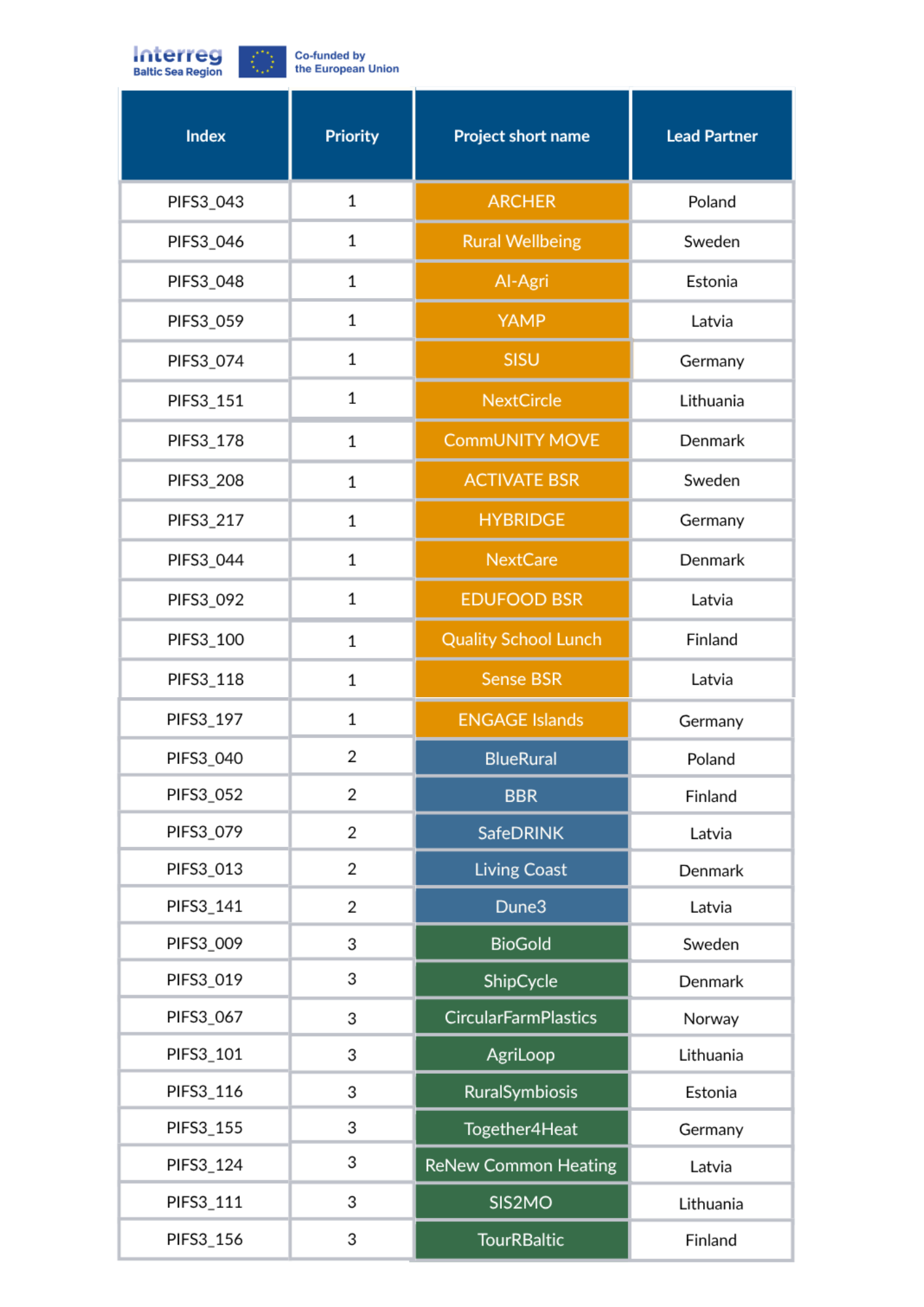
The third call for small project applications attracted high 100 applications. Out of these, the Monitoring Committee selected 28 projects for funding, allocating EUR 10.8 million from the European Regional Development Fund and EUR 0.12 million from the Norwegian National Fund.
The projects will involve 151 partners, with the highest number of partners coming from Poland, Latvia, and Lithuania. Looking at the types of organisations, NGOs stand out as the most represented group. They are followed by business support organisations and higher education and research institutions. Notably, 44% of partners are new to Interreg.
There is a balanced distribution of lead partners across countries, with each Programme country leading at least one project. The highest numbers of lead partners come from Latvia (6), Denmark (4), and Germany (4).
Under Priority 1 “Innovative societies”, 14 projects received the highest scores: nine under the objective Resilient economies and communities and five under the objective Responsive public services. These projects address topics such as social resilience, cultural heritage, rural tourism, healthcare, food literacy, redesign of public spaces, and youth empowerment.
The Monitoring Committee also selected five projects under Priority 2 “Water-smart societies”: three under the objective Sustainable waters and two under the objective Blue economy. The projects focus on microplastics, stormwater management, resilience to droughts and flooding, as well as harbours and grey dune restoration.
Nine projects under Priority 3 “Climate-neutral societies” received funding: five under the objective Circular economy, and two projects each under the objectives Energy transition and Smart green mobility. These projects cover a wide range of topics, including circular approaches in farming, agriculture and the ship industry, as well as decarbonisation, district heating, and active mobility.
This call for small projects marked the final call under this Programme.
Support for EU Strategy for the Baltic Sea Region
Moment of silence
More recent news
This September take Cooperation Further!
On 21 September, Interreg Cooperation Day brings projects across Europe out of the meeting room and into the streets. Here’s how your project can join in, and why it’s worth the effort.
Getting ready to turn ideas into action, new small projects gather in Kiel
25 June 2026 Getting ready to turn ideas into action, new small projects gather in Kiel Written by Anna ZaccaroBefore new projects can create...
From achievements to ambitions: shaping the future Interreg Baltic Sea Region
While the current Interreg Baltic Sea Region Programme is delivering results across the region, preparations for the next Programme are already gaining momentum. This dual focus was at the heart of the Monitoring Committee meeting held in Berlin on 9–10 June 2026.
High five: new project platforms onboard!
Five strong transnational partnerships, five strategic topics addressed, and endless opportunities to showcase the power of Interreg: the new project platforms, designated as Operations of Strategic Importance, met for their kick-off meeting in Berlin on 9 June.