




Port of Aalborg Pilots Circular Approach to Site Elevation — Replacing 122,000 m³ of Virgin Materials
16 March 2026
In its pilot, the Port of Aalborg make an ambitious effort to replace virgin construction materials with circular alternatives. If successful, the pilot could eliminate the need for 122,000 m³ of gravel and sand — materials that are already becoming scarce in parts of Denmark.
The challenge is compounded by Danish soil contamination law. Soil excavated within the port area is automatically classified as “slightly contaminated” under the Danish Soil Pollution Act, since the port sits in an urban zone. This means that surplus soil generated at the port cannot be reused on other sites without prior municipal approval — a regulatory barrier the pilot is directly working to address.
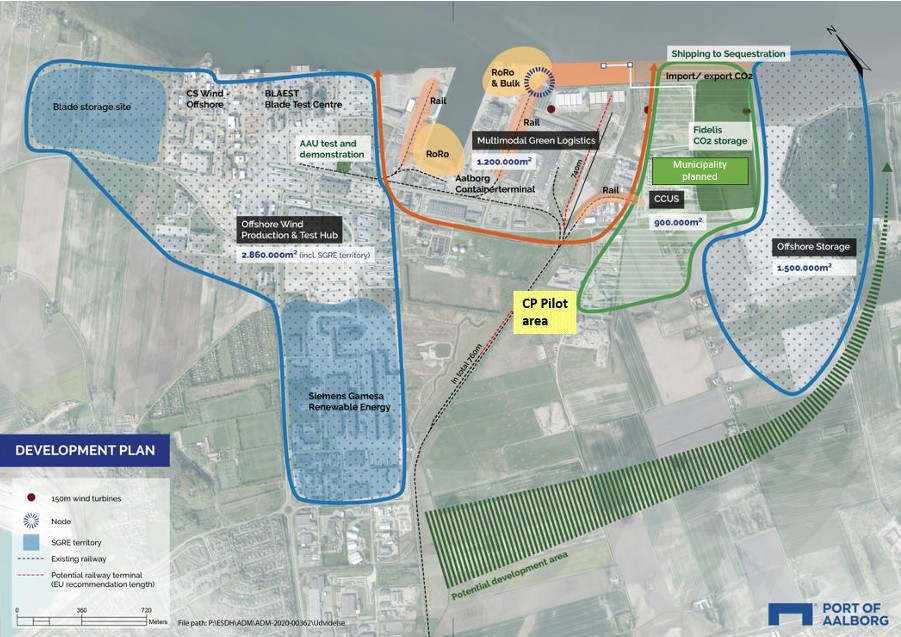
The study compares three scenarios on a 77,100 m² pilot site owned by Marius Pedersen A/S: a virgin materials baseline, the real-life project currently underway on site (using surplus friction fill transported by sea and 22,000 m³ of slag sourced from a neighbouring company), and a third fully circular scenario to be developed through the pilot’s workshop process. A key focus is identifying the regulatory barriers — including restrictions on reusing slightly contaminated port soil — that currently prevent more circular approaches.
The pilot is a co-creation process involving Port of Aalborg, Marius Pedersen A/S, Artelia, Andreasen & Hvidbjerg, Aalborg Municipality, the Region of Northern Jutland, Aalborg University, and the Climate Alliance Aalborg. Two workshops have been held, with scenario calculations, regulatory mapping, and final recommendations planned through to December 2026.
What Comes Next
The process plan extends through to December 2026, with upcoming milestones including the definition of materials for the fully circular Scenario 3 (March 2026), selection of assessment parameters at Workshop 3 (April 2026), and a mapping of the regulatory landscape at Workshop 4 (May 2026). Technical calculations of all three scenarios are planned for completion by August 2026, ahead of final conclusions and dissemination in November 2026.
The ultimate goal is to produce concrete recommendations for regulatory change — guidance that authorities, ports, consultancies, and construction industry players across the Baltic Sea Region can use to enable more circular construction practices.
Read the Report
The full pilot status report is available for download here: Circular Ports 1.2 Pilot Report – Building and Construction Materials, Port of Aalborg

details
-
Homepage
-
Project typeCore Project

-
ImplementationMarch 2025 - February 2028
-
StatusOngoing
-
Contribution to EUSBSRPolicy Area Transport, Policy Area Ship

-
Target groups
- Infrastructure and public service provider
- Local public authority
- Small and medium enterprise
-
Social media
-
Additional links
-
Tags