





Radio Interview with Project Coordinator About Using Spruce Bark in Paper Production
09 February 2026
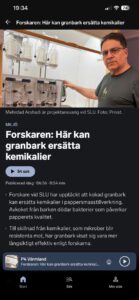
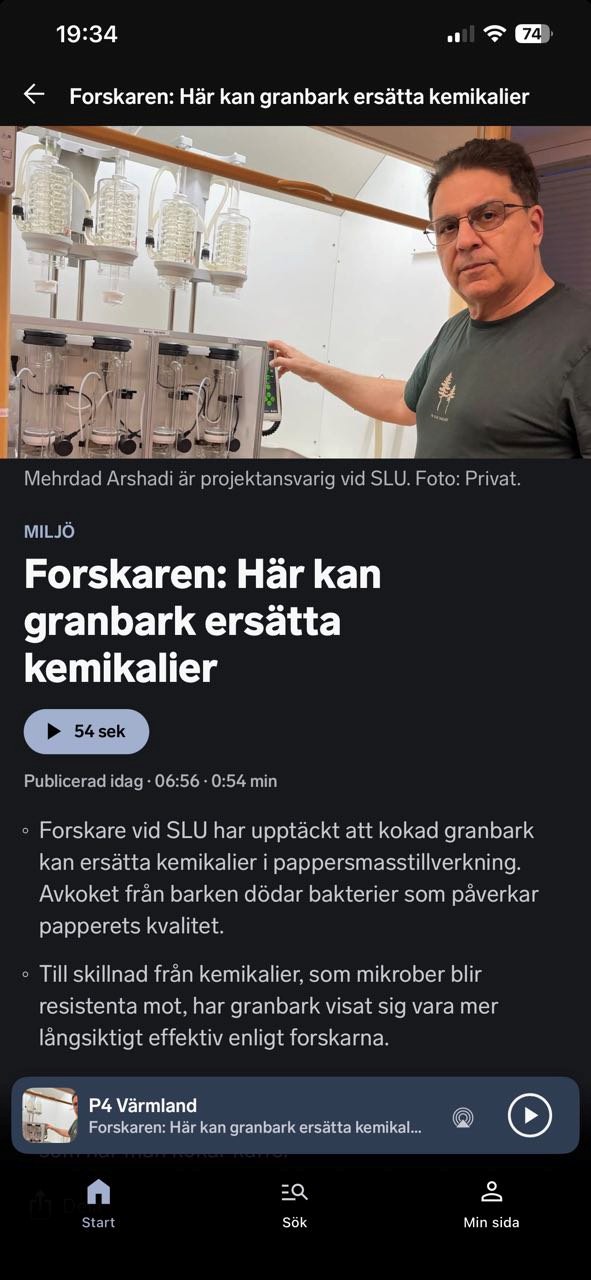
This is an interview with the project leader Mehrdad Arshadi from the Swedish University of Agricultural Sciences (SLU) in Umeå, conducted by the Swedish radio station (Swedish Radio P4 Värmland). The interview discusses new research showing that spruce bark could be used instead of chemicals to kill bacteria in paper production.
Introduction text by P4 Radio station:
In this region that we call Värmland (Sweden), paper production takes place in several locations across the county. It is a large forest region, so what do we make from wood? Among other things, paper.
Researchers at the Swedish University of Agricultural Sciences in Umeå have found a way to reduce the amount of chemicals used in paper production. They have discovered that spruce bark can be used instead of chemicals to kill bacteria. Mehrdad Arshadi is the project leader at SLU.
Introduction By Mehrdad Arshadi:
Our previous knowledge about the properties of spruce bark and how it protects trees made us curious to investigate what in the bark helps prevent microorganisms that can harm the trees. So, we examined its contents and found compounds with antimicrobial properties. With our knowledge of papermaking and knowing that the industry needs antimicrobial substances—chemicals—we began designing experiments to see whether these substances could be used instead of the chemicals currently used in paper mills.
Question 1: How is this spruce bark used more concretely?
Just like when you brew coffee, the bark is boiled to make a kind of extract. The substances we are interested in dissolve into the water. We can then use this water solution directly in the system, in the process.
These bacteria can produce toxic gases and a sticky slime that clogs pipes and reduces the quality of the paper.
Question 2: What effects have you seen that spruce bark has on this problem?
Spruce bark kills these bacteria, and we have several ways of measuring that. One way is by measuring the number of microbes in the solution found in the process water.
Another way is by monitoring the gases produced. There should not be too much hydrogen gas or hydrogen sulfide forming. We monitor this when we conduct our experiments.
The thing is that EU regulations are becoming stricter all the time. They want the paper industry to use fewer chemicals and less water. To reduce water consumption, companies reuse the same water repeatedly in the system.
But this creates a good environment for bacteria to grow.
Question 3: How significant would you say this discovery is?
The chemicals used today must be replaced every four to five years because microbes become resistant to them.
But our product has proven to be broader in its effect, because it contains many different substances. In addition, these substances have existed in nature for a very long time.
Our results show that it has better effects than the commercial products we tested at the same time.
There are several paper mills around the Baltic Sea region.
Question 4: What do you think about the possibility that this will actually start being used in industry?
We have already started contacts with SCA and other companies that manufacture paper.
We have also contacted chemical companies such as Kemira and Wibax. We hope that we will soon be able to present our results to them and see how they react and how they might want to move forward with this.
Our task is to develop the product. But turning it into a commercial industrial product will be up to the chemical companies and the paper mills to implement.
Arshadi is the project leader at SLU in Umeå. He was interviewed by Elias Andersson.
End Test by radio station:
Perhaps an end to chemicals—using spruce bark instead.
When it comes to paper production, this is certainly exciting research.

Additional links
details
-
Homepage
-
Project typeCore Project

-
ImplementationJanuary 2023 - December 2025
-
StatusCompleted
-
Contribution to EUSBSRPolicy Area Bioeconomy

-
Target groups
- Infrastructure and public service provider
- Interest group
- Large enterprise
- National public authority
- Small and medium enterprise
-
Social media
-
Additional links
-
Tags