





Spruce Bark Could Replace Toxic Chemicals
28 January 2026
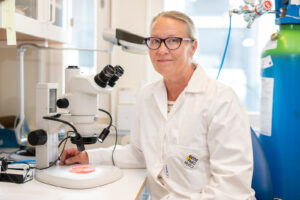
Maria Hedberg, Umeå University held the microbes back with spruce bark.
Spruce Bark Could Replace Toxic Chemicals
News published: 27/01/2026
A simple decoction made from spruce bark may offer a better alternative to the harsh chemicals traditionally used to prevent the formation of dangerous gases and slime in paper mills and wastewater systems.
In the warm, fiber-rich slurry that becomes paper and cardboard, microorganisms thrive — especially when recycled paper is part of the raw material. Large amounts of bacteria enter the process this way.
Smelly gases and slime
If their growth isn’t kept in check, explosive and foul‑smelling gases begin to form, along with a sticky slime that clogs pipes and degrades paper quality.
Today, mills typically add a cocktail of biocidal chemicals to keep microbes under control. But now, a research team in Umeå, Sweden, has developed more environmentally friendly method. By boiling spruce bark in water and pressing it, they produce an extract that can be mixed directly into the process water.
“Using spruce bark extract to fight bacteria is a highly promising alternative to synthetic products in paper mills and wastewater treatment plants,” says Mehrdad Arshadi, project leader at the Swedish University of Agricultural Sciences (SLU).
99 percent reduction
In a pilot study at the Obbola paper mill, bacteria levels dropped by 99 percent within 16 hours of adding the spruce bark extract. In fact, early results suggest the extract may outperform synthetic chemicals.
While the chemical biocide acted more quickly at first, spruce bark extract proved effective over longer time spans, significantly delaying gas formation—a crucial advantage during production stops.
Bacteria also appear less likely to develop resistance to the extract, which has a far more complex chemical composition than conventional biocides.
“It’s probably much harder for bacteria to outsmart something as chemically intricate as spruce bark extract,” says Maria Hedberg, a researcher at Umeå University’s Faculty of Medicine.
New value to spruce bark
The method has been developed within CEforestry, a European collaboration led by SLU, aimed at making better use of forestry by‑products. Spruce bark is abundant—every log debarked at industrial sites produces it—and currently its value is low, often ending up as fuel. As a raw material for antibacterial extracts, however, it could become significantly more valuable.
Beyond paper mills, spruce bark extract could also help municipalities struggling with corrosive, malodorous gases and troublesome pipe‑clogging slime in sewage systems.
More development needed
Still, more development is needed before the extract can be used at industrial scale. Large‑scale mill trials must confirm its effectiveness, and dedicated equipment for producing the extract—preferably on‑site—will be required.
“But this environmentally friendly product is a real asset for a paper mill,” says Olof Ögren, an industrial consultant on the project.
Contact
- Person
Mehrdad Arshadi, Project manager
mehrdad.arshadi@slu.se+46907868773 and 070-6117884
- Person
Torbjörn Esping, kommunikatör
Southern Swedish Forest Research Centre
torbjorn.esping@slu.se+4640415158 and +46730791198
Read Swedish text here:
https://www.slu.se/nyheter/2026/01/granbark-kan-ersatta-giftiga-kemikalier/

Additional links
details
-
Homepage
-
Project typeCore Project

-
ImplementationJanuary 2023 - December 2025
-
StatusCompleted
-
Contribution to EUSBSRPolicy Area Bioeconomy

-
Target groups
- Infrastructure and public service provider
- Interest group
- Large enterprise
- National public authority
- Small and medium enterprise
-
Social media
-
Additional links
-
Tags