




Why Reclaimed Water Might Be the Baltic Sea Region’s Next Sustainability Win
08 December 2025
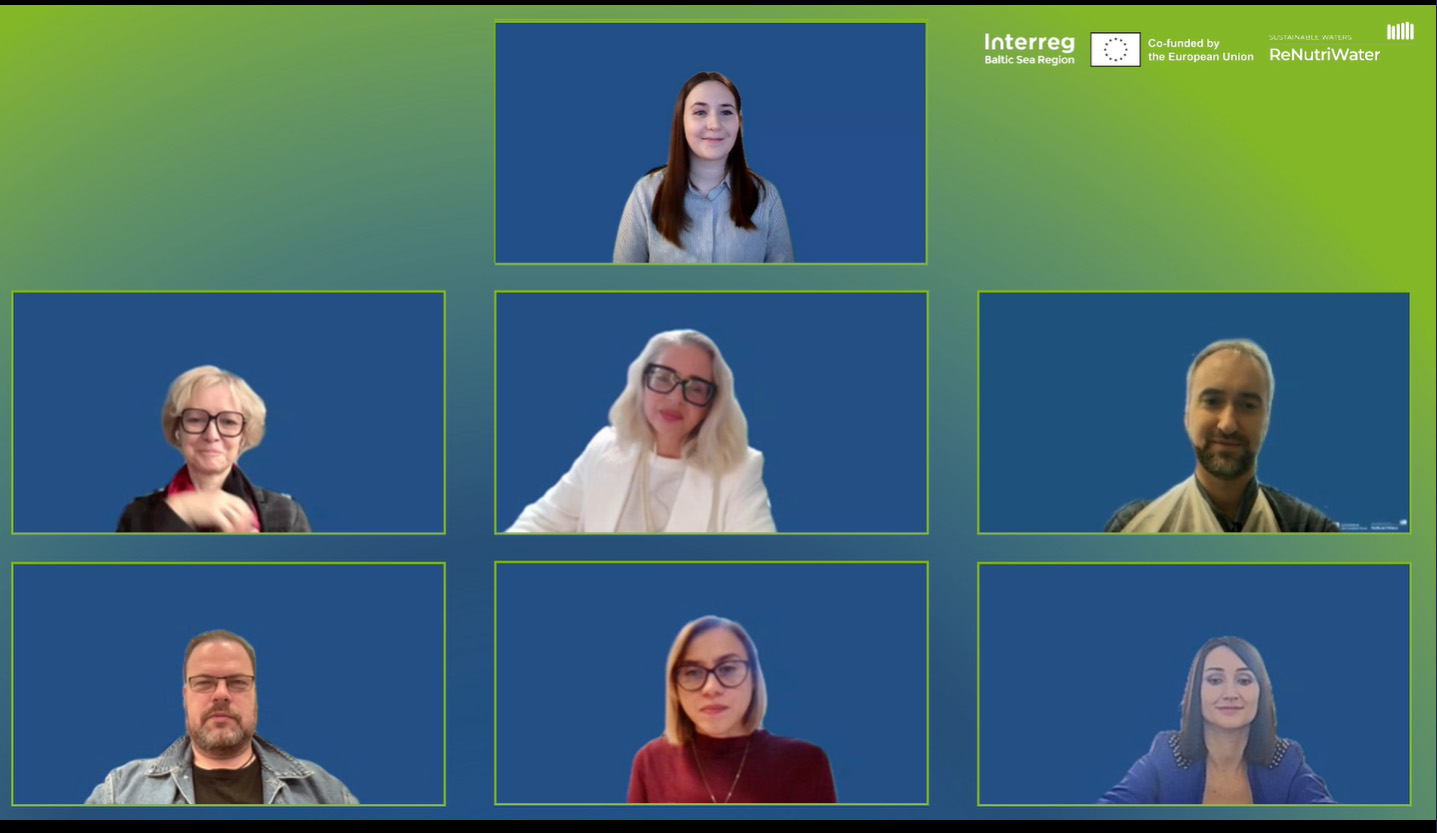
Hosted by the Centrum Balticum Foundation the “Water Reuse and Nutrient Recovery — Results from ReNutriWater” webinar highlighted how local water cycles can be closed through the safe reclamation and reuse of treated wastewater.
Project leader Klara Ramm, from Chamber of Commerce Polish Waterworks, opened the webinar by emphasizing the urgency of sustainable water management, even in water-abundant countries. Rising temperatures, changing precipitation patterns and growing nutrient loads in the Baltic Sea are intensifying pressures on local water systems. “Wastewater is 99% water,” Ramm noted. “The question is how to remove the remaining contaminants to obtain reclaimed water that is both safe and nutrient rich.”
“We must conserve freshwater resources and rethink how we treat the water we already have.”
-Klara Ramm
Piloting Reclaimed Water Across the Baltic Sea Region
Following the webinar’s introduction, participants were guided through the project’s three pilots, which spanned five countries and involved 14 partners from Poland, Latvia, Finland, Lithuania, and Denmark. Each pilot explored a different aspect of reclaimed water use. One focused on ensuring the disinfection efficiency of reclaimed water, making it safe for reuse. Another tested how the composition of reclaimed water could be adjusted for practical applications, including irrigating urban lawns and flower beds. The third pilot aimed to break barriers for wider use by evaluating greenhouse cultivation at four locations, comparing how different plant species responded to various water compositions.
Throughout these activities, researchers closely examined whether reclaimed water could meet the EU Regulation 2020/741 standards for agricultural reuse, while also weighing ecological impacts, economic feasibility, and regulatory requirements. “Our goal was fit-for-purpose water—safe, nutrient-balanced and supported by strong scientific evidence.” explained Monika Wojciechowska from Savonia University of Applied Sciences.
Scientific Insights: Safe, Adaptable and Fit-for-Purpose Water
Representing the University of Latvia, Oskars Purmalis shared scientific findings from the pilot activities. He stressed that while many European countries already apply reclaimed water in agriculture, several Baltic Sea Region countries remain cautious. The project’s data, however, show promising results for water reuse.
By sampling wastewater and reclaimed frequently, researchers observed how quality fluctuates weekly and seasonally. This deeper insight helps authorities and operators determine which technologies, such as ozonation, UV radiation, active carbon filtration, or peracetic acid, best ensure compliance and safety.
Purmalis highlighted that disinfection effectiveness varied, but all tested methods could reliably meet the highest quality class for reclaimed water. Many treatment steps also reduced emerging pollutants such as pharmaceuticals to below detectable levels.
“With the right technology, reclaimed water becomes a reliable resource for agriculture and urban use.” Purmalis emphasised.
From Lab to Practice: What Water Utilities Must Consider Before Reusing Water
Webinar discussions showed that moving from pilot tests to real-world implementation requires different considerations for small and large wastewater treatment plants.
From the perspective of smaller wastewater treatment plants, reclaimed water is not always feasible, as its suitability depends on both the technological design and the local regulatory requirements for treated wastewater.
“Reuse is not possible everywhere — your plant’s design and your local rules define what you can do,” noted Jānis Zviedris.
To determine feasibility a thorough risk analysis is the first essential step. Seasonal changes in wastewater quality can be influenced by factors such as variations in household practices, inflow fluctuations, stormwater infiltration and contributions from satellite catchments. Long-term, reliable quality data is equally important to anticipate future changes and to select sustainable reuse scenarios.
Large utilities, meanwhile, face challenges of scale rather than feasibility.
As Joanna Zgórska from Warsaw Waterworks emphasized: “For big plants, the question is not whether we can reuse water, but how to integrate full-scale solutions into existing, high-load systems.”
Advanced technologies—such as filtration, ion exchange and ozonation—have shown stable performance even under heavy and variable hydraulic loads. However, large plants also need space, time and clear regulatory expectations, especially regarding microplastics and emerging pollutants, to start investing in water reuse solutions.
Together, these perspectives highlight that reclaimed water can be a safe and reliable resource at different scales, but success depends on risk-aware planning, ongoing monitoring and choosing technologies that fit local conditions.
Business, Tools, and Mentorship Driving Circular Water Use
The project also explored the broader opportunities of circular water management. Sustainable business models were developed for wastewater treatment plants, focusing on water, energy, and material streams. Identifying value propositions and engaging stakeholders illustrated how reclaimed water can be economically viable alongside its environmental benefits.
Marzena Smol-Aruszanjan from Mineral and Energy Economy Research Institute of the Polish Academy of Sciences (MEERI), reiterated the point made by previous speakers that “The local conditions are the most important to be taken into account during the development of the business models.”
To support practical implementation, the WaterSafe IT tool was introduced. Municipalities and companies can input wastewater parameters, select target water quality classes, and receive guidance on suitable treatment technologies. This tool simplifies decision-making, making it easier to plan and implement safe water reuse practices.
Complementing technical and business approaches, a mentoring program provided workshops and one-on-one sessions. Participants developed tailored action plans for their organizations, learning to apply circular economy business models and utilize the IT tool effectively. The program strengthened awareness of water reuse, sustainability practices, and local engagement, helping participants translate project insights into actionable strategies.
A Step Toward Circular Water Use
According to project partners, the ReNutriWater results illustrate how reclaimed water can be safely integrated into the regional water cycle when supported by strong regulation, technology and stakeholder cooperation. The project outputs, including guidelines and scientific publications, are publicly available on the Interreg Baltic Sea Region’s project website.
The webinar concluded with a call for continued collaboration between municipalities, researchers, wastewater treatment plant operators, and policymakers. As climate change reshapes water availability, the Baltic Sea Region now has tested models for recovering water and nutrients, and for turning wastewater into a valuable resource.
“Water reuse turns challenges into opportunities. It is a concrete step toward more resilient and circular water systems,” the project team representatives concluded.
The webinar presentations can be viewed here and the webinar recording is available here.

Additional links
details
-
Homepage
-
Project typeCore Project
-
ImplementationJanuary 2023 - December 2025
-
StatusCompleted
-
Contribution to EUSBSRPolicy Area Nutri, Policy Area Tourism

-
Target groups
- Infrastructure and public service provider
- Interest group
- Local public authority
- Small and medium enterprise
-
Social media
-
Additional links
-
Tags